
Prussian General Ludwig Yorck's immediate French superior,…
December 1812 CE
As a soldier his duty was to break through, but as a Prussian patriot his position was more difficult.
He had had to judge whether the moment was favorable for starting a war of liberation; and, whatever might be the enthusiasm of his junior staff-officers, Yorck had no illusions as to the safety of his own head, and negotiated with Clausewitz.
While negotiations were ongoing at Tauroggen (now Tauragė, Lithuania) on December 26, Yorck had sent the king's adjutant, Major Wilhelm Henckel von Donnersmarck, back to Berlin via Königsberg, there to inform General Friedrich Wilhelm von Bülow about the impending Russian truce.
On December 29, Donnersmarck had told Bülow that Yorck had separated his forces from the French and that an agreement with Russia was at hand; the French should be treated as enemies.
In fact, the French headquarters are at Königsberg.
The Convention of Tauroggen, an armistice signed December 30, 1812 at Tauroggen between General Yorck on behalf of his Prussian troops and General Diebitsch, will be considered a turning point of Prussian history, triggering an insurgency against Napoleon in the Rheinbund.
At the time of the armistice, Tauroggen is situated in Russia, forty kilometers (twenty-five miles) east of the Prussian border.
Prussia's mandatory support of Napoleon's invasion of Russia according to the Treaty of Paris had resulted in some Prussians leaving their army to avoid serving the French, among them Carl von Clausewitz, who has joined Russian service.
Between October and December, Yorck had received numerous Russian requests to switch sides.
He had forwarded these to Berlin, but had received no instructions.
Locations
People
Regions
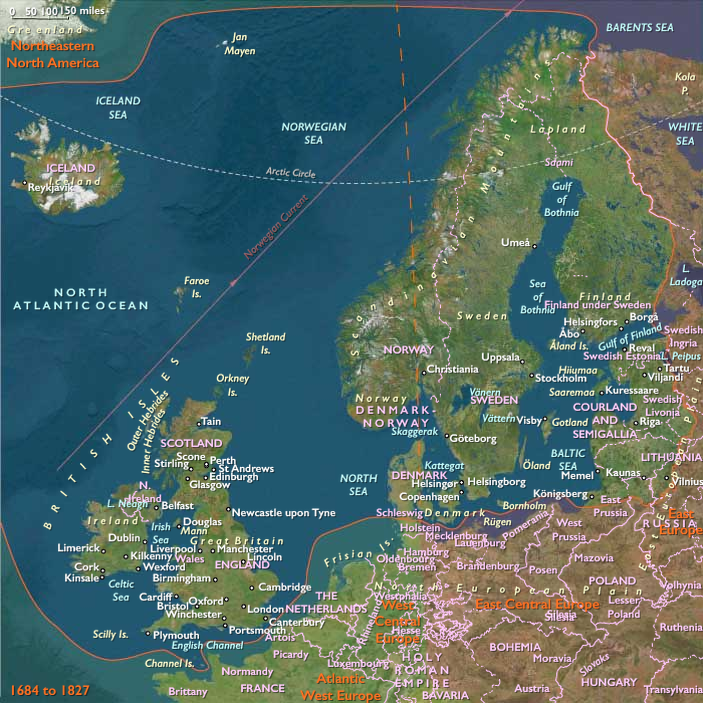
North Europe
View →Subregions
