
The Carolingians, late in the eighth or …
Years: 820 - 820
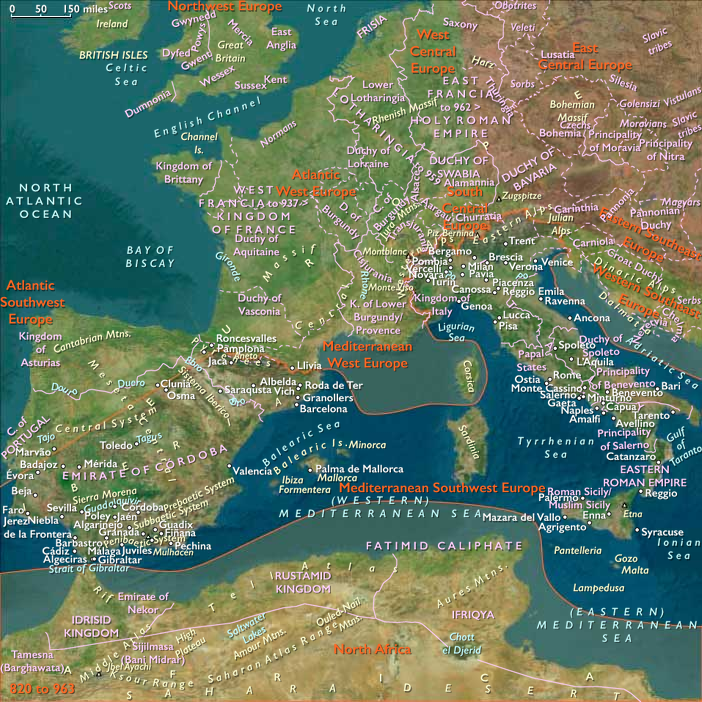
The Carolingians, late in the eighth or early in the ninth century, had created the County of Aragon or Jaca, a small Frankish marcher county in the central Pyrenean valley of the Aragon river, comprising Ansó, Echo, and Canfranc and centered on the small town of Jaca (Iacca in Latin and Chaca in Aragonese).
Originally intended to protect the central Pyrenean passes from the Moors in the same way that the Duchy of Vasconia and the Marca Hispanica are to protect the west and east, Aragon remains largely out of the reach of its nominal Carolingian lords, though it is an expressly Frankish creation and not an ethnically distinct region.
The earliest attested local ruler is Oriol, or Aureolus (807), probably either Frankish or Visigothic.
That Aragon is a combined creation of Frankish efforts at reconquest and the activity of the local Hispano-Visigothic elite to unite the rural populace against the Moors of the Ebro valley seems assured.
Aznar Galíndez I, the Count of Aragon and Conflent from 809 and Cerdanya and Urgell from 820, had succeeded Aureolus as count of the valley of the River Aragón on the latter's death in 809.
Some sources indicate him as count of Jaca, which is probably the seat of his authority within the valley.
Installed by the King of Aquitaine, Pepin I, he has remained a Frankish vassal.
In 820, however, he apparently abandons his Frankish benefactors and allies with the Basques to fight the Ebro valley’s Banu Qasi family of Muladis, local magnates converted to Islam that have manages to be independent of the emirs.
García, the son of Galindo Belascotenes, had married Matrona, the daughter of Aznar Galíndez.
However, according to tradition, García had taken offense at a prank played on him by his brothers-in-law, Centule and Galindo, who had locked him in a house during the Hogueras de San Juan.
In retaliation, he had murdered Centule and repudiated Matrona, allying himself with Íñigo Arista of Pamplona, whose daughter he had then married.
His role in these events led to his traditional nickname, 'the Bad'.
Íñigo, gathering a small army, deposes Aznar, making García count of Aragon and Conflent.
Locations
People
Groups
- Moors
- Christianity, Chalcedonian
- Vasconia, Duchy of
- Banu Qasi
- Córdoba, Umayyad Emirate of
- Marca Hispanica
- Aquitaine, (Carolingian) Kingdom of
- Frankish, or Carolingian (Roman) Empire
- Aragón, or Zaca, County of
- Basque people
Topics
Commodoties
Subjects
Regions

Subregions
Years: 820 - 820
Locations
People
Groups
- Moors
- Christianity, Chalcedonian
- Vasconia, Duchy of
- Banu Qasi
- Córdoba, Umayyad Emirate of
- Marca Hispanica
- Aquitaine, (Carolingian) Kingdom of
- Frankish, or Carolingian (Roman) Empire
- Aragón, or Zaca, County of
- Basque people
Topics
Commodoties
Subjects
Regions
Subregions