
Finland witnesses the rise of not one…
1828 CE to 1839 CE
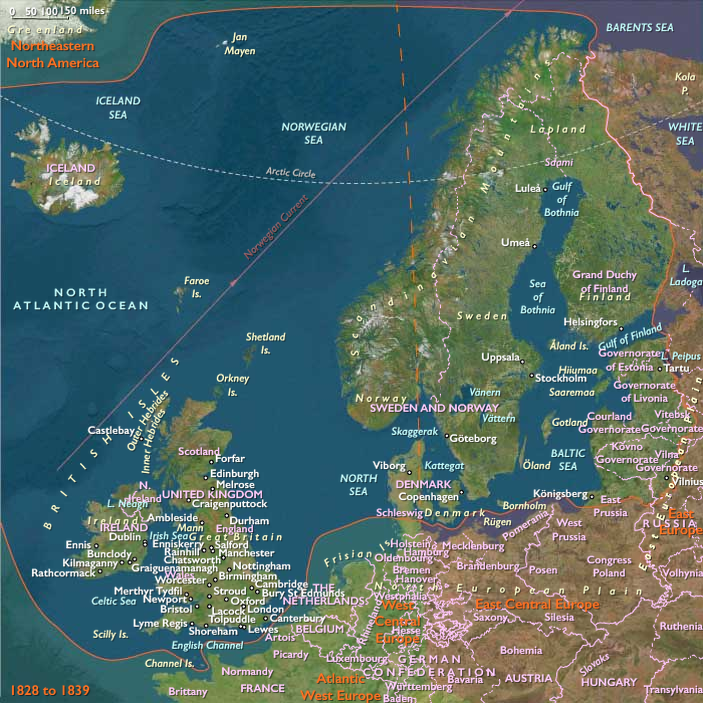
Finland witnesses the rise of not one but two national movements in the nineteenth century: Finnish-language nationalism and Swedish-language nationalism.
The creation of the independent Finnish state in the twentieth century will be made possible in large part by these nationalist movements.
Finnish-language nationalism has arisen in part as a reaction against the dominance of the Swedish language in Finland's cultural and political life.
The ethnic self-consciousness of Finnish speakers is given a considerable boost by the Russian conquest of Finland in 1809, because ending the connection with Sweden forced Finns to define themselves with respect to the Russians.
At first the Russian government generally supports Finnish linguistic nationalism, seeing it as a way to alienate the Finns from Sweden and thereby to preclude any movement toward reintegration.
For the same reason, the Russians in 1812 had moved the capital of Finland from Turku to Helsinki, bringing it closer to St. Petersburg.
Similarly, after a catastrophic fire n Turku, the University of Turku had been moved to Helsinki in 1827.
The University of Helsinki soon becomes the center of the Finnish nationalist movement.
Finnish-language nationalism, or the Fennoman movement, becomes the most powerful political force in nineteenth-century Finland.
A famous phrase of uncertain origin that is coined in the early nineteenth century sums up Finnish feelings as follows: "We are no longer Swedes; we cannot become Russians; we must be Finns."
Groups
Topics
Regions
North Europe
View →Subregions
