
The city of Taranto has suffered from …
Years: 927 - 927
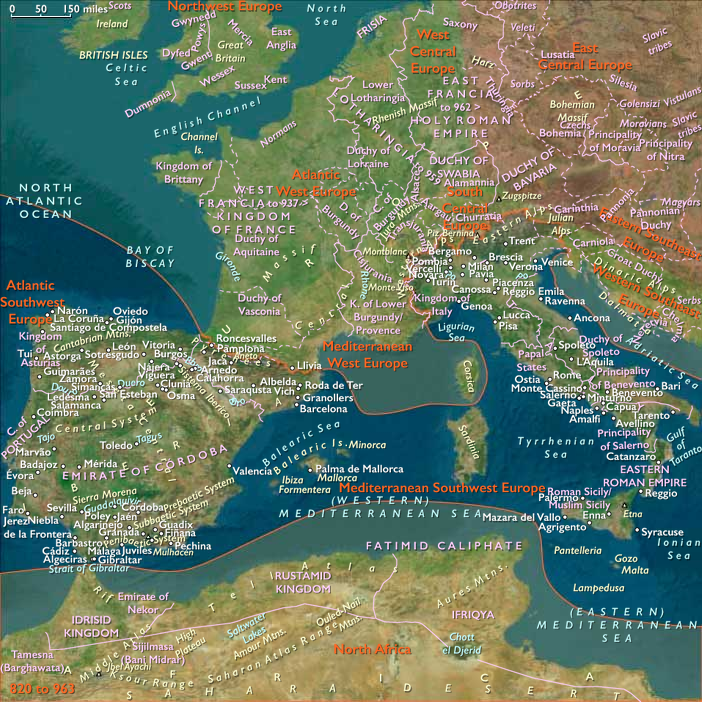
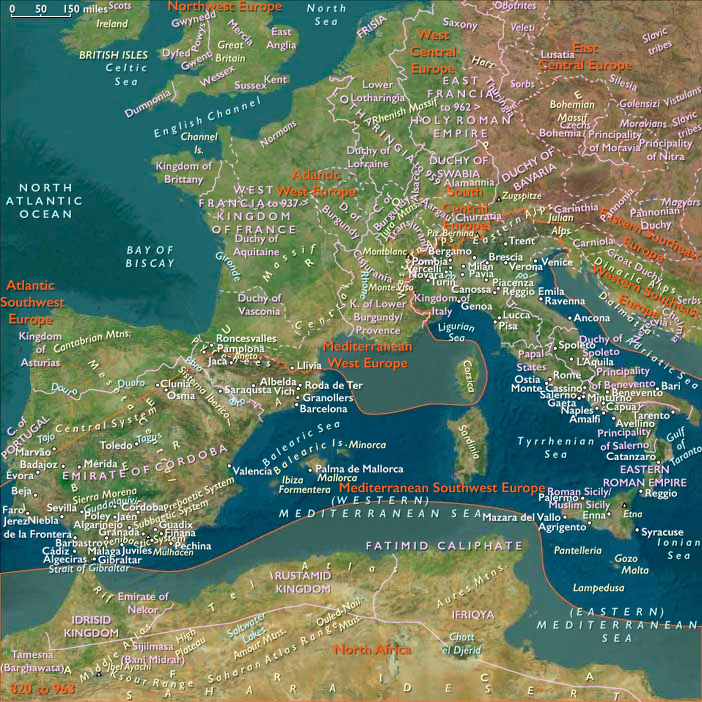
The city of Taranto has suffered from other Saracen raids, such as in 922.
The Saracens, led by the Slavic Sabir, conquer and destroy the city on May 27, 927, enslaving and deporting to Africa all the survivors.
Taranto will have no inhabitants until the Roman reconquest in 967.
Locations
People
Groups
- Greeks, Medieval (Byzantines)
- Saracens
- Roman Empire, Eastern: Macedonian dynasty
- Ifriqiya, Fatimid Caliphate of
- Longobardia, Theme of
Topics
Commodoties
Subjects
Regions
Subregions
Related Events
Filter results
Showing 10 events out of 53218 total
Wang Geon's naval raids in the Naju region, which have worked to disrupt trade and diplomatic ties with Southern Chinese kingdoms, have troubled Hubaekje for much of its existence by .
Hubaekje possesses considerable military strength, and Lee (1984, p. 99) writes of Gyeon Hwon that "Had Gung Ye and Wang Geon not stood in his way, he surely would have had little difficulty in toppling Silla."
Hubaekje shows its greatest strength in 927.
In this year, its armies attack and pillage the Silla capital at Gyeongju, slaying King Gyeongae and establishing King Gyeongsun as the ruler.
Before the attack, Silla had sent for aid from Goryeo, and Wang Geon arrives with a large army shortly after Gyeongju was taken.
The two armies meet near Palgong Mountain in present-day Daegu.
Wanggeon's forces in the battle reportedly number ten thousand men.
Hubaekje triumphs, and Wanggeon himself only escapes through the daring self-sacrifice of his general Shin Sung-gyeom and Kim Nak.
Ma Yin, named regional governor by the Tang court in 896 after fighting against a rebel named Yang Xingmi, had declared himself as the Prince of Chu with the fall of the Tang Dynasty in 907.
Ma’s position as Prince of Chu is confirmed by the Later Tang Dynasty in the north in 927 and is given the posthumous title of Chu Wumuwang.
Bulgaria has reached its cultural apogee during Simeon's reign, becoming the literary and spiritual center of Slavic Europe.
In this respect, Simeon has continued his father Boris' policy of establishing and spreading Slavic culture and attracting noted scholars and writers within Bulgaria's borders.
It is in the Preslav Literary School and Ohrid Literary School, founded under Boris, that the main literary work in Bulgaria has been concentrated during the reign of Simeon.
By the close of Simeon’s five-year campaign against the Empire, the Bulgarian khan has conquered most of Serbia, advanced to the walls of Constantinople four times, compelled Constantinople to pay him tribute, and driven the Empire’s Magyar allies into the Plain of Hungary.
In the last months of his life, Simeon prepares for another siege of Constantinople despite Romanos' desperate pleas for peace.
He dies of heart failure in his palace in Preslav on May 27, 927.
Byzantine chroniclers tie his death to a legend, according to which Romanos decapitated a statue which was Simeon's inanimate double, and he died at that very hour.
Twice married, Simeon leaves four sons, of whom the second, Peter, succeeds him, with George Sursuvul, the new emperor's maternal uncle, initially acting as a regent.
The long Bulgarian-Byzantine War ends with Simeon's death.
As part of the peace treaty signed in October 927 and reinforced by Peter's marriage to Maria (Eirene), Romanos' granddaughter, and with it an annual tribute.
The existing borders are confirmed, as are the Bulgarian ruler's imperial dignity and the head of the Bulgarian Church's patriarchal status.
This agreement will usher in a period of forty years of peaceful relations between the two powers, a time of stability and prosperity for Bulgaria.
Yusuf had been instructed by the caliph to take charge of the campaign against the Qarmatians of Bahrain in 926.
Yusuf's army, despite having a large numerical advantage, is defeated by the Qarmatians near Kufa in 927.
The Sajid is captured; he will be killed the following year.
In Azerbaijan, he is succeeded by his nephew Abu'l-Musafir al-Fath.
After only one and a half years of rule, however, he will be poisoned in Ardabil by one of his slaves.
The Sajid dynasty will end with his death.
Jimeno Garcés of Pamplona is sometimes said to have been regent for his nephew, García, but at least one contemporary document in which both appear names him and not his nephew as king.
Only in 931, the last year of his reign, will García also appear with the royal title.
Jimeno takes an army south in 927 to support his Banu Qasi kinsman, causing Abd-ar-Rahman III, Emir of Córdoba, nephew of Jimeno's wife, to retreat without offering battle.
Herbert II of Vermandois Uses Charles the Simple as a Political Pawn (925–927)
By 925, Herbert II of Vermandois, one of the most powerful nobles in West Francia, strategically leverages his captive, the deposed King Charles the Simple, to secure greater political power. Though he had initially supported King Rudolph of Burgundy, Herbert shifts his allegiance when it suits his ambitions, effectively blackmailing the monarchy to gain key titles for his sons.
The Manipulation of Charles the Simple
- Since 923, Herbert II had held Charles the Simple prisoner, using his status as a deposed Carolingian king as a bargaining chip in Frankish politics.
- Instead of remaining a loyal partisan of King Rudolph, Herbert negotiates for his own benefit, demanding territorial and ecclesiastical concessions in exchange for not using Charles as a rallying figure against Rudolph.
The Archbishopric of Reims for Hugh (925)
- In 925, Herbert secures the powerful Archbishopric of Reims for his son Hugh, a prestigious position that grants him control over one of the most important ecclesiastical centers in West Francia.
- The Archbishop of Reims traditionally plays a key role in royal coronations, giving Herbert’s family greater influence over future kingship decisions.
- This move also allows Herbert to extend his political dominance in northern Francia, as Reims was a key center of Carolingian legitimacy.
The County of Laon for Odo (927)
- In 927, Herbert secures the County of Laon for his other son, Odo of Vermandois, further expanding his family’s territorial control in northeastern Francia.
- Laon, historically a royal domain, strengthens Herbert’s hold over Carolingian lands, consolidating his dynastic power.
Consequences of Herbert’s Political Maneuvering
-
Rudolph’s Authority is Undermined
- Rudolph of Burgundy is forced to concede power to Herbert, demonstrating the king’s weak control over the nobility.
- The kingdom continues to fragment, as nobles increasingly act independently from the monarchy.
-
Herbert Becomes a Kingmaker
- By securing Reims and Laon, Herbert gains unparalleled influence in West Francia, effectively controlling succession politics.
- His family is now one of the most powerful in France, setting the stage for future dynastic struggles.
-
The Fate of Charles the Simple
- Despite Herbert’s political gains, Charles remains a prisoner and dies in captivity in 929.
- His death removes the last legitimate Carolingian claimant, but Herbert continues to wield power through his sons’ control over Reims and Laon.
Conclusion: Herbert’s Mastery of Feudal Politics
Herbert II of Vermandois’ tactical use of Charles the Simple to secure Reims for Hugh and Laon for Odo marks him as one of the most ruthless and effective political players of his time. His actions further weaken the West Frankish monarchy, demonstrating the growing power of feudal lords, who now wield greater authority than the king himself.
Herbert II of Vermandois Manipulates Charles the Simple’s Claim (927–928)
By 927–928, Herbert II of Vermandois, having already leveraged his royal prisoner, Charles the Simple, to secure key political gains, now uses Charles as a diplomatic tool in a new power play against King Rudolph of Burgundy. In response to Rudolph’s growing resistance, Herbert brings Charles out of captivity in a strategic move to challenge Rudolph’s legitimacy and gain further influence.
Herbert’s New Strategy: Using Charles Against Rudolph
- Rudolph of Burgundy, the reigning King of West Francia, begins to protest Herbert’s growing power, likely due to Herbert’s hold over Reims, Laon, and influence in the royal court.
- In response, Herbert II produces Charles the Simple, who had been his prisoner since 923, as a potential alternative king, hoping to pressure Rudolph into granting him even more concessions.
- Herbert takes Charles to William Longsword, son of Rollo, Duke of Normandy, to perform homage, attempting to rally Norman support for Charles' reinstatement.
- From there, Herbert brings Charles to Reims, the traditional coronation city of the Frankish kings, using it as a symbolic move to press Charles’ claim.
Seeking Papal Recognition from Pope John X
- To further legitimize Charles’ position, Herbert appeals to Pope John X, seeking papal recognition for Charles as the rightful king.
- This is a high-stakes move, as papal backing would severely undermine Rudolph’s authority, potentially leading to a civil war between factions loyal to Charles and those supporting Rudolph.
Consequences of Herbert’s Actions
-
Threat to Rudolph’s Reign
- By presenting Charles as a legitimate ruler, Herbert directly challenges Rudolph’s kingship, threatening to destabilize West Francia.
-
Herbert Strengthens His Own Position
- By controlling both Reims and Charles, Herbert ensures that he remains the most influential noble in the kingdom, acting as a kingmaker.
-
Norman Involvement in Frankish Politics
- Bringing William Longsword into the conflict signals that the Normans are becoming key political players in West Francia.
Conclusion: Herbert as the Ultimate Political Manipulator
Herbert II’s move to use Charles the Simple as a counter-king against Rudolph of Burgundy shows his mastery of feudal power politics. Though Charles remains a pawn, Herbert’s ability to maneuver between kings, popes, and Norman dukes ensures that his dynasty remains one of the most powerful in West Francia. His relentless ambition further weakens the monarchy, reinforcing the rise of noble autonomy and the ongoing fragmentation of Carolingian authority.
The Revival of the Ducal Title in Aquitaine (890s–927)
During the late 9th and early 10th centuries, the once-unified Duchy of Aquitaine, which had been fragmented following the decline of Carolingian power, is revived as a political entity by Count William the Pious of Auvergne.
William the Pious and the Reestablishment of the Duchy of Aquitaine (890s)
- William the Pious (d. 918), Count of Auvergne, is the first to assume the title of Duke of Aquitaine, effectively recreating the duchy in the 890s.
- His control over large parts of central and southern Francia, including Auvergne, Limousin, and Poitou, gives him the power base needed to assert dominance over Aquitaine.
- Though still nominally under the West Frankish king, William governs independently, a sign of the weakening of royal authority.
- His most enduring legacy is the founding of Cluny Abbey in 910, a landmark moment in medieval monastic reform.
The Transfer of the Ducal Title to the Counts of Poitiers (927)
- After William’s death in 918, his successor, William II (the Younger), Duke of Aquitaine, continues his rule but dies in 927 without a direct heir.
- With William II’s death, the title passes to the Count of Poitiers, who now inherits the Duchy of Aquitaine, further consolidating power under the House of Poitiers.
Significance of the Ducal Transition
-
The House of Poitiers Gains Dominance
- The transfer of the ducal title to the Poitevin counts establishes their long-term rule over Aquitaine, lasting for centuries.
-
Aquitaine as a Semi-Independent Duchy
- Under Poitevin leadership, Aquitaine continues to function as a de facto independent entity, though still technically part of West Francia.
-
The Weakening of Royal Power in Southern France
- The revival of the duchy outside royal control demonstrates the continued decentralization of West Francia, as local rulers gain autonomy at the expense of the monarchy.
Conclusion: The Foundations of Poitevin Rule in Aquitaine
The title of Duke of Aquitaine, first assumed by William the Pious, passes to the Poitevin counts in 927, marking the formal beginning of their long rule over the region. This transition reinforces Aquitaine’s autonomy, setting the stage for its later power struggles with the Capetian monarchy, culminating in its pivotal role in medieval France and England.
Edward the Elder had conquered the Danish territories in Mercia and East Anglia with the assistance of Æthelflæd and her husband, but when Edward died the Danish king Sihtric still ruled the Viking Kingdom of York (formerly the southern Northumbrian kingdom of Deira).
Æthelstan in January 926 had arranged for one of his sisters to marry Sihtric.
The two kings had agreed not to invade each other's territories or to support each other's enemies.
Sihtric dies the following year and Æthelstan seizes the chance to invade.
Guthfrith, a cousin of Sihtric, leads a fleet from Dublin to try to take the throne, but Æthelstan easily prevails.
He captures York and receives the submission of the Danish people.
According to a southern chronicler, he "succeeded to the kingdom of the Northumbrians", and it is uncertain whether he had to fight Guthfrith.
Southern kings had never ruled the north, and his usurpation is met with outrage by the Northumbrians, who have always resisted southern control.
However, at Eamont, near Penrith, on July 12, 927, King Constantine of Scotland, King Hywel Dda of Deheubarth, Ealdred of Bamburgh, and King Owain of Strathclyde (or Morgan ap Owain of Gwent) accepts Æthelstan's overlordship.
His triumph leads to seven years of peace in the north.
Years: 927 - 927
Locations
People
Groups
- Greeks, Medieval (Byzantines)
- Saracens
- Roman Empire, Eastern: Macedonian dynasty
- Ifriqiya, Fatimid Caliphate of
- Longobardia, Theme of
