
The Caroline Affair, on the Niagara River…
December 1837 CE
William Lyon Mackenzie is one of the key leaders of the Reform Movement of Upper Canada (today's Ontario) to make the British colonial rule in Canada more democratic and less corrupt.
He had been repeatedly elected to serve in a hostile parliament that repeatedly ejected him for his reform efforts.
By 1837, Mackenzie had given up on peaceful means for reform and began to prepare for an uprising.
In December 1837, Mackenzie had begun the Upper Canada Rebellion by fighting the British in the Battle of Montgomery's Tavern.
Mackenzie's forces had been seriously outnumbered and outgunned, and they were defeated in less than an hour.
He also suffered another major defeat a few days later in London.
After these defeats, Mackenzie had fled to Navy Island in the Niagara River, which they declared the Republic of Canada, on board the vessel SS Caroline.
Throughout these events, the Canadian rebels have enjoyed widespread support from the Americans, who provide them supplies and bases from which to launch raids on the British.
On December 29, 1837, while the Canadian rebels are on Navy Island, Canadian loyalist Colonel Sir Allan MacNab and Captain Andrew Drew of the Royal Navy commanding a party of militia, acting on information and guidance from Alexander McLeod that the vessel belongs to Mackenzie, cross the international boundary and seize the Caroline, chase off the crew, tow her into the current, set her afire, and cast her adrift over Niagara Falls, after killing one black American named Amos Durfee in the process.
U.S. newspapers falsely report "the death of twenty-two of her crew" when in fact, only Durfee had been killed.
Public opinion across the United States is outraged against the British.
President Martin Van Buren protests strongly to London, but is ignored.
Groups
Regions
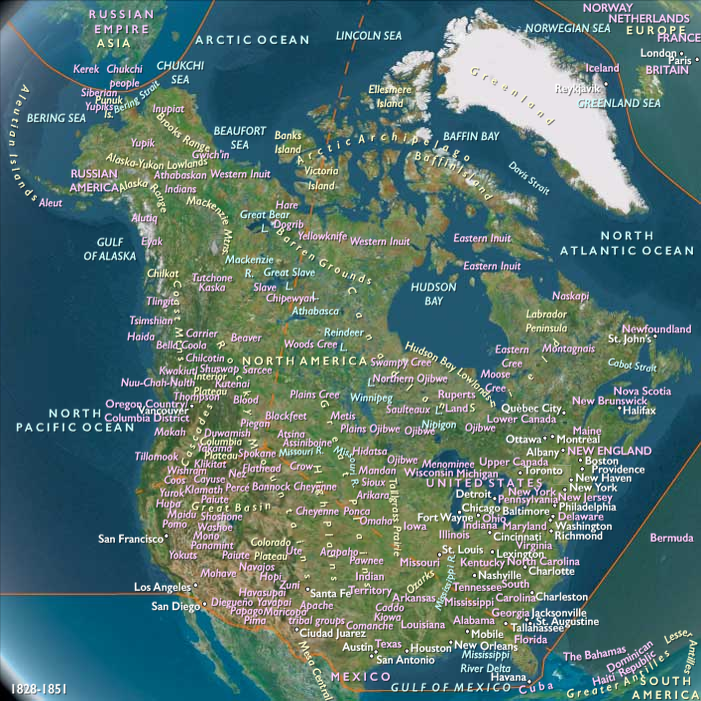
Northern North America
View →Subregions
