
Event
The core of Aachen Cathedral, the Carolingian…
The core of Aachen Cathedral, the Carolingian octagon, had originally been erected as Charlemagne's palace chapel and is also his grave.
After his death, on January 28, 814, he had been buried in his church; the exact spot is unknown, because of the lack of documentation and the ambiguity of the physical evidence.
However, it is probable that he was buried in the Persephone sarcophagus under the west tower at the entrance to the octagon.
Otto III has Charlemagne's vault opened in 1000.
Otto of Lomello, one of the courtiers who accompanied him, recorded the event, which is reported in the Chronicle of Novalesia, written about 1026.
The account reads: "So we went in to Charles. He did not lie, as the dead otherwise do, but sat as if he were living. He was crowned with a golden crown and held in his gloved hands a scepter; the fingernails had penetrated through the gloves and stuck out. Above him was a canopy of limestone and marble. Entering, we broke through this. Upon our entrance, a strong smell struck us. Kneeling, we gave Emperor Charles our homage, and put in order the damage that had been done. Emperor Charles had not lost any of his members to decay, except only the tip of his nose. Emperor Otto replaced this with gold, took a tooth from Charles’s mouth, walled up the entrance to the chamber, and withdrew again."
A large picture representing Otto and his nobles gazing on the dead Emperor is painted on the wall of the great room in the Town Hall.
-
{# Image navigates to the detail page; the magnifying-glass chip is the only Fancybox lightbox trigger (kept a separate sibling — anchors can't nest). #}
 The North Atlantic Lands
World
-
{# Image navigates to the detail page; the magnifying-glass chip is the only Fancybox lightbox trigger (kept a separate sibling — anchors can't nest). #}
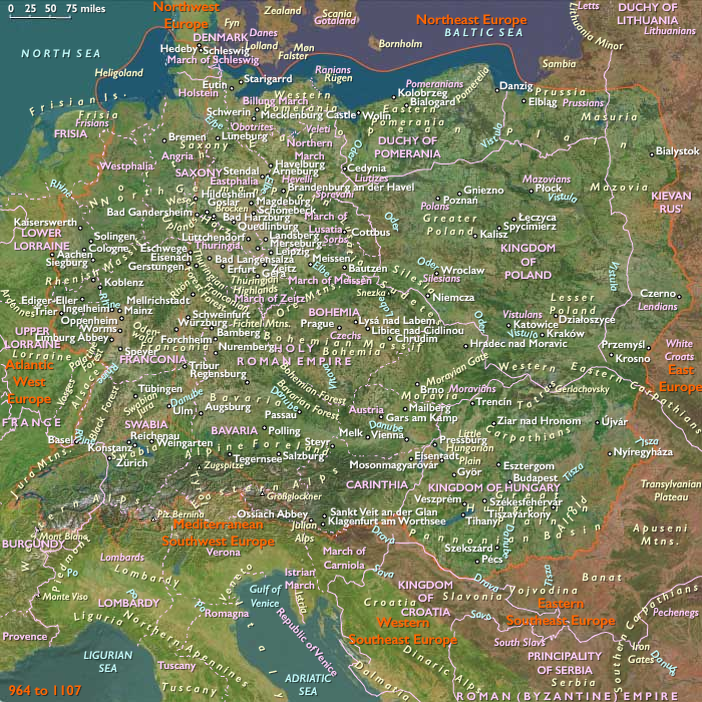 Central Europe
Region
-
{# Image navigates to the detail page; the magnifying-glass chip is the only Fancybox lightbox trigger (kept a separate sibling — anchors can't nest). #}
 West Central Europe
Subregion
