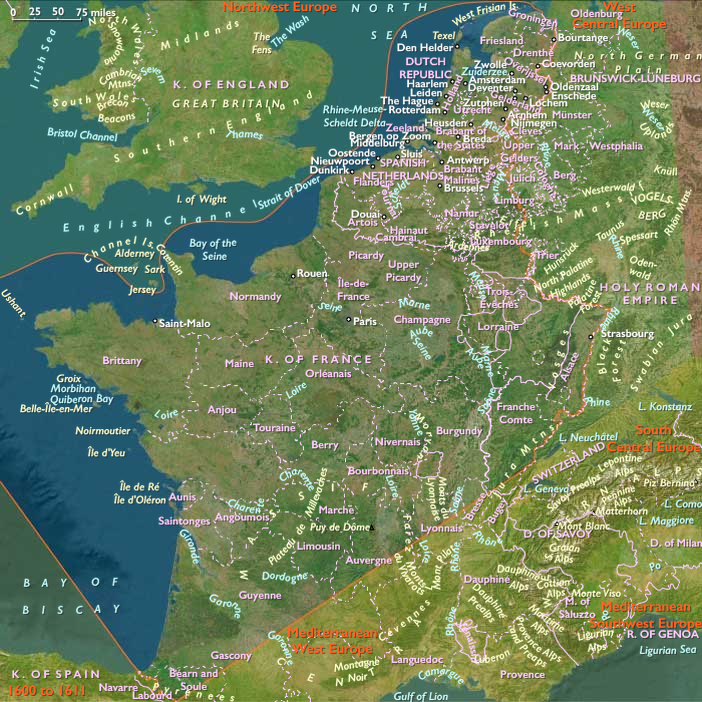
The cost of fortress-building and the upkeep…
April 1607 CE
The cost of fortress-building and the upkeep of the large standing armies puts both Spain and the Republic under severe fiscal strain.
Also because of the slump in trade that had been caused by the efficient trade embargo imposed by Spain on the Dutch since 1598, the Dutch regents estimate that they cannot safely increase the already heavy burden of taxation.
In September 1606, Oldenbarnevelt had therefore urged the States of Holland to seek an accommodation with Spain.
This had met with a surprisingly favorable reception from Spain, as Philip III and the Duke of Lerma have already resolved to concede sovereignty, if that proves inevitable in order to halt the war.
What has prompted them to this concession are the inroads that the Dutch East India Company (or VOC), that had been chartered by the States-General in 1602, has been making in the Portuguese empire's sphere of influence in the East Indies.
After all, since 1580 there has been a union of the crowns of Spain and Portugal.
The conquest of a number of Portuguese possessions in Ambon, Ternate and Tidore in 1605 by the VOC has caused such consternation that a Spanish presence had been quickly established to counterbalance Dutch gains.
Philip wants this stopped, and Oldenbarnevelt seems initially amenable to suggestions that the VOC be suppressed and another project to charter a similar Dutch company for the Americas be aborted.
The Archdukes, on instructions from Madrid, had therefore secretly declared in March, 1607, that they were willing to negotiate a peace with the States-General, as representatives of free lands over which they make no claim.
A ceasefire in the Netherlands is signed in April, 1607.
Groups
Topics
Commodities
Subjects
Regions
West Europe
View →Subregions