
The Struggle for Flanders: Trade, Urban Power,…
1300 CE
The Struggle for Flanders: Trade, Urban Power, and French Intervention (Late 13th Century)
By the late 13th century, Flanders had become one of the most prosperous and politically complex regions in Europe, with its autonomous cities and powerful merchant class increasingly coming into conflict with the French Crown.
The Division and Political Status of Flanders
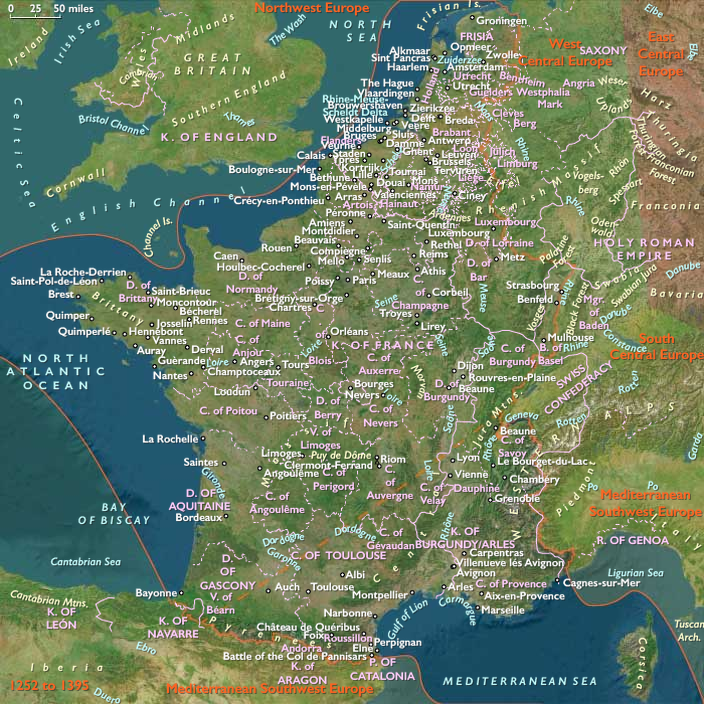
- In the late 12th century, western Flanders fell under French rule, while the remaining territories came under the Counts of Hainaut in 1191.
- Despite being formally part of the French kingdom, Flanders retained a high degree of autonomy, with its urban communes—including Bruges, Ghent, Ypres, Lille, Douai, Dunkirk, and Valenciennes—functioning as semi-independent economic and political centers.
- In 1297, Philip IV of France attempted to fully integrate Flanders into the crown lands, sparking fierce resistance from Flemish cities and nobility.
Bruges and the Rise of Mediterranean Trade
- In 1277, the first Genoese merchant fleet arrived in Bruges, marking the beginning of intensive Mediterranean trade in Flanders.
- This development opened the spice trade from the Levant and introduced advanced financial techniques and capital flows, solidifying Bruges’ status as the leading commercial hub of Northern Europe.
- Bruges became the Continental city with exclusive import rights on English sheep’s wool, a key resource for Flanders’ textile industry, controlled by the bourgeois merchants of the city.
Edward I of England’s Disruptive Policies
- The Flemish wool trade depended heavily on English supplies, and for years, Bruges' merchants had controlled exclusive import rights.
- However, King Edward I of England began dealing directly with Flemish customers, bypassing Bruges' merchant class and threatening their monopolistic control over the wool trade.
- In response, the Flemish traders and their political allies, the aldermen, appealed to their liege lord, Philip IV of France, to intervene and protect their economic interests.
French Intervention and Growing Unrest (1297–1299)
- Philip IV responded decisively, sending French troops to garrison Bruges and appointing Jacques de Châtillon, his wife Joan I of Navarre’s uncle, as Governor of Flanders.
- In a bold assertion of royal power, Philip IV took Count Guy of Dampierre and his two sons hostage, further tightening French control over Flanders.
- This intervention provoked serious unrest among Flemish urban guilds, particularly in Ghent, Bruges, and Ypres, where the merchant and artisan classes resisted centralized French authority.
Prelude to the Flemish Revolt
Philip IV’s policies alienated the fiercely independent Flemish cities, whose economic and political power was built on autonomy and free trade. The tensions between the French Crown and Flanders would soon erupt into open conflict, culminating in the Flemish uprising of 1302 and the Battle of the Golden Spurs.
People
Subjects
Regions
West Europe
View →Subregions
