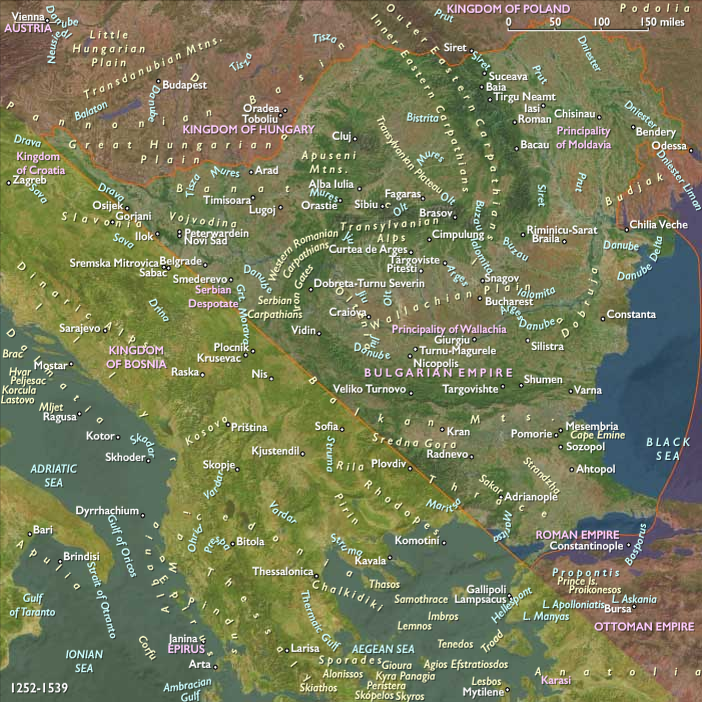
The Cuman people are believed to have…
1290 CE
The Cuman people are believed to have played a significant role in the Vlach-Bulgar Rebellion led by brothers Asen and Peter of Tarnovo, resulting in victory over Constantinople and the restoration of Bulgaria's independence in 1185.
The Cuman participation in the creation of the Second Bulgarian Empire in 1185 and thereafter brought about basic changes in the political and ethnic sphere of Bulgaria and the Balkans.
The Cumans were allies in the Bulgarian-Latin Wars with emperor Kaloyan of Bulgaria, who was descended from the Cumans.
In 1205, at the Battle of Adrianople (1205), fourteen thousand Cuman light cavalry had contributed to Kaloyan's crushing victory over the Latin Crusaders.
Cuman troops will continue to be hired throughout the thirteenth and fourteenth centuries by both the Bulgarians and Imperial Greeks.
The Cumans who remain east and south of the Carpathian Mountains establish a county named Cumania, which is a strong military base in an area consisting parts of Moldavia and Wallachia.
The Hungarian kings claim supremacy over Cumania—among the nine titles of the Hungarian kings of the Árpád and Anjou dynasties are rex Cumaniae—but few, if any, Cuman leaders recognize their overlordship, pointing to the fact that rex Cumaniae is an allegory title since the kings never fulfill this role.
The Cuman influence in Wallachia and Moldavia is very strong, according to some historians who claim that the earliest Wallachian rulers bore Cuman names (e.g., Tihomir and Bassarab).
The Cumans will play a crucial role in the formation of Wallachia at the end of the fourteenth century; many of the first Romanian nobleman are of Cuman descent.
The toponymy of the most densely populated regions of Romanian settlement shows strong evidence of Cuman place-names.
With a lack of convincing archaeological evidence of a Cuman civilization, it appears the Cumans may have been a minority in the local population, but they make up part of the ruling élite in Wallachia.
Locations
Groups
Commodities
Subjects
Regions
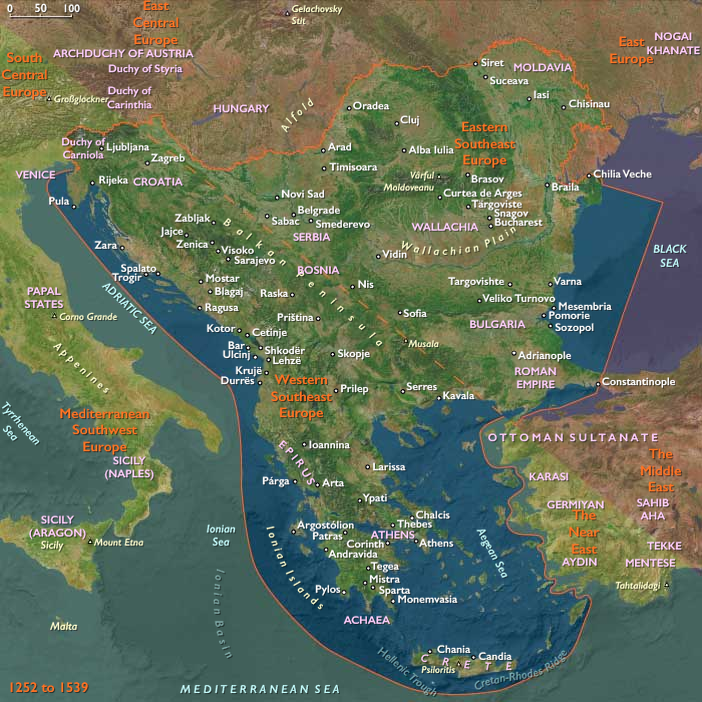
Southeast Europe
View →Subregions