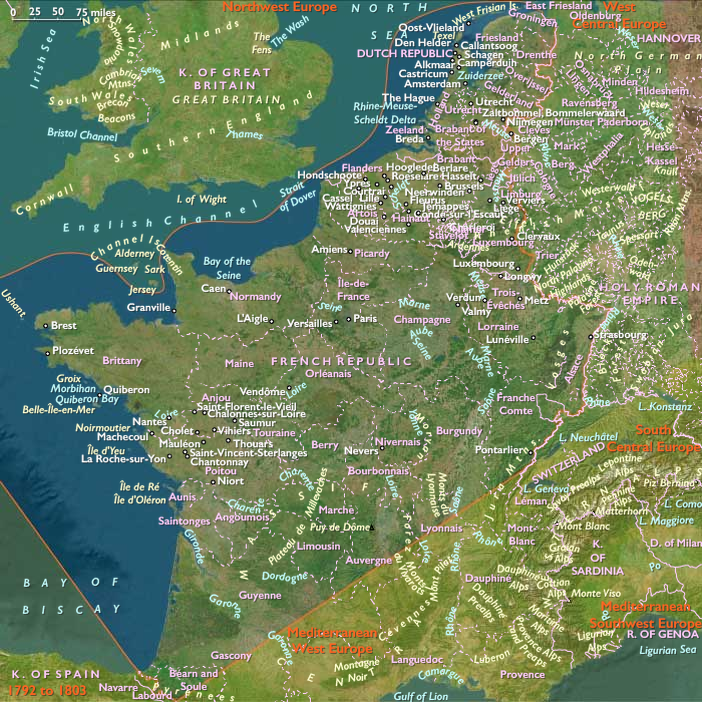
Britain and Russia send an expedition against…
August 1799 CE
Despite the conquest of the old Dutch Republic in 1795, the war had not ended; the Netherlands had just changed sides and now fully participates in the continuing conflagration, but its role has changed.
France does not need its army so much as its naval resources, in which France itself is deficient.
In 1796, under the new alliance, the Dutch had started a program of naval construction.
Manning the new ships is a problem, because the officer corps of the old navy is staunchly Orangist.
People like the "Hero of Doggerbank" Jan Hendrik van Kinsbergen honorably withhold their services.
The new navy is therefore officered by people like Jan Willem de Winter, who are of the correct political hue, but have only limited experience.
This had directly led to the debacles of the surrender at Saldanha Bay in 1796, and of the Battle of Camperdown in 1797.
At Camperdown the Batavian navy had behaved creditably, but this did not lessen the material losses, and the Republic had had to start its naval construction program all over again.
This program had soon brought the Batavian navy up to sufficient strength that Great Britain has to worry about its potential contribution to a threatened French invasion of England or Ireland.
The First Coalition had broken up in 1797, but Britain had soon found a new ally in Emperor Paul I of Russia.
The new Allies have scored some successes in the land war against France, especially in the puppet Cisalpine Republic and Helvetic Republic, where the armies of the Second Coalition have succeeded in pushing back the French on a broad front in early 1799.
The British, especially the Prime Minister, William Pitt the Younger, are eager to maintain this momentum by attacking at other extremes of the French "empire".
The Batavian Republic seems an opportune target for such an attack, with the Prince of Orange lobbying hard for just such a full military effort to reinstate him, and with Orangist agents leading the British to believe that France's hold over the Batavian Republic is weak and that a determined strike by the British towards Amsterdam will lead to a massive uprising against the French.
An added incentive is that a combined campaign against the Dutch had been a condition of the agreement with the Russians of December 28, 1798.
In that agreement, Emperor Paul I had placed forty-five thousand Russian troops at the disposal of the Coalition in return for British subsidies.
This convention is further detailed in an agreement of June 22, 1799, whereby Paul had promised to furnish a force of seventeen battalions of infantry, two companies of artillery, one company of pioneers, and one squadron of hussars for the expedition to Holland; 17,593 men in total.
In return, Britain had promised to pay a subsidy of eighty-eight thousand pounds, and another forty-four thousand pounds a month when the troops are in the field.
Great Britain itself is to furnish thirteen thousand troops and supply most of the transport and naval-escort vessels.
From the outset, the joint expedition that is now planned should not be a purely military affair.
Pitt assumes that, like the Italian and Swiss populations, the Dutch will enthusiastically support the invasion against the French.
Groups
Topics
Subjects
Regions
West Europe
View →Subregions