
The Duke of Orléans' Ambitions in Italy …
Years: 1405 - 1405
The Duke of Orléans' Ambitions in Italy and the Anglo-French Truce (1405–1407)
By 1405, Louis, Duke of Orléans, sought to expand his influence in Italy, leveraging his marriage to Valentina Visconti, daughter of Gian Galeazzo Visconti, the late Duke of Milan. Holding titles to largely theoretical fiefs in northern Italy, Louis aimed to persuade King Charles VI of France to intervene militarily on his behalf, potentially bringing France into renewed conflict with Italian states.
At the same time, Louis appeared eager to undermine the Anglo-French truce, going so far as to provoke Henry IV of England to a duel. This was a direct challenge to John the Fearless, Duke of Burgundy, whose economic interests in Flanders depended heavily on continued trade with England.
I. Louis of Orléans and His Italian Ambitions
- As son-in-law of Gian Galeazzo Visconti, Louis claimed fiefdoms in Italy, though these were largely hypothetical.
- He wanted French intervention to secure actual territorial power, possibly drawing France into Italian conflicts.
- His ambitions threatened to divert royal resources from the pressing domestic and English conflicts, something John the Fearless strongly opposed.
II. Threatening the Anglo-French Truce
- The truce between France and England, signed at Leulinghen in 1389, had maintained peace for over a decade, stabilizing trade relations.
- Louis' provocations toward Henry IV, including a possible challenge to a duel, threatened to shatter the fragile truce, potentially reigniting the Hundred Years’ War.
- John the Fearless, concerned about the economic well-being of Flanders, which was heavily reliant on English wool imports, could not allow this.
III. John the Fearless' Economic Concerns
- Flemish industry was entirely dependent on imported English wool, making the region extremely vulnerable to an English embargo.
- If the truce collapsed, Flemish merchants and cloth producers would suffer, creating economic instability in Burgundy’s most valuable territories.
- John, therefore, opposed any aggression toward England, as it would jeopardize the prosperity of Flandersand undermine his own political power.
IV. Escalation of the Burgundian-Orléanist Rivalry
- Louis’ reckless policies heightened tensions with John the Fearless, as the two competed for control over France during Charles VI’s mental instability.
- Their rivalry would soon escalate into outright conflict, culminating in the assassination of Louis of Orléans in 1407, ordered by John the Fearless.
V. Consequences and Legacy
- Louis’ foreign policy and provocations toward England further destabilized France, exacerbating internal divisions within the royal court.
- John the Fearless’ opposition to war with England aligned him with merchants and economic elites, strengthening his support among the bourgeoisie of Paris and Flanders.
- The growing feud between Orléans and Burgundy set the stage for the Armagnac-Burgundian Civil War (1407–1435), a conflict that would cripple France for decades.
The Duke of Orléans’ ambitions in Italy and his reckless hostility toward England in 1405–1407 placed France’s fragile peace at risk, prompting John the Fearless to take drastic measures to protect his economic and political interests, ultimately leading to the assassination of Louis and the outbreak of civil war.
Locations
People
Groups
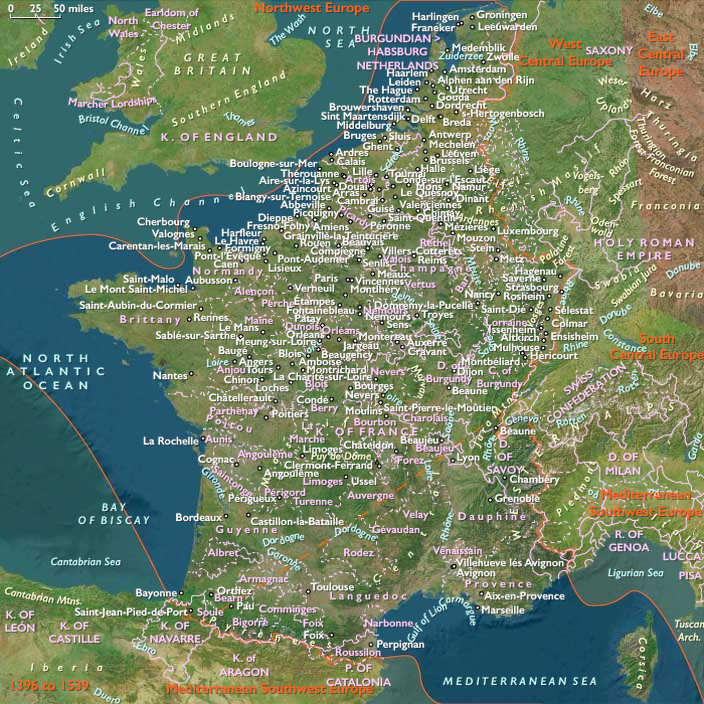
- Flanders, County of
- Burgundy, Duchy of
- France, (Valois) Kingdom of
- England, (Plantagenet, Lancastrian) Kingdom of
Topics
Commodoties
Subjects
Regions
Subregions
Related Events
Showing 10 events out of 42577 total
Years: 1405 - 1405
Locations
People
Groups
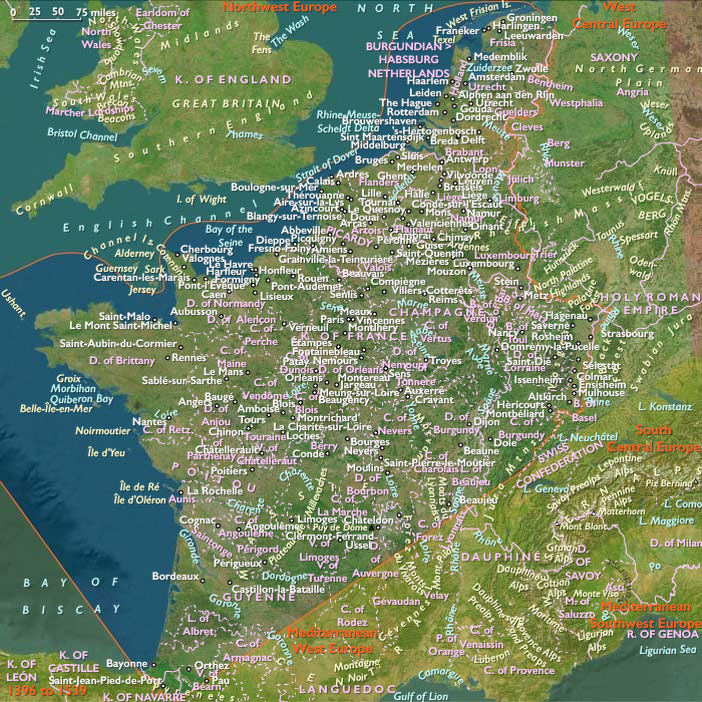
- Flanders, County of
- Burgundy, Duchy of
- France, (Valois) Kingdom of
- England, (Plantagenet, Lancastrian) Kingdom of
Topics
Commodoties
Subjects
Regions
Subregions