The Earldom of Ross is a vast…
1411 CE
The Earldom of Ross is a vast territory reaching from Skye to Ross and Inverness-shire, with superiority over the outlying lands of Nairn and Aberdeenshire.
Uilleam (William), Earl of Ross, had in 1370 eceived a charter from King David II, confirming his right to the title and directing that in the absence of male heirs, the entirety of the earldom, titles and lands would fall to "the elder daughter always" without division.
When Uilleam died in 1372 without a male heir, the title had passed to his daughter Euphemia, who by her first husband Sir Walter Leslie had had two children—Alexander Leslie and Mariota (anglicized as Margaret or Mary).
Euphemia after Walter's death had in 1382 married Alexander Stewart, Earl of Buchan (the "Wolf of Badenoch"), giving the Stewarts control of the earldom.
The marriage had been annulled in 1392 as Buchan had long been living with Mairead inghean Eachann, with whom he had a number of children, including Alexander Stewart, Earl of Mar.
At Euphemia’s death in 1394, her son Alexander Leslie had inherited the title.
Robert Stewart, Duke of Albany, had taken effective control of mainland Scotland towards the end of the reign of his father Robert II; his power had increased during the reign (1390–1406) of his ineffective elder brother Robert III.
Albany's daughter Isabel Stewart had married Alexander Leslie before 1398; their only child is a sickly daughter also called Euphemia.
According to the Calendar of Fearn, Leslie died on May 8, 1402, while his daughter was still a minor.
Albany had gained wardship of Euphemia, which gives him control of Ross.
After the capture, by the English, of Robert III's heir James and Robert's death soon afterwards in April 1406, Albany had been confirmed as regent; Albany will continue to govern Scotland until his death in September 1420.
Meanwhile Donald (Domhnall), Lord of the Isles, claims the earldom of Ross through his marriage to Euphemia's aunt, Mariota, the oldest living female descendant of Uilleam.
He had also signed an alliance on September 16, 1405, with Henry IV of England, which on May 8, 1408, had been renewed.
The Macdonald clan leaders of Scotland’s northwest call themselves “Kings of the Isles,” and operate like autonomous monarchs, the more so since the 1406 capture of Scottish king James I and his long imprisonment in England.
The dispute over control of the earldom of Ross with the nephew of James’ regent in 141i prompts Donald, assisted by the Macleans, to launch an attack against Aberdeen.
The Macdonald army, commanded by Maclean leader Red Hector of the Battles, engages the regent’s forces in the savage but inconclusive Battle of Red Harlaw, in which Red Hector perishes.
The Macdonald army withdraws, and peace ensues.
Topics
Subjects
Regions
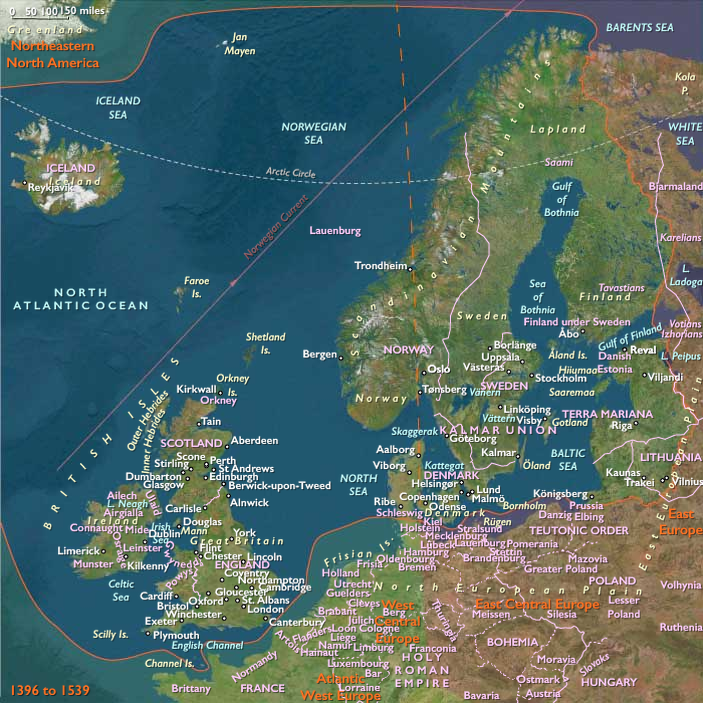
North Europe
View →Subregions