
Event
Brabant’s Economic Boom and the Charter of…
Brabant’s Economic Boom and the Charter of Kortenberg (1312)
In the early 14th century, the Duchy of Brabant experienced a significant economic boom, largely fueled by its flourishing cloth industry, which depended on English wool. This period also saw Brabant’s continued opposition to French expansion under Duke John II (r. 1294–1312) and an important constitutional development that granted political rights to the estates of the duchy.
Brabant’s Economic and Political Position
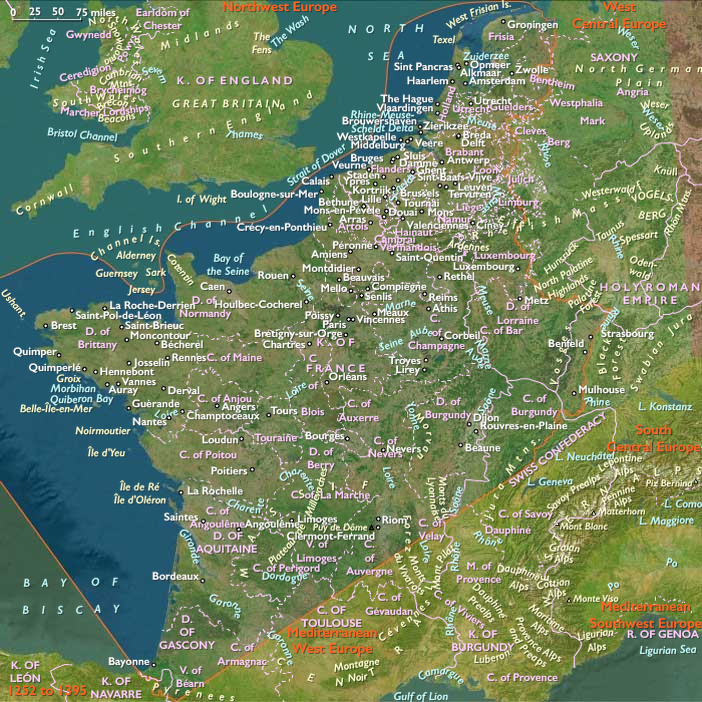
- Brabant’s towns, such as Brussels, Leuven, and Antwerp, thrived due to the textile trade, which relied on English wool imports.
- The duchy remained firmly within the anti-French coalition, resisting Capetian encroachments into the Low Countries.
- John II of Brabant attempted to expand his territory by conquering South Holland, a region under the control of the pro-French Count John II of Holland, but without success.
The Charter of Kortenberg (September 27, 1312)
-
Suffering from kidney stones and wanting to ensure a smooth succession for his son, John III, John II issued the Charter of Kortenberg on September 27, 1312.
-
This document granted participation in government to the estates of Brabant:
- The clergy
- The nobility
- The municipalities (burghers of major towns)
-
The Charter of Kortenberg is considered:
- The first constitutional document of the Low Countries.
- Possibly the first European charter granting an early form of representative governance.
Significance and Legacy
- The charter established the Estates of Brabant as a governing body, giving representatives from towns and the landed classes a voice in ducal decisions.
- It set a precedent for later constitutional developments in the Low Countries and Western Europe, influencing later political structures, including urban autonomy and early parliamentary systems.
- Brabant’s economic prosperity and political stability continued into the 14th and 15th centuries, strengthening its position within the Holy Roman Empire.
The Charter of Kortenberg (1312) marked a pioneering step toward representative government in medieval Europe, ensuring that Brabant’s towns and nobles had a say in governance—a development that foreshadowed the emerging political structures of the Renaissance and beyond.
-
{# Image navigates to the detail page; the magnifying-glass chip is the only Fancybox lightbox trigger (kept a separate sibling — anchors can't nest). #}
 The North Atlantic Lands
World
-
{# Image navigates to the detail page; the magnifying-glass chip is the only Fancybox lightbox trigger (kept a separate sibling — anchors can't nest). #}
 West Europe
Region
-
{# Image navigates to the detail page; the magnifying-glass chip is the only Fancybox lightbox trigger (kept a separate sibling — anchors can't nest). #}
 Atlantic West Europe
Subregion
