
The Eastern Jìn court has managed to…
373 CE
The Eastern Jìn court has managed to survive the rebellions of Wang Dun and Su Jun.
Another rebellious military leader, Huan Wen, had been perceived as one of the greatest generals since Jin's loss of northern China.
He had led the campaign that destroyed Cheng Han and annexed its lands to Jin, and had had some successes against the northern states Former Qin and Former Yan (although both campaigns ultimately ended in failure, perhaps due to his overcautiousness).
Huan Wen dies in 373 before he can carry out his intention to usurp the throne, but the Huan clan will remain entrenched in the Jin power structure for decades to come.
People
Groups
Topics
Commodities
Subjects
Regions
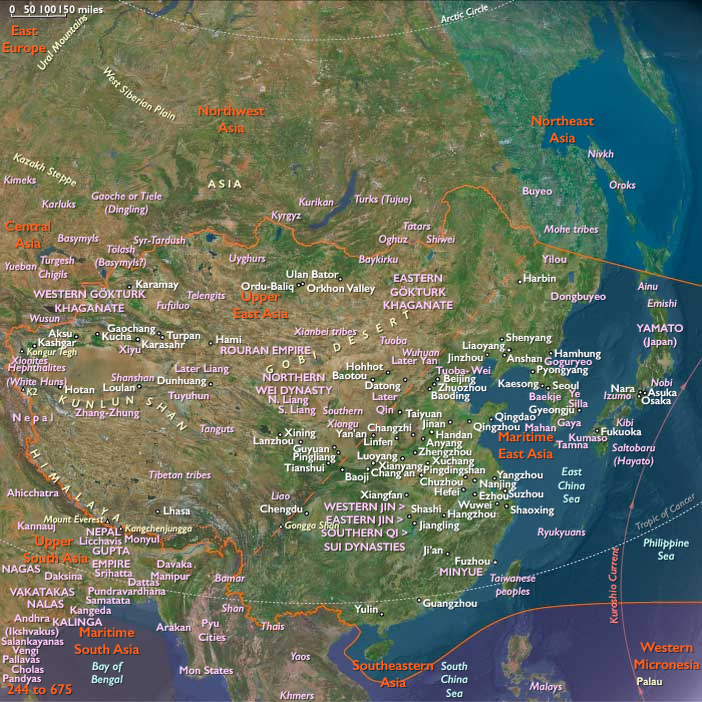
East Asia
View →Subregions
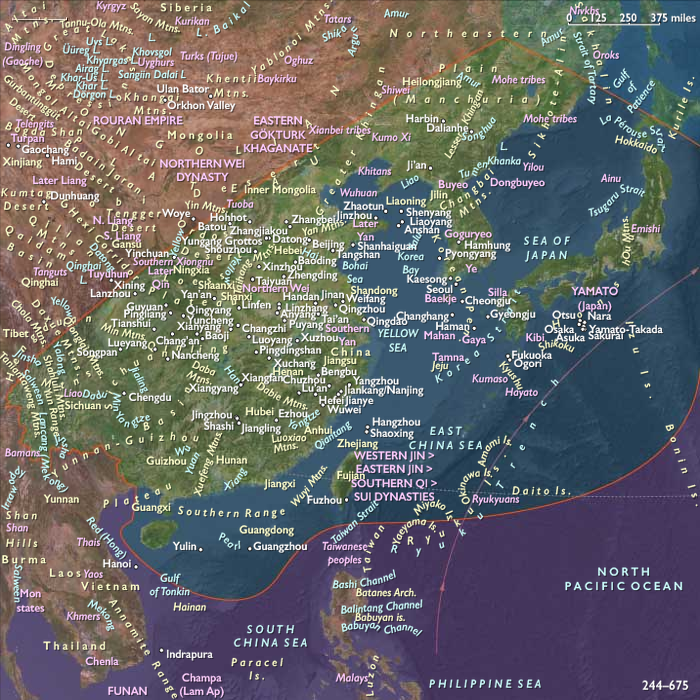
Maritime East Asia
View →Related Events
Showing 10 events out of 123 total
Displaced Goths and other tribes arrive in the summer and fall of 376 on the Danube River, on the border of the Roman Empire, requesting asylum from the Huns.
Fritigern, a leader of the Thervingi, appeas to the Roman emperor Valens to be allowed to settle with his people on the south bank of the Danube, where they hope to find refuge from the Huns, who lack the ability to cross the wide river in force.
Valens permits this, and promises the Goths farming land, grain rations, and protection under the Roman armies as “allies” (foederati).
The ones that crossed are supposed to have their weapons confiscated; however, the Romans in charge accept bribes to allow the Goths to retain their weapons.
With so many people in such a small area, famine strikes the Goths, and Rome is unable to supply them with either the food they were promised or the land; they herd the Goths into a temporary holding area surrounded by an armed Roman garrison.
There is only enough grain left for the Roman garrison, who simply let the Goths starve.
The Romans provide a grim alternative: the trade of slaves (often children and young women) for dog meat.
When Fritigern appeals to Valens for help, he is told that his people will find food and trade in the markets of the distant city of Marcianople.
Having no alternative, some of the Goths trek south in a death march, losing the sickly and old along the path.
When they finally reach Marcianople's gates, they are barred by the city's military garrison and denied entry; moreover, the Romans unsuccessfully try to assassinate the Goth leaders during a banquet.
Open revolt begins.
The main body of Goths spend the rest of 376 and early 377 near the Danube plundering food from the immediate region.
Roman garrisons are able to defend isolated forts but most of the country is vulnerable to Gothic plunder.
War begins in earnest in late winter 377.
The remaining Goths move south from the Danube to Marcianople, and next appear near Adrianople (modern Edirne).
The Roman response is to send a force under Valens to meet and defeat the Goths.
Valens moves north from Constantinople in 378 and is defeated (and himself killed) at the Battle of Adrianople.
The victory gives the Goths freedom to roam at will, plundering throughout Thrace for the rest of 378.
The Goths meet only light Roman resistance in 379 and advance northwest into Dacia, plundering that region.
The Goths divide in 380 into Terving and Greuthung armies, in part because of the difficulty of keeping such a large number supplied.
The Greuthungi move north into Pannonia, where they are defeated by western emperor Gratian.
The Tervingi under Fritigern move south and east to Macedonia, where they take "protection money" from towns and cities rather than sacking them outright.
Forces of the western Empire in 381 drive the Goths back to Thrace, where finally, peace is made on October 3, 382.
The Goths by the end of the war have killed a Roman emperor, destroyed a Roman army and laid waste large tracts of the Roman Balkans, much of which will never recover.
The Roman Empire has for the first time negotiated a peace settlement with an autonomous barbarian tribe inside the borders of the Empire, a situation that a generation before would have been unthinkable.
The lesson is not lost on other tribes, including the Goths themselves, who will not long remain peaceful.
Rome, after the crushing defeat, is no longer in a position to drive all its enemies from its territories.
Tribes that can no longer be expelled begin to be settled within the empire as foederati, receiving subsidies and in return supplying troops.
The Western Empire under the pressure of continued invasions will collapse within a century and be carved up into barbarian kingdoms.
China’s Eastern Jin Dynasty has developed an alliance with the barbarian Tuoba, a clan of the Xianbei people, against the Xiongnu state Han Zhao, and the Tuoba chief had in 315 been granted the title of the Prince of Dai.
After the death of its founding prince, Tuoba Yilu, however, the Dai state had stagnated and largely remained a partial ally and a partial tributary state to Later Zhao and Former Yan, finally falling in 376 to the Di kingdom of Qin, known to history as Former Qin.
The Chinese/Di state known as Former Qin had been founded in about 350 by the Fu family of the Di ethnicity.
Under Fu Jiān, an emperor (who, however, used the title "Heavenly Prince", or Tian Wang, during his reign), assisted by his able prime minister, the late Wang Meng, has destroyed not only Dai but also Former Yan and Former Liang, and seized Jin's Yi Province (modern Sichuan and Chongqing).
Fu Jiān aspires to destroy Jin as well to unite China.
The Dingling, a Siberian people who originally lived on the bank of the Lena River in the area west of Lake Baikal, had begun to expand westward in the third century.
Some groups of Dingling also moved to China and settled there in the first century CE as early as during Wang Mang's reign, forming part of the southern Xiongnu tribes known as Chile during the third century, from which the later name Chile originated.
They adopted the last name Zhai.
The name "Chile" and "Gaoche" had first appeared in Chinese literature during the campaigns of Former Yan and Dai in 357 and 363 respectively.
However, the protagonists will be equally addressed as "Dingling" in the literary record of the Southern Dynasties.
Dingling leader Zhai Bin, who had rebelled against Former Qin's emperor Fu Jiān in 383, had supported Later Yan's founding emperor Murong Chui when Murong Chui rebelled against Former Qin as well and established Later Yan.
However, in 384, as Murong Chui is besieging the important city Yecheng, which is defended by Fu Jiān's son Fu Pi, Zhai Bin, seeing that Murong Chui is unable to capture the city quickly, begins to consider other options.
When, in particular, he requests a prime ministerial title from Murong Chui and is refused, Zhai Bin prepares to ally with Fu Pi instead, but his plan is discovered, and he is killed, along with his brothers Zhai Tan and Zhai Min.
It is apparently at this time that Zhai Bin’s son or nephew Zhai Liao and his cousin Zhai Zhen flee with some of their Dingling troops and resists Later Yan's subsequent campaigns to take the territory north of and around the Yellow River.
The strategically important city of Xiangyang, gateway to the Middle Yangtze, had fallen to Fu Jian in 379.
The controversial Murong Chui, a great general of the Chinese/Xianbei state Former Yan, had fled to Former Qin and become one of Fu Jian’s generals, participating in the campaign commanded by Fu Jian's son Fu Pi against Jin's key city of Xiangyang.
Fu Jian had conquered all of north China by 381 and began preparing for an invasion of the south.
In 382, when Fu Jian wanted to launch a major campaign to destroy Jin and unite China, most officials, including Fu Jian's brother Fu Rong, Duke of Yangping, who had succeeded Wang Meng as prime minister after Wang's death in 375, opposed, but Murong Chui and Yao Chang urged the campaign.
In May of 383, a Jin army of one hundred thousand commanded by Huan Chong attempts to recover Xiangyang but is driven off by a Qin relief column of fifty thousand men.
Fu Jian responds by ordering a general mobilization against Jin, conscripting one in ten able men and mustering thirty thousand elite guards.
In August, Fu Jian sends his brother Fu Rong with an advance force of three hundred thousand.
Later this month, Fu Jian marches with his army of two hundred and seventy thousand cavalry and six hundred thousand infantry from Chang'an, reaching Xiangcheng in September.
Separate columns are to push downstream from Sichuan, but the main offensive is to occur against the city of Shouchun on the Huai River.
Emperor Xiaowu of Jin, hurriedly preparing a defense, assigns Huan Chong responsibility for the defense of the Middle Yangtze.
To Xie Shi and Xie Xuan and the elite eighty thousand-strong Beifu Army is given the defense of the Huai River.
The Jin army’s overall military strategist, prime minister Xie An, lacks military abilities but calms the panicking officials and people by his example.
The Former Qin forces under Fu Rong capture the important Jin city of Shouyang (in modern Lu'an, Anhui) in October.
Fu Jiān, seeing a possibility of a quick victory, leaves his main force at Xiangcheng and leads eight thousand light cavalry to rendezvous with Fu Rong while dispatching the captured Jin official Zhu Xu as a messenger to try to persuade Xie Shi to surrender.
Instead, Zhu advises Xie Shi that fact the Former Qin force has not entirely assembled and that he should try to defeat the enemy’s advance forces.
Xie Xuan and Liu Laozhi, leading five thousand elite troops to engage the Former Qin advance force, scored an unexpected victory, killing fifteen thousand of the enemy troops.
In November, the Former Qin troops encamp west of the Fei River; the numerically inferior Jin forces halt east of the river, unable to advance.
Xie Xuan sends a messenger to Fu Rong, suggesting that the Former Qin forces retreat slightly west to allow Jin forces to cross the Fei River, so that the two armies can engage.
Most of Fu Jian’s generals oppose this plan, but Fu Jiān, planning to attack the Jin forces as they cross the river, overrules them.
Fu Rong agrees and orders a retreat but the Qin army, its morale low, panics when Zhu Xu manages to broadcast the false information that their retreating force has been defeated.
The retreat becomes a rout, and the generals Xie Xuan, Xie Yan, and Huan Yi cross the river to launch a major assault.
Fu Rong attempts to halt the retreat and reorganize his troops, but after becoming unhorsed, he is killed by Jin troops.
The Jin army continues their pursuit, and the entire Former Qin force collapses.
In the ensuing retreat, beset by famine and death from exposure and harried by the Jin army, the Former Qin force loses an estimated seventy to eighty percent of its strength.
The battle is considered one of the most significant in the history of China.
Almost the entire Former Qin army has collapsed, although the forces under Murong Chui's command remain intact, and Fu Jian, who had suffered an arrow wound during the defeat, has fled to Murong Chui.
Murong Chui's son Murong Bao and brother Murong De have both tried to persuade Murong Chui to kill Fu Jian while it is within his power to do so, but Murong Chui instead returns his forces to Fu Jian's command and returns to Luoyang with Fu Jian.
However, responding to a suggestion by his son Murong Nong, he plans a rebellion to rebuild the Yan state.
Murong Chui tells Fu Jian that he fears rebellion by the people of the Former Yan territory, and that it would be best if he were to lead a force to pacify the region.
Fu Jian agrees, despite opposition by Quan Yi, and Murong Chui leads the army to Yecheng, defended by Fu Pi.
They suspect each other, but neither ambushes the other.
When the Dingling chief Zhai Bin rebels and attacks Luoyang, defended by Fu Pi's younger brother Fu Hui, Fu Pi orders Murong Chui to put down Zhai's rebellion, and Fu Pi sends his assistant Fu Feilong to serve as Murong Chui's assistant.
On the way to Luoyang, however, Murong Chui kills Fu Feilong and his Di soldiers and prepares to openly rebel.
Meanwhile, despite his suspicions of Murong Chui, Fu Pi does not put under surveillance Murong Chui's son Murong Nong and nephews Murong Kai and Murong Shao, and the three flee from Yecheng and initiate a rebellion of their own.
Murong Chui, not yet in open rebellion against Former Qin, arrives at Luoyang in spring 384, but Fu Hui, hearing of Fu Feilong's death, refuses to welcome him.
Murong Chui then enters into an alliance with Zhai Bin, who urges him to take the imperial title.
Murong Chui refuses at this point (reasoning that he should welcome Murong Wei back as emperor) but accepts the title of Prince of Yan, formally breaking away from Former Qin and establishing Later Yan.
(All rulers of the Later Yan will declare themselves "emperors".)
Immediately, the struggle is on for Murong Chui to capture the territory that was formerly Former Yan's.
Both Murong Chui and Murong Nong quickly capture many cities, isolating Luoyang and …
…Yecheng.
Fu Pi tries to persuade him to stop his rebellion, but he refuses, and instead tries to persuade Fu Pi to leave Yecheng with his forces intact; Fu Pi refuses, and Murong Chui puts Yecheng under siege.
With Former Qin now facing further rebellion by Murong Chui's nephews Murong Hong and Murong Chong, and Yao Chang, in the west, Yecheng is not able to receive any reinforcements, but Murong Chui is still unable to capture it quickly.
When Zhai Bin, in disappointment over not being given a prime ministerial title, considers switching sides again to Former Qin, Murong Chui kills him.
Zhai Bin's nephew Zhai Zhen rebels against Later Yan, and for the next several years, while battling Former Qin remnants, Murong Chui will also have to battle Dingling forces under Zhai Zhen and later his cousins Zhai Cheng and Zhai Liao.
Yáo Cháng founds Later Qin, a state of Qiang ethnicity of the Sixteen Kingdoms Era, entirely distinct from the ancient Qin Dynasty, the Former Qin, and the Western Qin, in 384.
All rulers of the Later Qin will declare themselves "emperors."