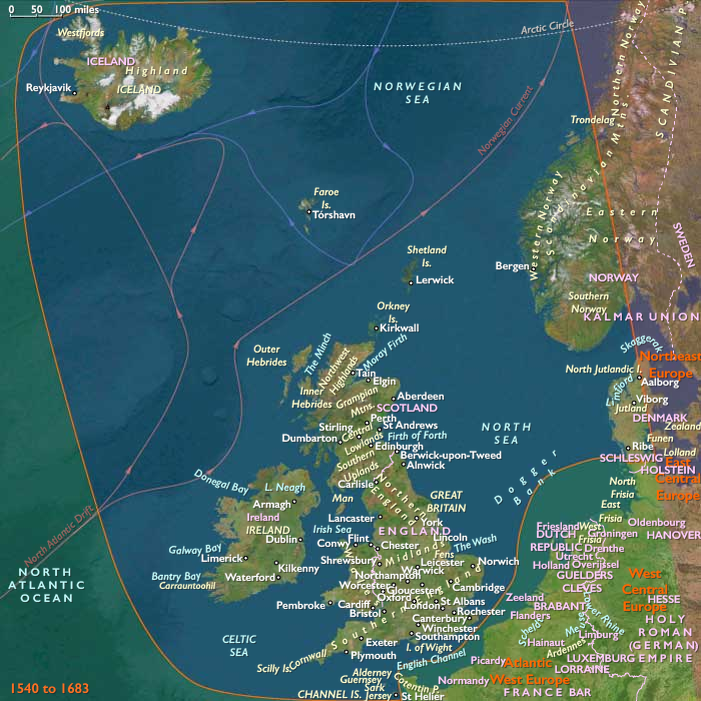
The English army, weakened by illness and…
September 1650 CE
The English army, weakened by illness and demoralized by lack of success, has by early September begun to withdraw towards its supply base at Dunbar.
Leslie, believing that the English army is retreating, orders his army to advance in pursuit.
The Scots army reaches Dunbar first and Leslie positions his troops on Doon Hill, overlooking the town and the Berwick Road, which is Cromwell's land route back to England.
However, the Scots army is funded by the Church of Scotland.
Eager not to waste funds, the church officials put Leslie under great pressure to finish the battle quickly.
Leslie brings his army down from Doon Hill on September 2, 1650, and approaches the town.
Cromwell, witnessing this maneuver, quickly realizes that here is an opportunity for him to turn the tables on the Scots.
That night, under cover of darkness, Cromwell secretly redeploys a large number of his troops to a position opposite the Scottish right flank.
Just before dawn on September 3, shouting their battle cry 'The Lord of Hosts!', the English launch a surprise attack.
Soldiers in the center and on the left flank catch Leslie's men unawares but are held by the greater number of Scottish opponents.
On the right flank, however, the Scots soldiers are pushed back under the weight of superior English numbers until their lines start to disintegrate.
Observing this disaster, the rest of the Scottish army loses heart, breaks ranks and flees.
In the rout that follows, the English cavalry drive the Scots army from the field in disorder.
Cromwell will claim that three thousand Scots were killed.
On the other hand, Sir James Balfour, a senior officer with the Scottish army, noted in his journal that that were only "8 or 900 killed".
There is similar disagreement about the number of Scottish prisoners taken: Cromwell claimed that there were ten thousand, while the English Royalist leader, Sir Edward Walker, put the number at six thousand, of which one thousand sick and wounded men were quickly released.
The more conservative estimates of the Scottish casualties are borne out by the fact that, the day after the battle, Leslie retreated to Stirling with some four thousand to five thousand of his remaining troops.
Topics
Commodities
Subjects
Regions
North Europe
View →Subregions