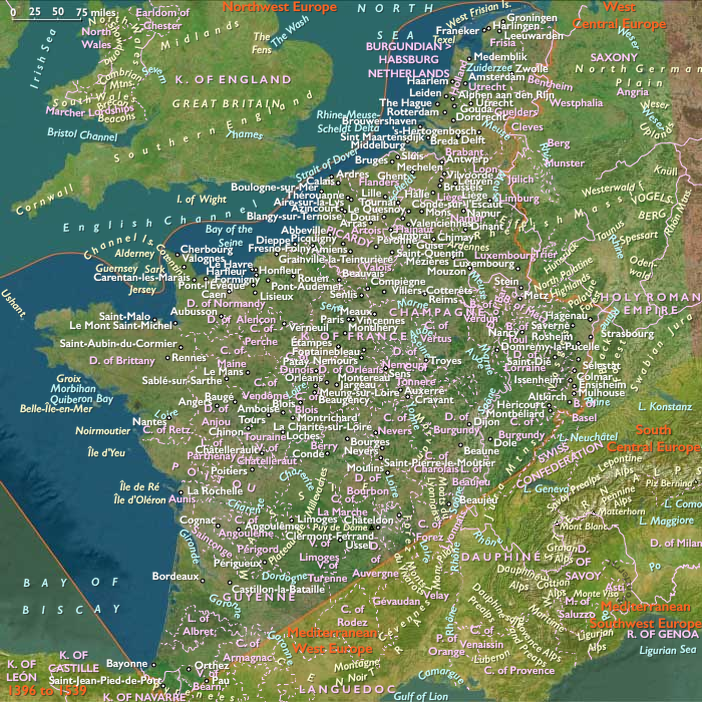
The Treaty of Picquigny and the Anglo-French…
1475 CE
The Treaty of Picquigny and the Anglo-French Peace (1475)
On August 29, 1475, the strategic plans of Charles the Bold, Duke of Burgundy, suffered a major diplomatic setback with the Treaty of Picquigny, a significant peace agreement concluded between the English king Edward IV—Charles’s brother-in-law—and the French king Louis XI. Intended as a critical part of Charles’s broader strategy to destabilize and ultimately partition France, Edward IV’s invasion force, after landing in France, was halted decisively by Louis XI’s adept diplomacy, effectively isolating Charles and marking the end of English participation in Burgundian-led hostilities.
Diplomatic Context: The Anglo-Burgundian Alliance
Initially, Charles had successfully persuaded King Edward IV of England to launch a military expedition against Louis XI, exploiting their familial connection and shared strategic interests in containing French power. Charles envisioned English military intervention as central to his broader diplomatic strategy, aiming at weakening Louis and partitioning French territory. However, Louis XI’s skillful diplomatic counter-measures quickly undermined Charles’s plans.
Treaty Terms and Louis XI’s Diplomatic Victory
The Treaty of Picquigny, signed on August 29, 1475, saw Edward IV abandon military operations against France in exchange for substantial financial compensation—an immediate cash payment and subsequent annual pensions paid directly by Louis XI. In return, Louis secured peace with England, effectively nullifying Charles’s carefully arranged military threat. The treaty also included a marriage agreement between the French dauphin and Edward’s daughter, further solidifying Anglo-French diplomatic reconciliation.
Immediate Diplomatic Consequences
Edward IV’s abandonment of Charles represented a serious diplomatic humiliation for Burgundy, profoundly weakening Charles’s diplomatic and military position. With English support removed, Charles found himself increasingly isolated in his confrontations with Louis and other rivals, notably the powerful Swiss Confederation and the cities along the Rhine, Alsace, and Lorraine.
Louis XI’s diplomatic victory at Picquigny vividly illustrated his effectiveness in employing financial inducements and diplomatic concessions to neutralize enemies and safeguard French interests, underscoring the primacy of diplomatic maneuvering in the late medieval political landscape.
Economic and Cultural Implications
The treaty demonstrated the economic leverage Louis XI effectively wielded, granting Edward a substantial annual pension and thus turning a costly potential war into a mutually beneficial peace. The resulting stability allowed France to avoid destructive conflict, preserve economic resources, and maintain internal prosperity, facilitating continued royal centralization and economic growth.
Long-Term Historical Significance
The Treaty of Picquigny (1475) marked a pivotal turning point in the diplomatic history of Atlantic West Europe, decisively thwarting Charles the Bold’s ambitious strategy of French containment and partition. Louis XI’s diplomatic skill not only preserved French territorial integrity but also set a precedent for future diplomatic practice, highlighting negotiation and financial diplomacy as effective alternatives to costly warfare.
For Burgundy, the treaty meant strategic isolation, stripping Charles of vital English support and exacerbating his already strained diplomatic situation. This isolation significantly contributed to Burgundy’s vulnerability, precipitating Charles’s later catastrophic military defeats against the Swiss and Lorraine, ultimately culminating in the end of independent Burgundian power at the Battle of Nancy (1477).
Long-Term Historical Significance
The Treaty of Picquigny permanently reshaped the regional balance of power, contributing directly to Burgundy’s diplomatic isolation, vulnerability, and ultimate collapse. Simultaneously, it underscored the emerging primacy of diplomatic strategy and financial incentives in late medieval European geopolitics, profoundly influencing subsequent diplomatic practices across Atlantic West Europe.
Locations
Groups
Commodities
Subjects
Regions
West Europe
View →Subregions