Bamberg Cathedral, on which reconstruction begins in…
1237 CE
Bamberg Cathedral, on which reconstruction begins in about 1237, copies the French Gothic style towers of Laon Cathedral.

Locations
Groups
Regions
Central Europe
View →Subregions
East Central Europe
View →Related Events
No active filters.
Showing 10 events out of 46953 total
The surviving Sword-Brothers, after the disastrous Battle of Saule, merge in 1237 with the Teutonic Order of Prussia and became known as the Livonian Order.
The influx of German colonists into Bohemia continues under King Wenceslas, bringing prosperity to Bohemia.
Wenceslaus manages to negotiate the expansion of Bohemia north of the Danube, annexing territories offered by Duke Frederick in order of forming and maintaining their alliance.
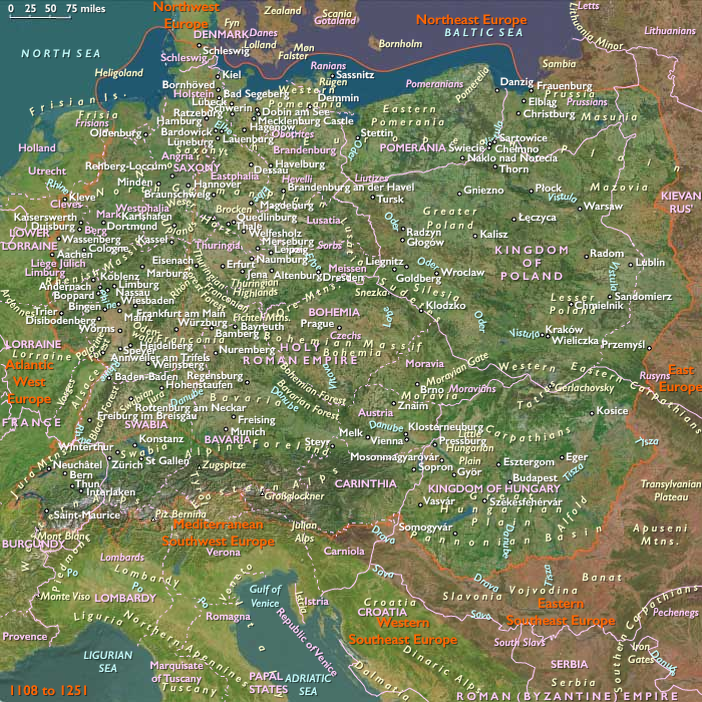
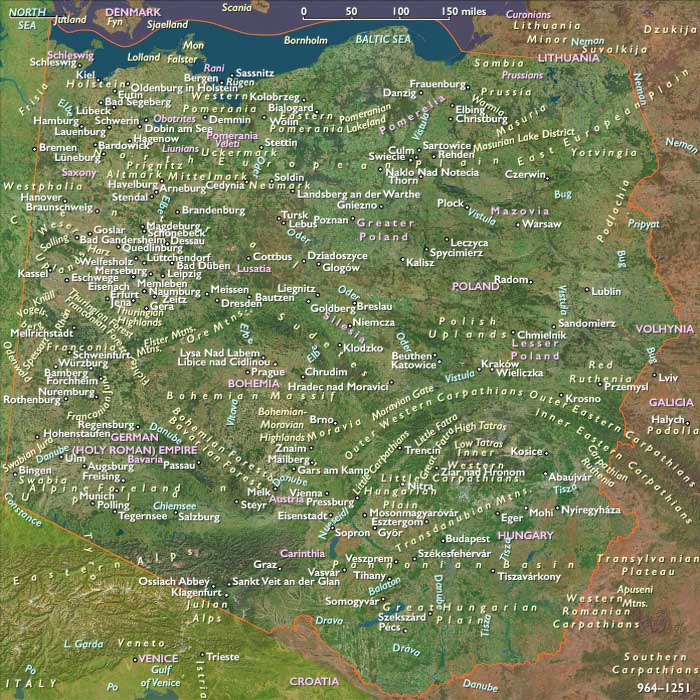
Laon Cathedral’s towers are copied also in Naumburg at St. Peter and Paul's Cathedral (known in German as the Naumburger Dom), an impressive Cathedral in the late Romanesque and Gothic style, on which construction begins in about 1237.
Conrad, born in Andria, is the second but only surviving son of the Hohenstaufen Emperor Frederick II and the queen regnant of Jerusalem, Isabella II (Yolanda), who dies while giving birth to him.
He is also the grandson of Emperor Henry VI through his father and great-grandson of Emperor Frederick I. Conrad had lived in Italy until 1235, when he had first visited Germany.
During this period, his kingdom of Jerusalem, ruled by his father as regent through proxies, will be wracked by the War of the Lombards until Conrad declares his majority and his father's regency loses its validity.
When Frederick II deposes his eldest son, Conrad's rebellious older brother Henry, in 1237 in the midst of the struggle between his father and the papacy, the Emperor has Conrad elected King of the Romans in diet in Vienna.
This title presumes a future as Emperor of the Holy Roman Empire.
Ekbert governs from February to his death on June 5, 1237.
Wenceslaus is hardly pleased with this apparent expansion of direct imperial authority close to his borders, and he and Duke Frederick form an alliance against the Emperor, who chooses to lift the ban in 1237 rather than maintain another open front.
German poet Neidhart von Reuenthal, who is probably active in Bavaria and then is known to have been a singer at the court of Frederick II in Vienna, composes narrative poems often depicting peasant brawling from a perspective of aristocratic disdain.
Neidhart, breaking—like his predecessor Walther von der Vogelweide—with the conventionalized lyric of courtly love, turns instead to the subject of rustic courtships.
Neidhart is very well known for being rather sarcastic and comical.
More melodies survive by him than from any other minnesinger.
A peace is arranged between the Bulgarians and the Nicaeans in 1237.
The hopes that John of Brienne might restore the Latin Empire to its earlier glory falter with his death in March 1237.
The emperor returns again to Italy in August 1237, this time aiming to definitely crush the Second Lombard League.
He crosses the Alps to Verona and here his two thousand knights are joined by Ezzelino III da Romano's troops, including soldiers from Treviso, Padua, Vicenza and Verona itself, as well as by Tuscan men led by Gaboard of Arnstein.
Six thousand infantry and horsemen from the Kingdom of Sicily come later, including Apulian Muslim archers.
The rest of the army is formed by Ghibellines from Cremona, Pavia, Modena, Parma and Reggio, for a total of twelve thousand to fifteen thousand men.
The imperial army marches first against Mantua, which decides to surrender instead of being sacked, and then to …