
The geographer Ptolemy had written that the …
Years: 388 - 399
The geographer Ptolemy had written that the "Huni" were between the Bastarnae and the Roxolani in the Pontic area under the rule of Suni by CE 139, although it is not known for certain if these people were the Huns.
It is possible that the similarity between the names "Huni" and "Hunnoi" is only a coincidence, considering that while the West Romans often wrote Chunni or Chuni, the East Romans never used the guttural Χ at the beginning of the name.
Possibly Mongol in origin, the Huns now include substantial numbers of Germanic and Indo-Iranian groups, their culture and organization a melange of many different customs.
The nomadic horde, heavily reliant on animal herding, is sustained by the plundering of sedentary peoples.
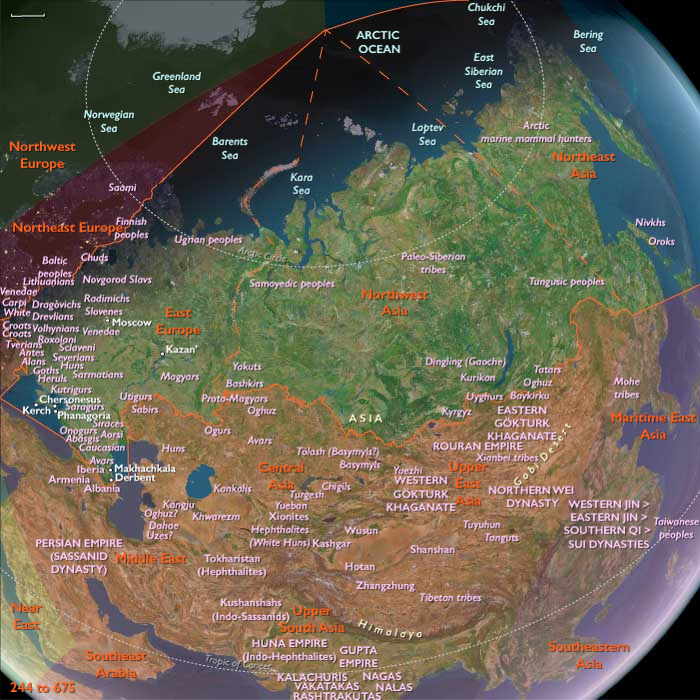
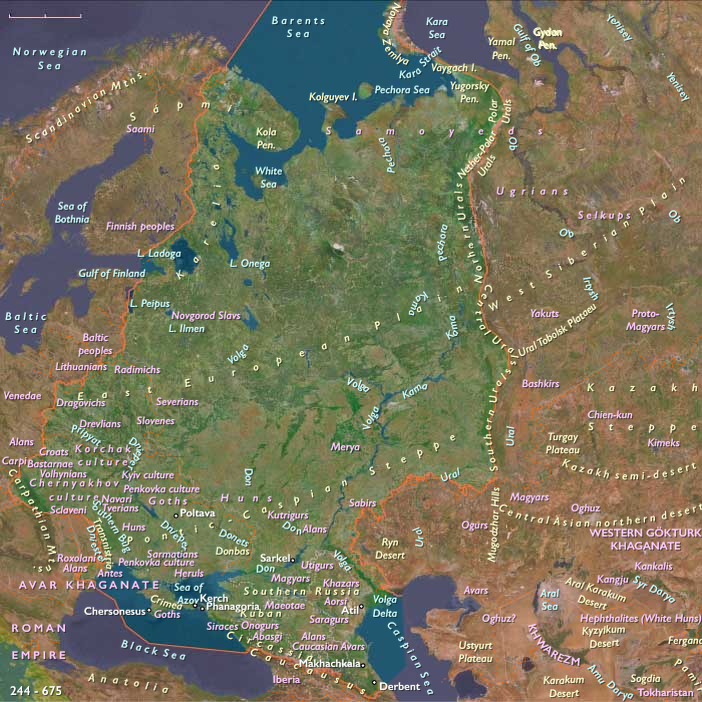
The Huns had first appeared in Europe north of the Black Sea around 370, then crossed the Volga river and attacked the Alans, whom they had subjugated.
Jordanes reports that the Huns were led at this time by Balamber while modern historians question his existence, seeing instead an invention by the Goths to explain who defeated them.
Denis Sinor suggests that Balamber, if he existed, may have been a chief of a small faction of Huns, since Vithimiris utilized Hun mercenaries against him, which suggests a lack of unity among the Huns.
Sinor also cites Ammianus' statement that the Huns "are subject to no royal restraint," casting further doubt on Balamber's status as king.
(Sinor, ed.
by Denis (1994).
The Cambridge history of early Inner Asia (1. publ.
ed.).
Cambridge [u.a.
]: Cambridge Univ.
Press).
After the Huns defeated the Alans, the Huns and Alans had started plundering Greuthungic settlements.
The Greuthungic king, Ermanaric, had committed suicide and his great-nephew, Vithimiris, had taken over.
but had been killed during a battle against the Alans and Huns in 376, resulting in the subjugation of most of the Ostrogoths.
Vithimiris' son, Viderichus, was only a child so command of the remaining Ostrogothic refugee army had fallen to Alatheus and Saphrax.
The refugees had streamed into Thervingic territory, west of the Dniester.
The destruction of the Gothic kingdoms by the Huns in 372-375 is the trigger for the barbarian invasions of the fifth century, which will include the capture and looting of the city of Rome by the Visigoths in 410 and by the Vandals in 455.
With a part of the Ostrogoths on the run, the Huns had next come to the territory of the Visigoths, led by Athanaric.
Athanaric, not to be caught off guard, had sent an expeditionary force beyond the Dniester.
The Huns avoided this small force and attacked Athanaric directly.
The Goths had retreated into the Carpathians.
Support for the Gothic chieftains had diminished as refugees headed into Thrace and towards the safety of the Roman garrisons.
After these invasions, the Huns had begun to be noted as Foederati and mercenaries.
As early as 380, a group of Huns had been given Foederati status and allowed to settle in Pannonia.
Hunnish mercenaries are also seen on several occasions in the succession struggles of the Eastern and Western Roman Empire during the late fourth century.
However, it is most likely that these were individual mercenary bands, not a Hunnish kingdom.
People
Groups
- Goths (East Germanic tribe)
- Huns
- Thervingi (East Germanic tribe)
- Greuthungi (East Germanic tribe)
- Hunnic Empire
- Ostrogoths, Realms of the
- Visigoths, Realm of the
Topics
Commodoties
Subjects
Regions
Subregions
Years: 388 - 399
People
Groups
- Goths (East Germanic tribe)
- Huns
- Thervingi (East Germanic tribe)
- Greuthungi (East Germanic tribe)
- Hunnic Empire
- Ostrogoths, Realms of the
- Visigoths, Realm of the
Topics
Commodoties
Subjects
Regions
Subregions