An Anglo-Swedish agreement in December 1804 had…
August 1805 CE
An Anglo-Swedish agreement in December 1804 had led to the creation of the Third Coalition against France.
British Prime Minister William Pitt has spent 1804 and 1805 in a flurry of diplomatic activity geared towards forming a new coalition against France, and by April 1805, Britain and Russia had signed an alliance.
Austria has been defeated twice in recent memory by France and is keen on revenge, but political conflicts in Vienna have delayed her entry into the Third Coalition.
After hostilities of the War of the Second Coalition ended in 1801, Archduke Charles—the emperor's brother—had taken advantage of the subsequent years of peace to develop a military restructuring plan.
He had carefully put this plan into effect beginning in 1803–04, but implementation is incomplete in 1805 when Karl Mack, Lieutenant Field Marshal and Quartermaster-General of the Army, implements his own restructuring. Mack bypassed Charles' methodical approach.
Occurring in the field, Mack's plan also undermines the overall command and organizational structure.
Regardless, Mack has sent an enthusiastic report to Vienna on the military's readiness.
Furthermore, after misreading Napoleon's maneuvers in Württemberg, Mack has reported to Vienna on the weakness of French dispositions.
His reports convince the war party advising the emperor, Francis II, to enter the conflict against France, despite Charles' own advice to the contrary.
The emperor and his council of ministers vote on August 29, 1805, in favor of going to war with France.
Responding to the report and rampant anti-French fever in Vienna, Francis dismisses Charles from his post as generalissimo and appoints his Francophobic brother-in-law, Archduke Ferdinand, as commander.
The inexperienced Ferdinand is a poor choice of replacement for the capable Charles, having neither maturity nor aptitude for the assignment.
Although Ferdinand retains nominal command, day-to-day decisions are placed in the hands of Mack, equally ill-suited for such an important assignment.
When Mack is wounded early in the campaign, he will be unable to take full charge of the army.
Consequently, command will further devolved to Lieutenant Field Marshal Karl Philipp, Prince of Schwarzenberg, an able cavalry officer but inexperienced in the command of such a large army.
Locations
Groups
Regions
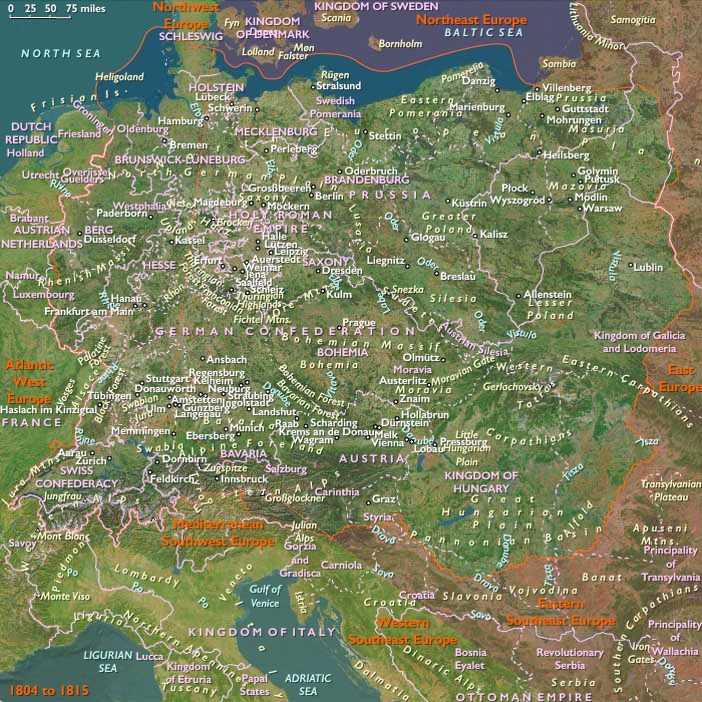
Central Europe
View →Subregions