
The Greek rulers of Epirus and Thessaly,…
1262 CE
The Greek rulers of Epirus and Thessaly, like the emperors in Trebizond, refuse to recognize Michael VIII as emperor.
Trebizond continues as a separate state after the Nicaean Greeks recover control of Constantinople.
The empire’s eponymous capital, which has formed the basis of several states, has throughout history been an important meeting point for international trade and cultural exchange due to its strategic location which controls the east-west (Asia-Europe) and north-south (Russia-Middle East) trading routes.
It becomes a major commercial center, and is today the capital of Turkey’s Trabzon Province.
People
Groups
Commodities
Subjects
Regions
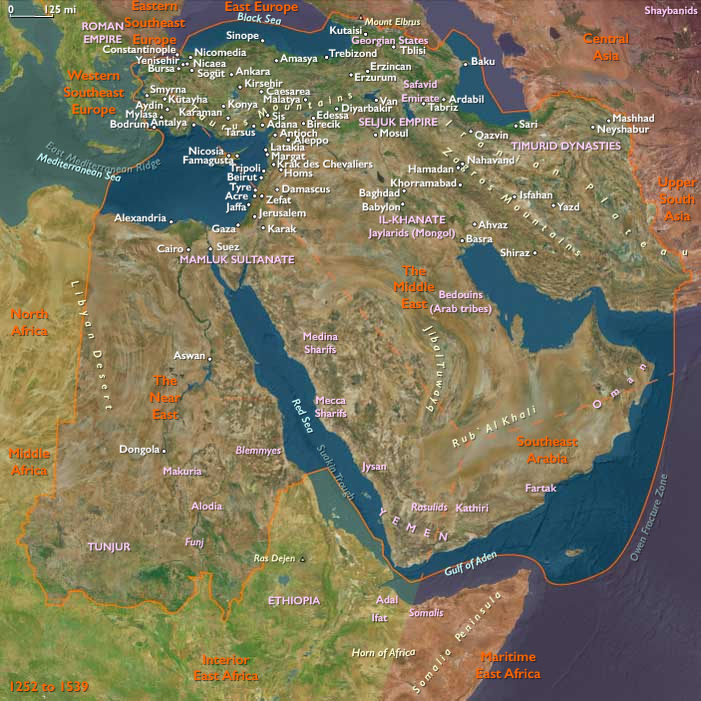
The Near and Middle East
View →Subregions
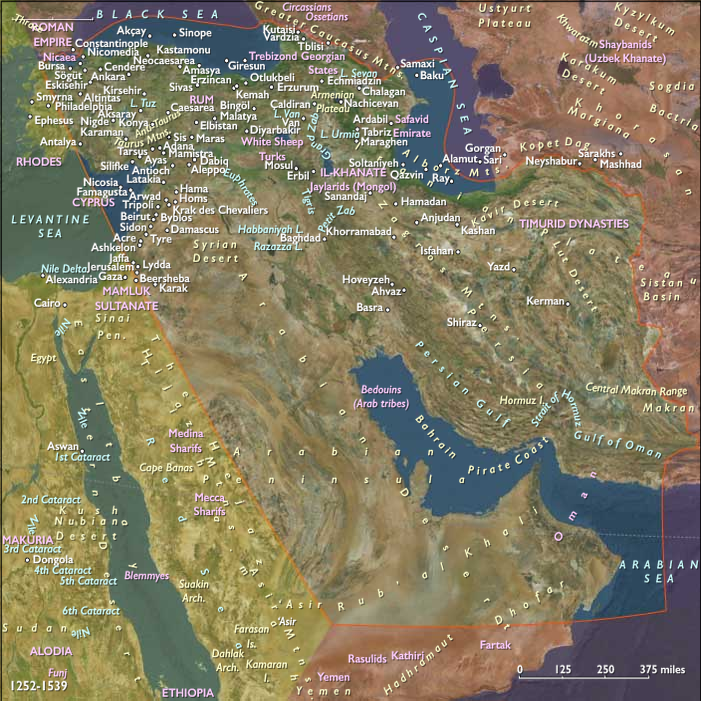
Middle East
View →Related Events
Showing 10 events out of 34 total
Northeastern Eurasia (1828–1971 CE)
From Tsarist Frontiers to Soviet Heartlands and Cold War Rimlands
Geography & Environmental Context
Northeastern Eurasia consists of three fixed subregions:
-
Northeast Asia — eastern Siberia (including Primorsky Krai), Sakhalin, the Chukchi Peninsula, Wrangel Island, Kuril Islands, and Hokkaidō (except its extreme southwest).
-
Northwest Asia — western and central Siberia from the Urals to roughly 130°E, including the West Siberian Plain, Altai, and the Central Siberian Plateau.
-
East Europe — the European portion of Russia, Belarus, and Ukraine, together with the Russian republics west of the Urals.
Anchors include the Arctic Ocean littoral (Kara, Laptev, and Okhotsk seas), the great river systems of the Ob–Irtysh, Yenisei, Lena, Amur–Ussuri, Dnieper, Don, and Volga, and the industrial–urban nodes of Leningrad (St. Petersburg), Moscow, Kyiv, Novosibirsk, Krasnoyarsk, Irkutsk, Vladivostok, and Sapporo. From tundra and taiga to loess plains and monsoon coasts, the region spans half the Northern Hemisphere’s climates and biomes.
Climate & Environmental Shifts
A sharply continental regime dominated interiors: long, frigid winters and short summers. The tail of the Little Ice Age persisted into the 19th century, then gave way to gradual warming, earlier river thaws, and glacier retreat in the Altai and Kamchatka by the mid-20th century. Periodic dzud winters devastated herds; drought pulses struck the Ukrainian steppe and Lower Volga (famines in the 1890s and early 1920s, and the Holodomor, 1932–33). In the Far East, typhoons and sea-ice shifts shaped fisheries; permafrost constrained construction across Siberia.
Subsistence & Settlement
-
Indigenous lifeways: Evenki, Nenets, Khanty, Chukchi, Koryak, Nivkh, Yupik, and Ainu sustained reindeer herding, sea-mammal hunting, fishing, trapping, and foraging—progressively curtailed by colonization, collectivization, and settlement policies.
-
Tsarist and Soviet expansion: Villages and penal settlements pushed east along the Trans-Siberian and river corridors; after 1917, collectivized agriculture and kolkhoz/sovkhoz systems reorganized the countryside of East Europe and southern Siberia.
-
Urbanization and industry: European Russia’s cities ( Moscow, Leningrad, Kyiv, Kharkiv, Donbas ) became heavy-industry cores; Siberia’s hubs ( Novosibirsk, Kemerovo, Krasnoyarsk, Irkutsk ) rose on coal, metals, and hydro, while Vladivostok, Khabarovsk, and Sapporo anchored the Pacific rim.
Technology & Material Culture
Railways (Trans-Siberian, 1891–1916; later Turk-Sib, branch lines) integrated steppe, taiga, and ports. Hydropower (e.g., Krasnoyarsk and Bratsk dams) and mining complexes transformed landscapes. In East Europe, steel, machine-building, and chemicals defined mass industrialization; in Northeast Asia, shipyards, ports, and fisheries expanded, while Hokkaidō underwent Meiji-to-postwar colonization and industrial growth. Everyday material culture shifted from log izbas and yurts to khrushchyovka apartments; radios, then TVs, entered homes by the 1960s.
Movement & Interaction Corridors
-
River highways: Seasonal shipping on the Ob, Yenisei, Lena, and Amur pre-dated and then fed rail hubs.
-
Trans-continental rails: Funneled grain, coal, ore, and people between European Russia and the Pacific; wartime evacuations (1941–42) relocated factories east.
-
Maritime arcs: The Okhotsk and Japan seas, Sakhalin–Hokkaidō–Kurils chain, and the Northern Sea Route(seasonal) tied fisheries, timber, and defense installations into Pacific networks.
-
Forced mobility: Tsarist exile and the Soviet Gulag (Kolyma, Norilsk, Vorkuta) drove coerced resettlement and resource extraction at massive human cost.
Cultural & Symbolic Expressions
Orthodox Christianity, Islam (in the Volga–Ural and North Caucasus margins of East Europe), Buddhism (Buryat and Mongol spheres), shamanic traditions, and—on Hokkaidō—suppressed Ainu culture framed identity against the rise of secular ideologies. Russian literature, music, and film radiated from Moscow and Leningrad; Soviet monumentalism and avant-gardes coexisted uneasily. Indigenous carving, song, and festival cycles persisted in Siberia and the Arctic, often underground, reviving visibly in the later 20th century.
Environmental Adaptation & Resilience
-
Permafrost engineering (pile foundations, winter roads) and taiga architecture enabled Siberian settlement.
-
Pastoral strategies: Herd diversification and seasonal migrations buffered dzud risk; state reindeer farms mixed traditional practice with planned quotas.
-
Agrarian adaptations: Shelterbelts, canals, and later the Virgin Lands campaigns extended cereal belts—often with soil erosion and dust storms by the 1960s.
-
Conservation beginnings: Zapovednik nature reserves (from 1916) protected representative biomes, even as industrial pollution rose in the Donbas, Upper Volga, and Kuzbass.
Political & Military Shocks
-
Tsarist consolidation and reform: The Emancipation of the Serfs (1861); Siberian penal colonization; the founding of Vladivostok (1860); Sakhalin as penal colony.
-
Revolution and Civil War (1917–22): Collapse of empire; shifting fronts across East Europe; creation of the USSR (1922).
-
Collectivization and terror: The Holodomor (1932–33) in Ukraine; purges; mass deportations to the Gulag and internal exiles in Siberia and the Far North.
-
Russo-Japanese War (1904–05) and Sakhalin/Kurils disputes; Hokkaidō settler colonialism and Ainu dispossession.
-
World War II: The Eastern Front ( Moscow, Stalingrad, Kursk, Leningrad ); devastation and liberation; Soviet seizure of southern Sakhalin and the Kurils (1945).
-
Cold War: East Europe as Soviet core; Northeast Asia militarized on both sides—the Pacific Fleet at Vladivostok; closed cities; the DEW Line/radar arcs in the Arctic; border incidents along the Amur by the late 1960s.
Transition
Between 1828 and 1971, Northeastern Eurasia was remade from a mosaic of imperial frontiers and Indigenous homelands into the industrial heartlands and strategic rimlands of two modern states: the USSR and Japan. Railways, mines, and dams bound taiga and tundra to Moscow; Hokkaidō’s Meiji-to-postwar transformation integrated it into Japan’s national economy. The costs were immense—famines, repression, deportations, cultural suppression—yet the region also generated vast material output and scientific achievement. By 1971, Northeastern Eurasia stood as a Cold War fulcrum: East Europe anchoring Soviet power, Northwest Asia supplying raw materials and hydro-electricity, and Northeast Asia bristling with fleets, airbases, and fisheries—its peoples negotiating survival and renewal between permafrost, ports, and power blocs.
East Europe (1828–1971 CE): Tsarist Expansion, Socialist Transformation, and Cold War Frontiers
Geography & Environmental Context
East Europe includes Belarus, Ukraine, the European portion of Russia, and the sixteen Russian republics west of the Urals. Anchors span the Baltic–Black Sea watershed, the Dnieper, Don, and Volga basins, the Carpathian fringe in western Ukraine, and the vast Russian Plain stretching toward the Urals. Major cities include Moscow, Leningrad (St. Petersburg), Kyiv, Minsk, Smolensk, Kharkiv, Odessa, and Novgorod.
Climate & Environmental Shifts
A continental climate produced harsh winters and hot summers. Crop failures punctuated the 19th century (famines in 1840s, 1891–92). Deforestation and soil exhaustion pressed peasants; steppe droughts recurred, notably in the 1920s and 1940s. The Virgin Lands campaign (1950s) extended cultivation into steppe margins, often unsustainably. River control projects (Dnieper Hydroelectric Station, Volga–Don Canal) and massive reforestation campaigns altered landscapes, while industrial pollution intensified after WWII.
Subsistence & Settlement
-
Agriculture: Wheat, rye, barley, oats, and later maize and sugar beet dominated. The black earth (chernozem) zone in Ukraine and southern Russia remained the empire’s and USSR’s breadbasket. Dairy, potatoes, and flax sustained Belarus and northern Russia.
-
Rural settlement: Villages of wooden cottages (izbas) under communal landholding (mir or obshchina) persisted until reforms. After collectivization (1930s), collective and state farms reorganized the countryside.
-
Urbanization: By the late 19th century, cities like Moscow, Kyiv, and Odessa swelled with factories. Soviet industrialization (1930s onward) created new cities in the Urals’ western fringe and magnified Donbas, Kharkiv, and Moscow. By the 1960s, Minsk, Kyiv, and Moscow were industrial and cultural hubs.
Technology & Material Culture
-
19th century: Railways (Moscow–St. Petersburg, Odessa–Kyiv) integrated markets. Peasants used iron plows, scythes, and horse-drawn wagons.
-
Industrialization: Steelworks in Donbas, textile mills in Moscow, machine building in Kharkiv, and shipyards in Odessa expanded. Hydroelectric stations on the Dnieper and Volga symbolized Soviet modernization.
-
Everyday life: Peasant households centered on icon corners, ovens, and handmade tools until collectivization introduced standardized housing. Soviet urban apartments, radios, and later televisions spread by mid-20th century.
Movement & Interaction Corridors
-
River highways: Dnieper and Volga carried grain, timber, and coal.
-
Railways: By the late 19th century, St. Petersburg–Warsaw, Kyiv–Moscow, and Odessa–Donbas lines integrated the empire.
-
Ports: Odessa and Sevastopol tied Ukraine to Black Sea trade. Murmansk and Leningrad were naval and commercial gates.
-
Migration: Serfs freed in 1861 moved to new lands; Soviet deportations and wartime evacuations displaced millions. After WWII, labor mobilization filled Siberian and Ural industries with migrants from Ukraine and Belarus.
Cultural & Symbolic Expressions
-
Religion: Orthodoxy remained central under tsars; Catholic enclaves persisted in Belarus and Ukraine; Judaism flourished in the Pale of Settlement until pogroms and emigration. Soviet atheism after 1917 repressed churches, though folk religiosity endured underground.
-
Literature & arts: 19th-century classics (Gogol, Tolstoy, Dostoevsky, Shevchenko) defined world literature. Soviet culture emphasized socialist realism (Gorky, Sholokhov, Ehrenburg). Ukrainian and Belarusian revivals flourished briefly in the 1920s before Stalinist repression.
-
Music & folklore: Russian ballets, Ukrainian folk songs, Belarusian epics, and Soviet mass songs coexisted. After 1945, film and radio disseminated propaganda alongside cultural achievements.
Environmental Adaptation & Resilience
-
Peasant strategies: Crop rotation, communal redistribution, and grain storage buffered famine but often failed under poor harvests.
-
Soviet collectivization: Mechanization, state seed reserves, and irrigation projects aimed at stability but caused dislocation and famine (notably Holodomor, 1932–33).
-
Postwar: Massive rebuilding campaigns restored cities and farms after Nazi devastation; dams and canals mitigated drought but caused salinization and ecological strain.
Political & Military Shocks
-
Tsarist reforms: Emancipation of serfs (1861); industrialization drives under Alexander III and Nicholas II.
-
Revolutions: 1905 unrest; 1917 February and October revolutions toppled tsarism and established Bolshevik rule.
-
Civil War (1918–21): Ukraine, Belarus, and western Russia ravaged by conflict and shifting borders.
-
Stalinist era: Collectivization, purges, forced deportations, famines, and rapid industrialization.
-
World War II: Nazi invasion (1941) devastated Belarus, Ukraine, and western Russia. Battles of Kyiv, Stalingrad, Kursk, and the siege of Leningrad defined the Eastern Front. Soviet victory in 1945 left East Europe under Moscow’s control.
-
Cold War: The subregion formed the USSR’s European core, with Moscow and Leningrad as global Cold War capitals. Eastern Europe beyond was drawn into Warsaw Pact (1955), cementing the frontier with NATO.
Transition
Between 1828 and 1971, East Europe was transformed from a Tsarist agrarian empire into the industrial, military, and political heartland of the Soviet Union. Grain surpluses, railways, and industrial cities arose in the 19th century; revolutions and civil war destroyed imperial order; collectivization, purges, and world war remade society. By the 1960s, Moscow, Kyiv, and Minsk were modern socialist cities, commanding an empire stretching from Berlin to the Urals. Yet the costs were immense—famine, repression, war, and environmental degradation—leaving a legacy of resilience shaped by both survival and control.
Southeast Europe (1828–1971 CE)
Empires in Retreat, Nations in Rebirth, and Frontiers Between Worlds
Geography & Environmental Context
Southeast Europe includes two fixed subregions:
-
Eastern Southeast Europe — Romania, Moldova, Bulgaria (except the southwestern portion), northeastern Serbia, northeastern Croatia, extreme northeastern Bosnia and Herzegovina, modern-day Moldova, and the European side of Turkey, including Istanbul.
-
Western Southeast Europe — Greece, Albania, Montenegro, North Macedonia, Kosovo, most of Bosnia and Herzegovina, most of Croatia, southwestern Serbia, and the Adriatic and Aegean coasts facing the Mediterranean.
Anchors include the Balkan Mountains, Carpathians, Danube River, Aegean, Adriatic, and Black Sea coasts, as well as key cities such as Istanbul, Bucharest, Sofia, Athens, Belgrade, Sarajevo, and Thessaloniki. The subregion links central Europe to the eastern Mediterranean and Anatolia — a crossroads of empires, faiths, and ideologies.
Climate & Environmental Shifts
The region’s temperate continental and Mediterranean climates supported mixed agriculture and mountain pastoralism. Deforestation and erosion increased through the 19th century as railways and timber exports expanded. Flooding along the Danube and its tributaries required early engineering works. Twentieth-century industrialization and urbanization accelerated pollution but also brought reforestation and hydroelectric projects. Coastal areas remained vulnerable to earthquakes and drought, while inland winters could be severe.
Subsistence & Settlement
-
Agrarian life dominated until mid-20th century, with cereals, vines, olives, and livestock central to rural economies. Peasant communities balanced subsistence with market sales under Ottoman, Habsburg, and later national administrations.
-
Urban centers such as Athens, Belgrade, Sofia, Bucharest, and Istanbul expanded as administrative and industrial capitals. Port cities—Salonika (Thessaloniki), Constanța, Dubrovnik, and Trieste—thrived on Mediterranean and Black Sea trade.
-
After World War II, socialist land reforms and collectivization reshaped rural life; industrial towns multiplied along river corridors and mining basins (e.g., Nis, Ploiești, Varna).
-
Tourism and migration to Western Europe after 1950 introduced remittances and urban growth on the coasts.
Technology & Material Culture
Railways, bridges, and telegraphs of the 19th century tied the Balkans to European networks. Textile mills, shipyards, and munitions factories developed under both Ottoman and Habsburg influence. Twentieth-century modernization brought hydropower dams, concrete housing blocks, and expanding road systems. Material culture reflected blending: Ottoman bazaars stood beside neoclassical and socialist architecture; folk crafts, Orthodox icons, and Islamic calligraphy persisted as living art forms.
Movement & Interaction Corridors
-
Trade and migration followed the Danube, Adriatic, and Aegean routes linking inland markets to seaports.
-
Pilgrimage and faith networks connected Orthodox monasteries on Mount Athos with Slavic and Greek communities; Muslim routes linked Sarajevo and Istanbul.
-
Labor migrations carried Balkan workers to Vienna, Paris, and later Germany and Switzerland.
-
Military corridors—from the Crimean and Balkan Wars to both World Wars—crossed the peninsula repeatedly, leaving deep scars on settlements and memory.
Cultural & Symbolic Expressions
National revivals defined the century: Romantic historians, philologists, and poets reasserted Slavic, Greek, Albanian, and Romanian identities. Orthodox Christianity, Catholicism, and Islam coexisted, often in tension but also in hybrid traditions. Literature and art—Vuk Karadžić’s language reforms, Ion Luca Caragiale’s satires, Nikola Tesla’sinnovations, Nikos Kazantzakis’s epics—bridged folk and modernist sensibilities. Music and dance, from Byzantine chant to sevdah and rebetiko, expressed cultural resilience. After 1945, socialist realism and modernism merged in film, muralism, and architecture.
Environmental Adaptation & Resilience
Mountain terraces and transhumance persisted into the 20th century. Drainage projects reclaimed wetlands along the Danube and Thessaly Plain. Postwar collectivization altered traditional landholding but expanded irrigation. Coastal regions diversified into fishing and tourism; interior highlands relied on remittances and forest products. Hydroelectric and reforestation projects mitigated erosion, though industrial pollution rose near new mining and chemical centers.
Political & Military Shocks
-
Ottoman decline and independence: Greece (independence 1830), Serbia and Romania (recognized 1878), Bulgaria (autonomous 1878, independent 1908), and Albania (1912) emerged from imperial rule.
-
Balkan Wars (1912–13) redrew frontiers; Ottoman Europe contracted to Istanbul and Eastern Thrace.
-
World War I: Sparked by the assassination in Sarajevo (1914), it devastated the region and dissolved empires.
-
Interwar instability: Ethnic minorities, border disputes, and authoritarian monarchies dominated.
-
World War II: Axis occupation and resistance movements (notably Tito’s Partisans in Yugoslavia, the Greek Resistance) reshaped politics.
-
Postwar socialism and division: Yugoslavia under Josip Broz Tito pursued independent socialism; Bulgaria, Romania, and Albania aligned with the Soviet bloc; Greece experienced civil war (1946–49) and joined NATO (1952).
-
Cold War era: The Iron Curtain cut through the Balkans; Yugoslavia balanced East and West, hosting the Non-Aligned Movement (1961); Bulgaria and Romania industrialized under Soviet models; Greece rebuilt under Western alliances and endured military dictatorship (1967–74, partially beyond our range).
Transition
Between 1828 and 1971, Southeast Europe moved from imperial frontier to a complex patchwork of nation-states, socialist republics, and contested borderlands. Independence movements, world wars, and ideological divides repeatedly redrew its map. Ottoman bazaars and Byzantine monasteries gave way to factories, collective farms, and concrete housing blocks. Yet, amid wars and revolutions, cultural synthesis persisted: Orthodox chants, sevdah songs, and folk embroidery survived in socialist festivals and tourist markets alike. By 1971, the peninsula was once again at Europe’s fault line—its peoples navigating between memory and modernity, nationalism and integration, the Mediterranean and the East.
Eastern Southeast Europe (1828–1971 CE): From Ottoman Provinces to Socialist Republics and Cold War Faultlines
Geography & Environmental Context
Eastern Southeast Europe includes Turkey-in-Europe (Istanbul/Constantinople and Thrace), Thrace-in-Greece, all of Bulgaria (except the southwest), northeastern Serbia, northeastern Croatia, extreme northeastern Bosnia and Herzegovina, and all of modern Moldova and Romania. Anchors include the Danube River corridor (Iron Gates, the Wallachian plain, the Delta), the Balkan Mountains (Stara Planina), the Rhodope foothills, the Dobrudja steppe, and the Black Sea ports (Constanța, Varna, Burgas). The region also encompasses major cities such as Istanbul, Bucharest, Sofia, Belgrade, Zagreb, Chișinău, and Iași.
Climate & Environmental Shifts
The region sits between continental and Mediterranean zones. Harsh winters in the Danube plain alternated with drought-prone summers, especially in Dobrudja and eastern Bulgaria. The Danube’s flooding cycles challenged settlements until large-scale river control projects in the 19th and 20th centuries. The 20th century brought irrigation, drainage of marshlands, and damming (e.g., the Iron Gates hydroelectric project, 1964–71). Agricultural collectivization after 1945 transformed landscapes, replacing small peasant plots with mechanized state farms.
Subsistence & Settlement
-
19th century:
-
The Danubian plains of Wallachia, Moldavia, and Bulgaria produced wheat, maize, and livestock for export through Black Sea ports.
-
Vineyards, orchards, and tobacco fields dotted Thrace and the Bulgarian lowlands.
-
Istanbul remained an imperial metropolis, provisioning itself from the Thracian hinterlands.
-
-
20th century:
-
Under socialism, collectivized farms in Romania and Bulgaria mechanized cereal, maize, and sunflower cultivation.
-
Industrialization accelerated in cities like Bucharest, Sofia, and Varna.
-
Black Sea fisheries and ports (Constanța, Varna, Burgas) expanded as hubs of trade, energy, and tourism.
-
Technology & Material Culture
-
Transport: 19th-century railways tied Bucharest, Sofia, and Constanța to Vienna and Istanbul. After WWII, highways, electrification, and hydro dams modernized the region.
-
Industry: From the late 19th century, oil in Romania (Ploiești), textiles in Bulgaria, and shipyards on the Black Sea were developed. By the 1960s, heavy industry (steel, chemicals, machinery) dominated socialist economies.
-
Everyday life: Villages retained traditional Orthodox churches, Ottoman-style houses, and folk crafts until mid-20th-century collectivization introduced apartment blocks and standardized housing. Radios and televisions spread after 1950.
Movement & Interaction Corridors
-
Danube River: The artery linking Vienna, Belgrade, and the Black Sea, carrying grain, timber, and later oil.
-
Caravan & rail: Ottoman caravan trails gave way to 19th-century railways (e.g., Bucharest–Giurgiu line, 1869).
-
Black Sea: Ports exported grain, oil, and industrial products to Mediterranean and global markets.
-
Labor and migration: Peasants moved to towns during industrialization; after WWII, rural depopulation accelerated as cities absorbed labor for factories.
Cultural & Symbolic Expressions
-
Religion: Orthodoxy dominated in Romania and Bulgaria; Islam retained influence in Thrace; Catholic enclaves persisted in Croatia and Bosnia. Churches and mosques coexisted uneasily, often politicized in nationalist discourse.
-
Nationalism:
-
Romanian and Bulgarian revivals in the 19th century emphasized language, folklore, and Orthodox faith.
-
Revolutionaries in 1848, independence fighters in the Russo-Turkish War (1877–78), and Balkan wars (1912–13) created heroic pantheons.
-
-
Modern culture: Interwar Bucharest earned the nickname “Paris of the East.” Socialist regimes after 1945 promoted workers’ culture, folk dance troupes, and monumental architecture while censoring dissent.
Environmental Adaptation & Resilience
-
Agrarian cycles: Crop rotation, terracing, and pastoralism provided resilience until collectivization.
-
River control: Drainage of the Danube marshes in Romania and Bulgaria reclaimed farmland and reduced malaria.
-
Social welfare: After WWII, socialist states subsidized food, housing, and education, cushioning shocks but reducing household autonomy.
Political & Military Shocks
-
1828–1878: Russo-Turkish Wars and nationalist uprisings freed Romania, Bulgaria, and Serbia from Ottoman rule.
-
1878 Berlin Congress: Established Romania, Serbia, and Bulgaria as independent or autonomous; left Thrace and Macedonia under Ottoman control.
-
Balkan Wars (1912–13): Bulgaria and Romania fought over Macedonia and Dobruja; territorial shifts embittered neighbors.
-
World War I: Romania and Bulgaria fought on opposing sides; Dobruja and Transylvania contested.
-
Interwar: Authoritarian monarchies and peasant movements shaped politics.
-
World War II: Romania allied with Axis, Bulgaria with Axis but resisted deporting Jews, while Yugoslav and Greek partisans fought German occupation.
-
1944–48 Soviet expansion: Romania and Bulgaria absorbed into the Soviet bloc, establishing one-party socialist states; purges, collectivization, and repression followed.
-
Cold War: Eastern Southeast Europe became a Warsaw Pact frontier with NATO’s Turkey and Greece; heavy militarization and ideological control lasted through 1971.
Transition
Between 1828 and 1971, Eastern Southeast Europe transformed from Ottoman provinces into independent kingdoms, then into Soviet-aligned socialist republics. The Danube and Black Sea tied the region into global grain and oil markets in the 19th century, while nationalism redrew maps through wars and uprisings. After 1945, industrialization, collectivization, and Soviet patronage reshaped economies and societies. By 1971, Romania and Bulgaria were deeply embedded in the socialist bloc, while Thrace and Istanbul marked the border between NATO and the Warsaw Pact—this subregion now firmly a faultline of the Cold War world.
East Europe (1948–1959 CE): Cold War Intensification and Stalinist Consolidation
Political and Military Developments
Formation and Consolidation of the Eastern Bloc
During this era, the Soviet Union firmly consolidated control over Eastern Europe, formalizing communist regimes across countries such as Poland, East Germany (German Democratic Republic), Czechoslovakia, Hungary, Romania, and Bulgaria. These nations collectively formed the Eastern Bloc, solidifying the geopolitical division between East and West.
NATO and Warsaw Pact Formation
In response to the Western alliance (NATO, 1949), the Soviet Union and its Eastern European allies formed the Warsaw Pact in 1955, significantly shaping Cold War geopolitics. The Pact institutionalized military cooperation and strategic alignment within the Eastern Bloc.
Soviet Military Expansion and Nuclear Arms Race
Military capabilities significantly expanded, with extensive modernization of conventional forces and intensified development of nuclear weapons. This period marked the onset of the nuclear arms race with Western powers, heightening global Cold War tensions.
Economic and Technological Developments
Centralized Economic Planning and Industrial Growth
Economic policies were dominated by centralized planning, emphasizing heavy industry, infrastructure development, and resource extraction. Industrial production expanded rapidly, supporting both domestic reconstruction and military requirements.
Technological Advancements
Technological advancements accelerated, particularly in nuclear technology, aerospace, and military-industrial sectors. The launch of Sputnik 1 in 1957 marked a significant Soviet achievement, igniting the global Space Race.
Cultural and Artistic Developments
Continued Cultural Control and Socialist Realism
The Soviet regime maintained tight cultural control, promoting Socialist Realism as the exclusive artistic standard. Artistic and literary works were strictly regulated to align with ideological objectives, emphasizing socialist achievements and collective goals.
Educational Expansion and Scientific Development
Educational institutions expanded significantly, emphasizing scientific and technical fields to meet industrial and military needs. The period saw notable advancements in science education and research, solidifying Soviet technological capabilities.
Settlement Patterns and Urban Development
Accelerated Urbanization and Housing Development
Eastern European cities rapidly expanded to accommodate growing populations and industrial activity. Urban planning emphasized mass housing projects, improved infrastructure, and efficient transportation networks to support industrial productivity.
Fortified Borders and Military Infrastructure
Strategic infrastructure, including fortified borders and extensive military installations, was significantly developed, reflecting ongoing geopolitical tensions and preparedness for potential Cold War conflicts.
Social and Religious Developments
Intensified Social Control and Repression
Social policies during this period were characterized by intensified state control, surveillance, and political repression. Dissent was systematically suppressed, maintaining a rigidly controlled social order aligned with Stalinist policies.
Continued Anti-Religious Measures
Anti-religious policies remained vigorous, with religious practices severely restricted, clergy persecuted, and religious institutions dismantled or heavily controlled. The state continued promoting atheism as the ideological standard.
Long-Term Consequences and Historical Significance
The period from 1948 to 1959 CE was pivotal for Eastern Europe, marked by intense Cold War divisions, extensive Soviet consolidation, and accelerated technological and economic development. The establishment of the Warsaw Pact and significant military and technological achievements solidified Eastern Europe's strategic importance, shaping global political dynamics profoundly in subsequent decades.
The Soviet Union, having become the world's second nuclear power, establishes the Warsaw Pact alliance, and enters into a struggle for global dominance, known as the Cold War, with the rivaling United States and NATO.
After Stalin's death in 1953 and a short period of collective rule, the new leader Nikita Khrushchev denounces Stalin and launches the policy of de-Stalinization, releasing many political prisoners from the Gulag labor camps.
The general easement of repressive policies will become known later as the Khrushchev Thaw.
In 1957, the Soviet Union launches the world's first artificial satellite, Sputnik 1, thus starting the Space Age.
Eastern Southeast Europe (1948–1959 CE): Cold War Alignments and Communist Consolidation
Political Consolidation and Divergence
Yugoslavia: Break from Moscow and Non-alignment
In 1948, Yugoslavia dramatically broke from Soviet influence following ideological and political disagreements between Josip Broz Tito and Joseph Stalin. Tito asserted Yugoslav independence by rejecting Soviet domination and expelled pro-Stalin elements from the Yugoslav Communist Party. Yugoslavia subsequently pursued a path of Non-Aligned Movement (NAM) leadership, advocating neutrality between the Eastern and Western blocs, and establishing a distinct model of socialist governance characterized by worker self-management and relative openness to Western influence.
Romania: Full Integration into the Soviet Bloc
In contrast, Romania deepened its alignment with Moscow under Gheorghe Gheorghiu-Dej. The Romanian Communist Party (PCR) purged internal dissent and fully embraced Stalinist policies, implementing rapid industrialization, collectivization of agriculture, and suppression of political opposition. Gheorghiu-Dej strengthened the Securitate, Romania’s secret police, using severe repression to maintain the Communist Party’s dominance.
Bulgaria: Stalinist Rule under Chervenkov
Under Valko Chervenkov, Bulgaria intensified its alignment with Soviet policies, adopting extreme Stalinist measures. Chervenkov initiated ruthless political purges, heightened collectivization, and promoted heavy industrialization at significant human cost. This era saw severe restrictions on individual liberties, with extensive state surveillance and political repression.
Economic Centralization and Collectivization
Yugoslavia: Economic Experimentation
Yugoslavia introduced an innovative economic system of worker self-management, decentralizing control over industries. Factories and enterprises came under the governance of worker councils, shifting away from centralized Soviet-style planning toward greater economic autonomy at the local level. Despite initial challenges, this unique approach fostered moderate economic growth and improved living standards relative to other communist states.
Romania: Forced Industrialization and Collectivization
Romania aggressively pursued industrialization based on the Soviet model, prioritizing heavy industries and large-scale infrastructure projects, often at the expense of consumer goods. Simultaneously, forced collectivization of agriculture in the early 1950s led to widespread rural hardship and resistance, severely impacting agricultural productivity and peasant livelihoods.
Bulgaria: Agricultural Collectivization and Economic Strain
Bulgaria also pursued aggressive collectivization, forcibly merging private farms into state-controlled collective units. Resistance was harshly punished, contributing to rural unrest and migration toward cities. Although industrial output increased modestly, Bulgaria’s economy remained inefficient and heavily reliant on Soviet subsidies and trade.
Social and Cultural Policies
Yugoslavia: Relative Openness and Cultural Flourishing
Despite political repression, Yugoslavia enjoyed greater cultural and intellectual freedom compared to its communist neighbors. Tito’s regime allowed limited openness to Western cultural influences, leading to a dynamic, though controlled, cultural environment with flourishing cinema, literature, and intellectual debate.
Romania and Bulgaria: Rigid Cultural Control
Both Romania and Bulgaria enforced stringent cultural policies reflecting Stalinist ideological purity. Socialist realism dominated all aspects of cultural production, and any deviation from official ideology risked severe punishment. Censorship was pervasive, severely limiting artistic freedom and stifling intellectual development.
Cold War Geopolitics
Yugoslavia’s Non-Aligned Diplomacy
Yugoslavia’s break from Moscow significantly reshaped Cold War dynamics. Tito skillfully navigated between East and West, hosting the first Non-Aligned Movement Summit in 1961 (prepared in the late 1950s), positioning Yugoslavia as a significant diplomatic actor independent from the Soviet Union.
Romania and Bulgaria: Soviet Bloc Integration
Romania and Bulgaria became deeply entrenched within the Soviet bloc, economically integrated through organizations like COMECON (Council for Mutual Economic Assistance) and militarily aligned within the Warsaw Pact established in 1955. Their foreign policies strictly adhered to Soviet directives, maintaining rigid ideological and political solidarity with Moscow.
Key Historical Developments (1948–1959)
-
Yugoslavia’s break from Soviet domination in 1948, fostering the non-aligned movement.
-
Intense Stalinist policies in Romania and Bulgaria, with severe repression and forced collectivization.
-
Yugoslav implementation of worker self-management, creating an alternative socialist economic model.
-
Formation of the Warsaw Pact and integration of Romania and Bulgaria into the Soviet military alliance.
-
Cultural repression under socialist realism in Romania and Bulgaria, contrasted by relative openness in Yugoslavia.
Long-Term Consequences and Historical Significance
The period from 1948 to 1959 solidified divergent paths within Eastern Southeast Europe. Yugoslavia's independence and economic experimentation offered an alternative model to Soviet-style socialism. Meanwhile, Romania and Bulgaria became quintessential examples of Soviet satellite states, characterized by strict political and economic control, ideological conformity, and significant human rights abuses. These divergent experiences set the stage for long-term regional distinctions within the broader context of the Cold War.
Romania’s forced collectivization campaign has produced only about 17 percent state ownership of Romania's land.
The authorities shift to a policy of slow collectivization and cooperativization, allowing peasants to retain their land but requiring delivery to the state of a portion of their output.
Large compulsory-delivery quotas have driven many peasants from the land to higher-paying jobs in industry.
The Soviet Union continues to formalize its domination of Romanian affairs through various devices: the Warsaw Treaty Organization (or Warsaw Pact), formed in 1955 to counteract the Western allies' North Atlantic Treaty Organization; and Soviet “advisers” throughout the Romanian party and government.
Integration into the Soviet sphere is evident in Romania's unstinting support of Soviet foreign policy.
Gheorghiu-Dej, who has gradually adopted economic and foreign policies that serve Romania's national interests rather than those of international socialism as defined by the Soviet leaders, again takes up the reins of government.
Despite its new policy of international cooperation, Romania joins the Warsaw Treaty Organization (Warsaw Pact) in 1955, which entails subordinating and integrating a portion of its military into the Soviet military machine.
(Romania will later refuse to allow Warsaw Pact maneuvers on its soil and limit its participation in military maneuvers elsewhere within the alliance.)
Bulgaria joins the Warsaw Pact on May 14, 1955.
In spite of the 1954 party shifts, Chervenkov remains the unchallenged leader of Bulgaria.
The Chervenkov period has featured harsh repression of all deviation from the party line, arbitrary suppression of culture and the arts along the lines of Soviet-prescribed socialist realism, and an isolationist foreign policy.
The economic shift away from heavy industry toward consumer goods continues in the mid-1950s, and direct Soviet intervention in Bulgarian economic and political life diminishes.
By 1955, some 10,000 political prisoners have been released.
In an attempt to win political support from the peasants, Chervenkov eases the pace of collectivization and increases national investment in agriculture.
However, events in the Soviet Union will soon end this brief period of calm.
The Belgrade Declaration restores Soviet-Yugoslav friendship and reinstates Tito to the fraternity of world communist leaders, but because Chervenkov had branded Tito and the Yugoslavs as arch-villains during his rise to power, this agreement erodes his position.
Albania’s private farms still produce about eighhty-seven percent of the country’s agricultural output.
The government begins a program of rapid industrialization after the APL's Second Party Congress and a campaign of forced collectivization of farmland in 1955.
In this year, Albania becomes a founding member of the Warsaw Treaty Organization (better known as the Warsaw Pact, the only military alliance the nation has ever joined.
Although the pact represents the first promise Albania has obtained from any of the communist countries to defend its borders, the treaty does nothing to assuage the Albanian leaders' deep mistrust of Yugoslavia.