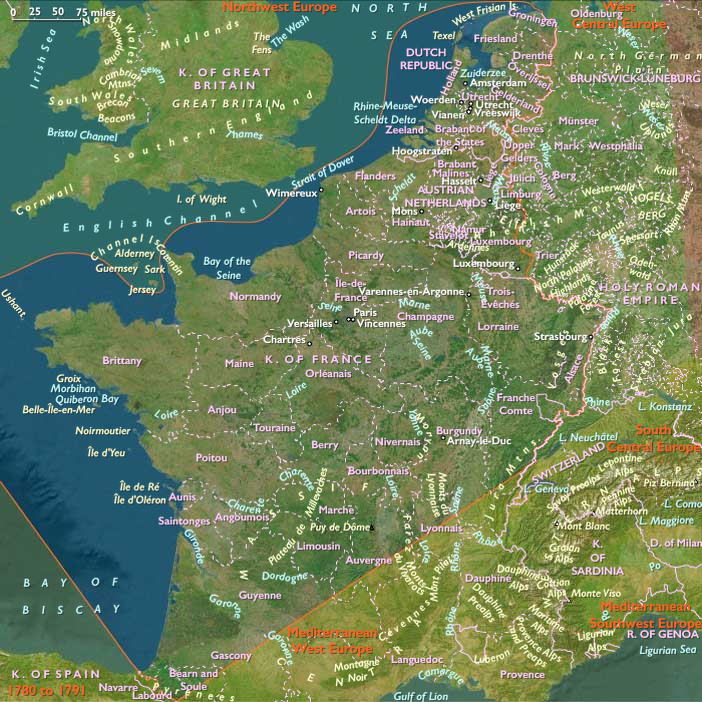
Each state in pre-revolutionary Europe has its…
April 1791 CE
Some countries, such as Spain and Russia, see the advantages of harmonizing their units of measure with those of their trading partners.
However, vested interests who profit from variations in units of measure oppose this.
This is particularly prevalent in France, where the huge inconsistency in the size of units of measure was one of the causes that, in 1789, led to the outbreak of the French Revolution.
During the early years of the revolution, savants including the Marquis de Condorcet, Pierre-Simon Laplace, Adrien-Marie Legendre, Antoine Lavoisier and Jean-Charles de Borda set up a Commission of Weights and Measures.
The commission is of the opinion that the country should adopt a completely new system of measure based on the principles of logic and natural phenomena.
Logic dictates that such a system should be based on the radix used for counting.
Their report of March 1791 to the Assemblée nationale constituante considers but rejects the view of Laplace that a duodecimal system of counting should replace the existing decimal system; the view that such a system is bound to fail prevails.
The commission's final recommendation is that the assembly should promote a decimal-based system of measurement.
The leaders of the assembly accept the views of the commission.
Initially France attempts to work with other countries towards the adoption of a common set of units of measure.
Among the supporters of such an international system of units is Thomas Jefferson who, in 1790, had presented to Congress a document titles Plan for Establishing Uniformity in the Coinage, Weights, and Measures of the United States, in which he advocated a decimal system that used traditional names for units (such as ten inches per foot).
The report had been considered but not adopted by Congress.
Locations
People
Groups
Topics
Regions
West Europe
View →Subregions