
New Granada's dominant criollos pride themselves on …
Years: 1684 - 1827
New Granada's dominant criollos pride themselves on their Spanish descent, but bloodlines in practice are often less pure than they might appear.
In order to gain access to higher education, for example, it is technically necessary to prove one's limpieza de sangre, or "cleanness of blood," which means not just European pedigree but freedom from any trace of Jews, Muslims, or heretics in the family tree.
However, both formal marriage and informal unions with the native population produce an ever-larger mestizo, or mixed European and native, population; by the end of the colonial period, this is the largest single demographic group.
For most purposes, the population of mestizos is not clearly differentiated from that of criollos.
Nevertheless, for a mestizo to enter the higher social strata and possibly marry the descendant of some conquistador, it does help to have a light complexion and some respectable economic assets, because upward mobility in colonial society is not easy to achieve.
It is even harder for someone of African or part-African descent to rise in society.
The first enslaved Africans to reach New Granada had arrived with the conquistadors themselves because African slavery existed on a small scale in Spain.
Greater numbers had come later directly from Africa, to work in the placer gold deposits of the western Andes and Pacific slopes, landed estates of the Caribbean coastal plain, and assorted urban occupations.
Few are to be found in the Andean highlands, and roughly the same relative distribution of Afro-Colombian people as in the eighteenth century continues to this day.
Although at first all were slaves, the processes of voluntary manumission, self-purchase (with money slaves could earn by working on their own account), and successful escape into the backcountry has produced a growing population of free blacks.
Free and slave alike mix with other ethnic groups, and some of the free—mainly pardos ("browns") of part-European ancestry—become small landowners, independent artisans, or lower-ranking professionals, but unlike mestizos, anyone with a discernible trace of African ancestry faces not just social prejudice but also legal prohibitions very roughly comparable to the Jim Crow laws that mandate segregation in the United States between 1876 and 1965.
These laws are not always enforced, but they place a limit on the advancement even of free pardos.
In order to gain access to higher education, for example, it is technically necessary to prove one's limpieza de sangre, or "cleanness of blood," which means not just European pedigree but freedom from any trace of Jews, Muslims, or heretics in the family tree.
However, both formal marriage and informal unions with the native population produce an ever-larger mestizo, or mixed European and native, population; by the end of the colonial period, this is the largest single demographic group.
For most purposes, the population of mestizos is not clearly differentiated from that of criollos.
Nevertheless, for a mestizo to enter the higher social strata and possibly marry the descendant of some conquistador, it does help to have a light complexion and some respectable economic assets, because upward mobility in colonial society is not easy to achieve.
It is even harder for someone of African or part-African descent to rise in society.
The first enslaved Africans to reach New Granada had arrived with the conquistadors themselves because African slavery existed on a small scale in Spain.
Greater numbers had come later directly from Africa, to work in the placer gold deposits of the western Andes and Pacific slopes, landed estates of the Caribbean coastal plain, and assorted urban occupations.
Few are to be found in the Andean highlands, and roughly the same relative distribution of Afro-Colombian people as in the eighteenth century continues to this day.
Although at first all were slaves, the processes of voluntary manumission, self-purchase (with money slaves could earn by working on their own account), and successful escape into the backcountry has produced a growing population of free blacks.
Free and slave alike mix with other ethnic groups, and some of the free—mainly pardos ("browns") of part-European ancestry—become small landowners, independent artisans, or lower-ranking professionals, but unlike mestizos, anyone with a discernible trace of African ancestry faces not just social prejudice but also legal prohibitions very roughly comparable to the Jim Crow laws that mandate segregation in the United States between 1876 and 1965.
These laws are not always enforced, but they place a limit on the advancement even of free pardos.
Locations
Groups
- Tairona
- Arawak peoples (Amerind tribe)
- Kalinago (Amerind tribe)
- Muisca (Amerind tribe)
- Spaniards (Latins)
- Spain, Habsburg Kingdom of
- Granada, New Kingdom of (Spanish colony)
- Peru, Viceroyalty of
- Spain, Habsburg Kingdom of
- Quito, Real Audiencia of
- Bogotá, Audiencia de Santa Fe de (Captaincy General of New Granada)
- Venezuela Province
- New Granada, Viceroyalty of
- New Granada, Viceroyalty of
- Venezuela, Captaincy General of
Topics
Commodoties
Subjects
Regions
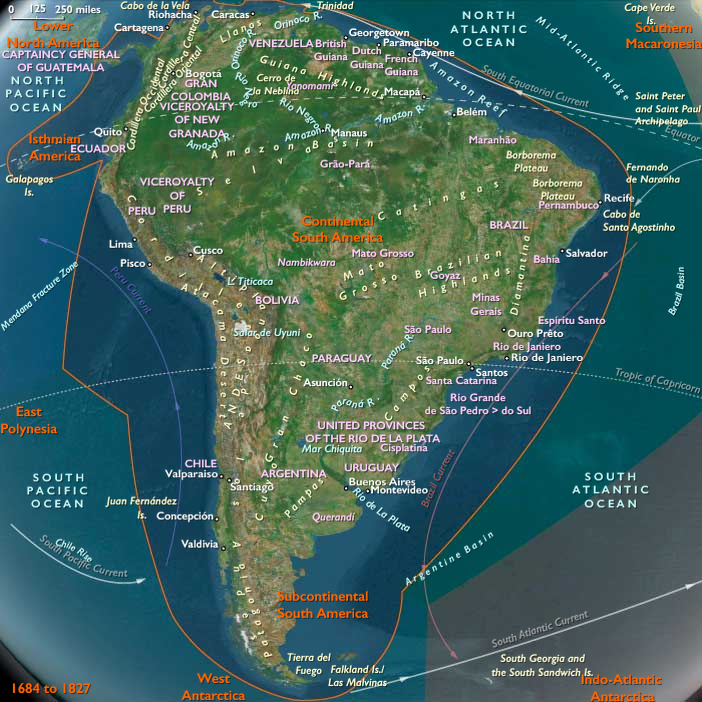
Subregions
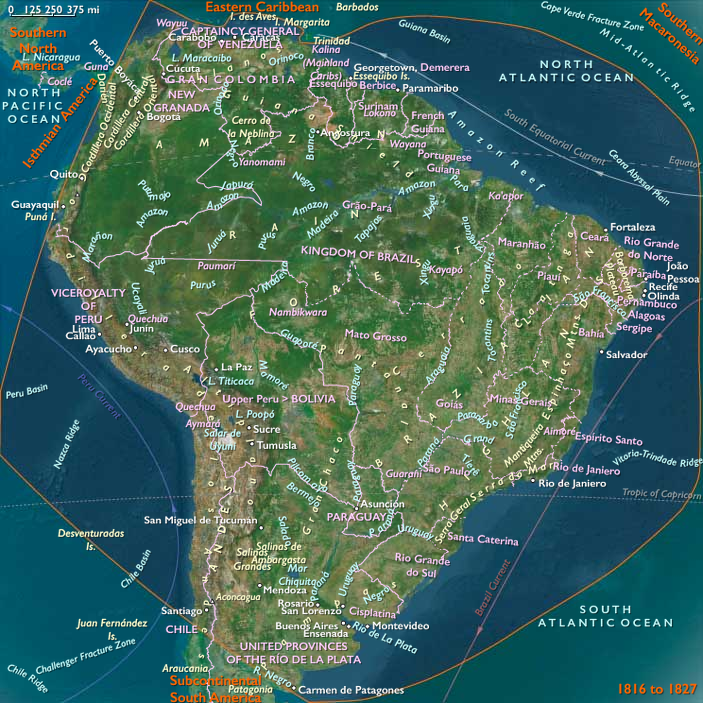
Related Events
Showing 10 events out of 30218 total
Years: 1684 - 1827
Locations
Groups
- Tairona
- Arawak peoples (Amerind tribe)
- Kalinago (Amerind tribe)
- Muisca (Amerind tribe)
- Spaniards (Latins)
- Spain, Habsburg Kingdom of
- Granada, New Kingdom of (Spanish colony)
- Peru, Viceroyalty of
- Spain, Habsburg Kingdom of
- Quito, Real Audiencia of
- Bogotá, Audiencia de Santa Fe de (Captaincy General of New Granada)
- Venezuela Province
- New Granada, Viceroyalty of
- New Granada, Viceroyalty of
- Venezuela, Captaincy General of
Topics
Commodoties
Subjects
Regions
Subregions