
Event
The Liberal Revolution of 1820 in Portugal…
The Liberal Revolution of 1820 in Portugal – The Rise of Constitutionalism
By 1820, Porto had become the center of Portuguese liberalism, with the Sinedrio, a Masonic-inspired secret society, rapidly gaining adherents and spreading constitutionalist ideals. The Portuguese army, emerging from the Peninsular War as the country’s strongest institution, became a breeding ground for liberal sentiment, especially after Marshal William Carr Beresford’s departure for Brazil in March 1820.
Beresford’s Mission to Brazil (March 1820)
- Marshal Beresford, the de facto ruler of Portugal, traveled to Brazil in March 1820 to persuade King João VI to return to Lisbon and resume direct rule.
- His absence created a political vacuum, allowing liberal influence to spread within the Portuguese army.
The August 24, 1820 Revolt in Porto – The Liberal Uprising Begins
- On August 24, 1820, army regiments in Porto revolted, demanding:
- A constitutional government.
- The immediate return of King João VI from Brazil.
- An end to absolutist rule under the regency.
- The rebels established a provisional junta, which bypassed the regency and assumed control of the government.
- The provisional junta called for a Cortes (parliament) to draft a constitution, ensuring a transition to constitutional monarchy.
The Fall of the Regency and the Blockade of Beresford
- The regency in Lisbon, weakened by financial crises and political instability, was unable to resist the growing liberal movement.
- By late 1820, the liberal revolution had spread across Portugal, with Lisbon also rising in support.
- When Beresford returned from Brazil, the new government refused to allow him entry, effectively ending his control over the Portuguese military.
Consequences – The Birth of Constitutional Portugal
- The Cortes Gerais (General Cortes) was convened, marking the first step toward drafting Portugal’s first liberal constitution (1822).
- João VI was forced to return from Brazil in 1821, officially recognizing the new constitutional government.
- The revolution marked the end of British dominance in Portuguese affairs, as Beresford was permanently sidelined.
Conclusion – The Dawn of Portuguese Liberalism
The Revolution of 1820 was a turning point in Portuguese history, establishing the foundations of constitutional monarchy and ending absolutist rule. Though political instability would continue, the event marked the emergence of liberalism as a dominant force in Portugal, shaping its political landscape for decades to come.
-
{# Image navigates to the detail page; the magnifying-glass chip is the only Fancybox lightbox trigger (kept a separate sibling — anchors can't nest). #}
 The North Atlantic Lands
World
-
{# Image navigates to the detail page; the magnifying-glass chip is the only Fancybox lightbox trigger (kept a separate sibling — anchors can't nest). #}
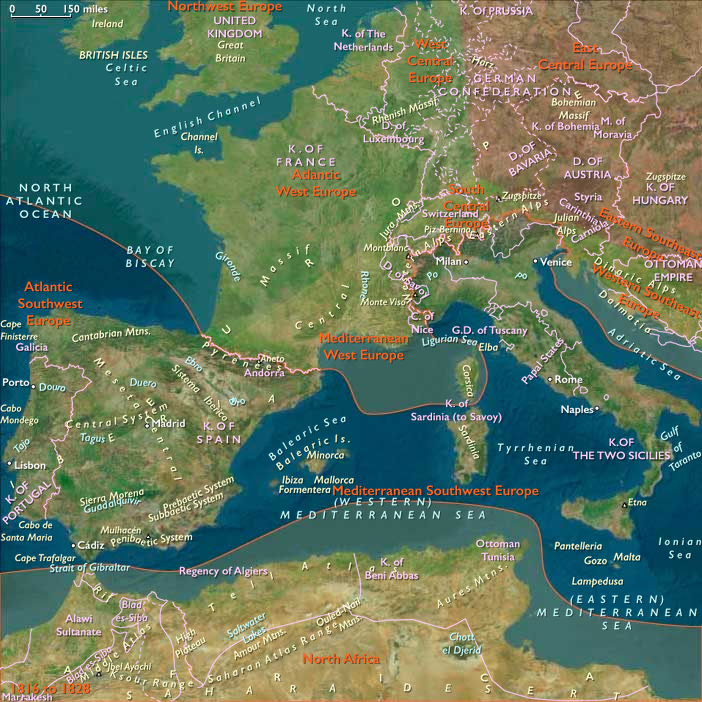 Southwest Europe
Region
-
{# Image navigates to the detail page; the magnifying-glass chip is the only Fancybox lightbox trigger (kept a separate sibling — anchors can't nest). #}
 Atlantic Southwest Europe
Subregion
