
The Indus Valley civilization has begun to…
1917 BCE to 1774 BCE
The Indus Valley civilization has begun to decline.
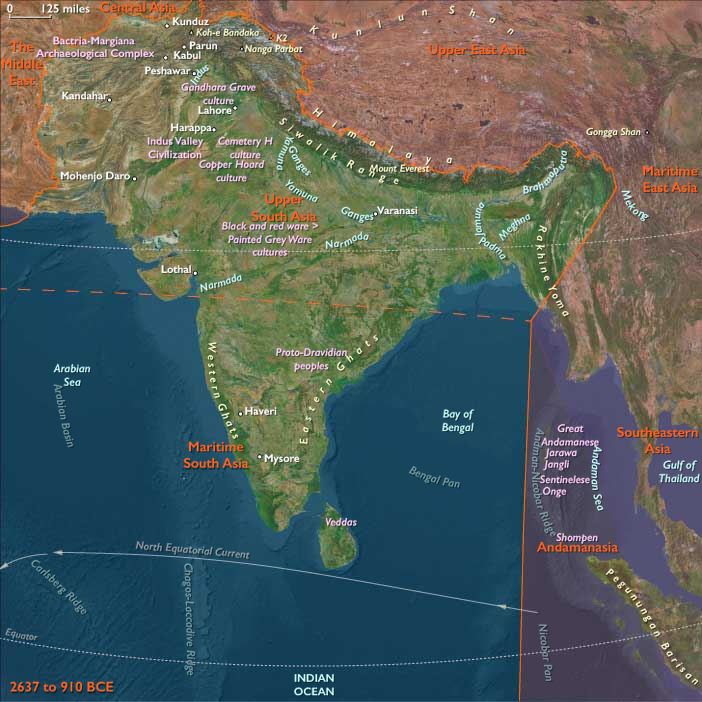
The so-called Cemetery H culture, named after a cemetery found in "area H" at Harappa, had developed out of the northern part of the Indus Valley Civilization around 1900 BCE, in and around the Punjab region.
Also known as Late Harappan, it is part of the Punjab Phase, one of three cultural phases that have developed in the Localization Era of the Indus Valley Tradition.
Together with the Gandhara grave culture and the Ochre Colored Pottery culture, some scholars consider it a nucleus of Vedic civilization, although the culture shows clear biological affinities with the earlier population of Harappa.
In the preceding Mature Harappan phase, bodies had been buried in wooden coffins, Now, human remains are cremated and bones stored in painted pottery burial urns.
The culture’s reddish pottery, painted in black with antelopes, peacocks etc., sun or star motifs, features different surface treatments in contrast to the earlier period.
Rice now becomes a main crop, and settlements expand to the East.
The use of mud brick for building continues, but materials such as marine shells are no longer used indicating an apparent breakdown of the widespread trade of the Indus civilization.
Archaeologist Jonathan Mark Kenoyer notes, in "The Indus Valley tradition of Pakistan and Western India" (Journal of World Prehistory 5: 1–64), that this culture "may only reflect a change in the focus of settlement organization from that which was the pattern of the earlier Harappan phase and not cultural discontinuity, urban decay, invading aliens, or site abandonment, all of which have been suggested in the past."
Locations
Commodities
Subjects
Regions
South Asia
View →Subregions
