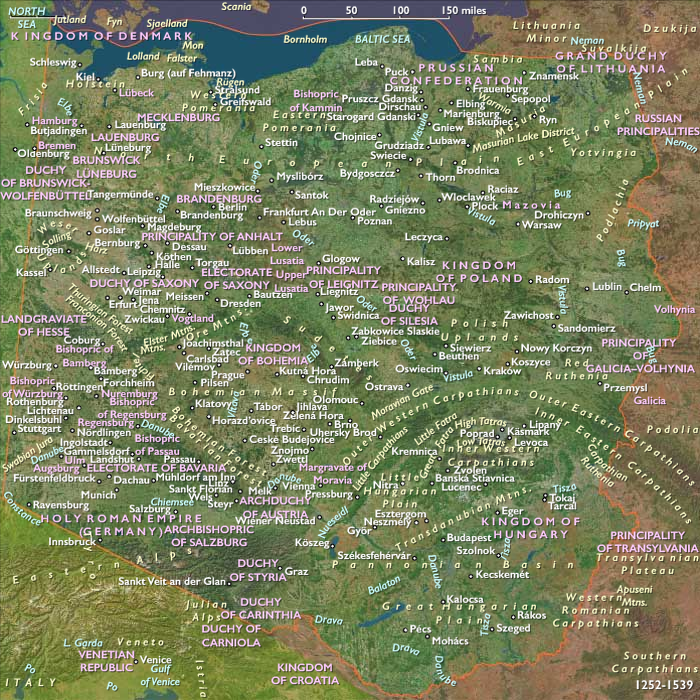
The international situation is becoming increasingly complicated.The…
August 1458 CE
The international situation is becoming increasingly complicated.
The new Prince-Bishop of Ermeland, Cardinal Eneas Silvio Piccolomini, known for his pro-Teutonic sympathies, is in 1458 elected Pope Pius II.
Another complication is the death of Ladislas the Posthumous and the election of the Hussite leader George of Podebrady as the new king of Bohemia, and Matthias Corvinus as king of Hungary.
One positive sign is peace with Denmark.
King Christian I of Denmark has finally conquered Sweden, but the Swedish king Charles VIII has escaped to Poland and started supporting the Polish cause financially.
Danzig and Charles VIII begin hiring more privateers, which seriously damages Baltic trade, and finally Christian I decides to sign a ceasefire in July 1458.
In the spring, Casimir had again called for a levée en masse which included the Masovians.
Ignoring the mediation of John Giskra (Jan Jiskra), a Czech mercenary who hopes for an end to war with Prussia and the start of a new conflict with Hungary, the Polish army has slowly marched into Prussia, crossing the Vistula via a pontoon bridge near Thorn in June.
Again, the army is supported by Tatar auxiliary forces from the Crimea and by the king's own army, commanded by Piotr of Szamotuly, the castellan of Poznań.
The Polish army marches directly to Marienburg, reaching the city on August 10.
This time it is well-equipped with artillery sent by Danzig and Elbing.
The siege, however, is another fiasco, due partly to lengthy negotiations, and partly to Piotr's lack of aggression on the battlefield.
His inept leadership allows Fritz Raweneck to take yet another castle.
The nobles demand the storming of the castle, and when this does not happen, they start deserting and returning to Poland.
People
Groups
Topics
Commodities
Subjects
Regions
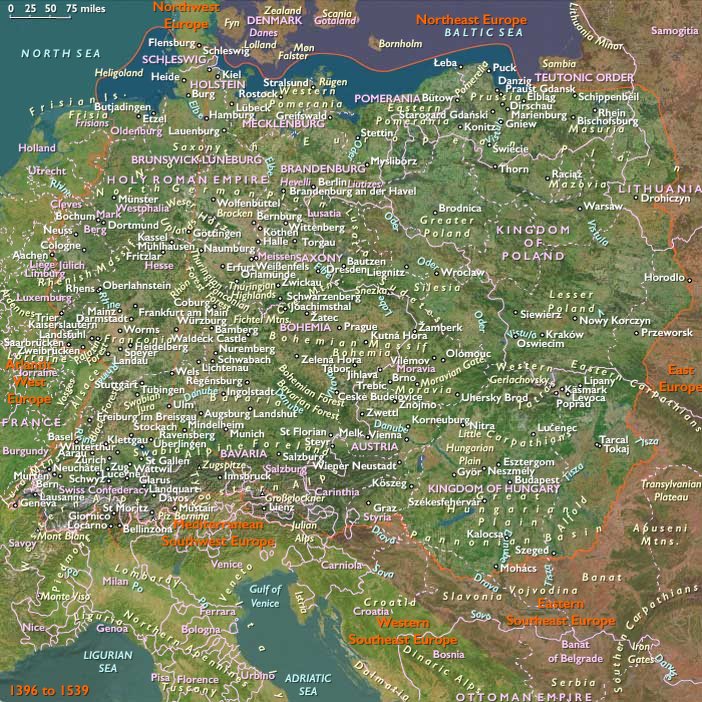
Central Europe
View →Subregions