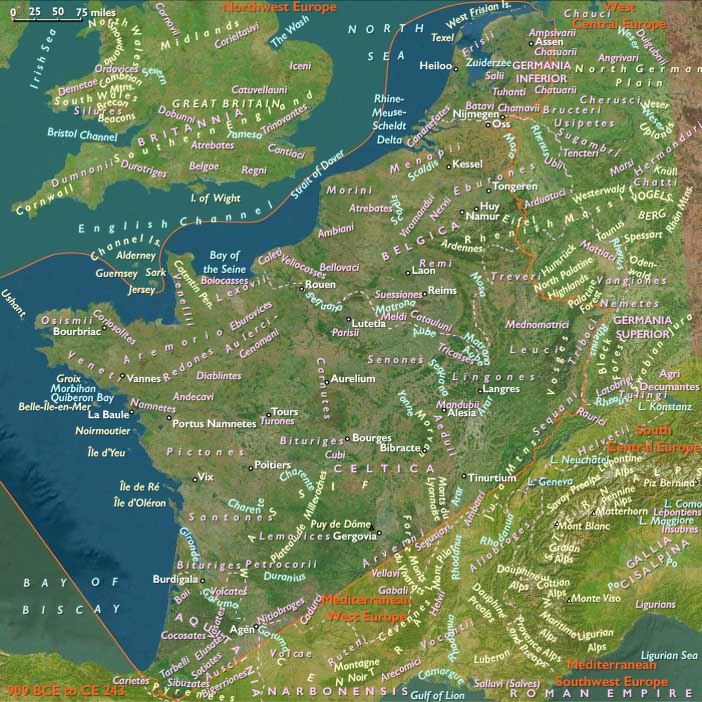
Climate Change and the Migration of Germanic…
333 BCE to 190 BCE
Climate Change and the Migration of Germanic Tribes (c. 850–250 BCE)
The deteriorating climate in Scandinavia around 850 BCE, which worsened further by 650 BCE, may have been a key factor triggering the migration of Germanic tribes from the North. These migrations led to the emergence of distinct cultural and linguistic groups in the Low Countries and surrounding regions. By 250 BCE, the process was largely complete, with several major tribal identities taking shape.
Germanic Groups in the Low Countries
-
North Sea Germanic (Ingvaeones)
- Settled in the northern Low Countries.
- Later evolved into the Frisii and early Saxons.
- Strongly influenced by North Sea trade and maritime traditions.
-
Weser-Rhine Germanic (Istvaeones)
- Inhabited the middle Rhine and Weser regions, as well as the southern Low Countries, south of the great rivers.
- This group later became the Salian Franks, who played a crucial role in the Frankish Kingdom and medieval European history.
Celtic Expansion and the La Tène Influence (c. 450 BCE – Roman Conquest)
- The Celtic La Tène culture expanded across much of Western and Central Europe, reaching into the southern Low Countries.
- La Tène material culture, social structures, and warrior traditions influenced the local population.
- Some areas may have been culturally mixed, with both Celtic and Germanic elements coexisting.
The Nordwestblock Hypothesis: A Third Ethnic Identity?
Some scholars suggest that a third, non-Germanic and non-Celtic culture, referred to as the Nordwestblock culture, may have survived in the Netherlands and surrounding regions until the Roman period.
- The Nordwestblock people may have spoken a now-extinct language, possibly distantly related to Italic or pre-Germanic Indo-European dialects.
- Over time, this cultural group was likely absorbed by the Celts in the south and the Germanic peoples from the east.
- Archaeological evidence, including unique burial traditions and settlement patterns, suggests a distinct cultural identity in the region.
Significance of These Ethnic and Cultural Transformations
- The climatic deterioration and resulting migrations contributed to the formation of early Germanic tribal identities, which later played major roles in European history.
- The Low Countries became a cultural crossroads, influenced by Germanic migrations, Celtic expansion, and possible remnants of the Nordwestblock peoples.
- These demographic shifts helped shape the linguistic and ethnic landscape of Northwestern Europe, setting the stage for Roman interactions and later medieval state formations.
Thus, by 250 BCE, the Low Countries had become a complex cultural region, where Germanic, Celtic, and possibly older indigenous influences intertwined, shaping the future development of the region.
Groups
Topics
Subjects
Regions
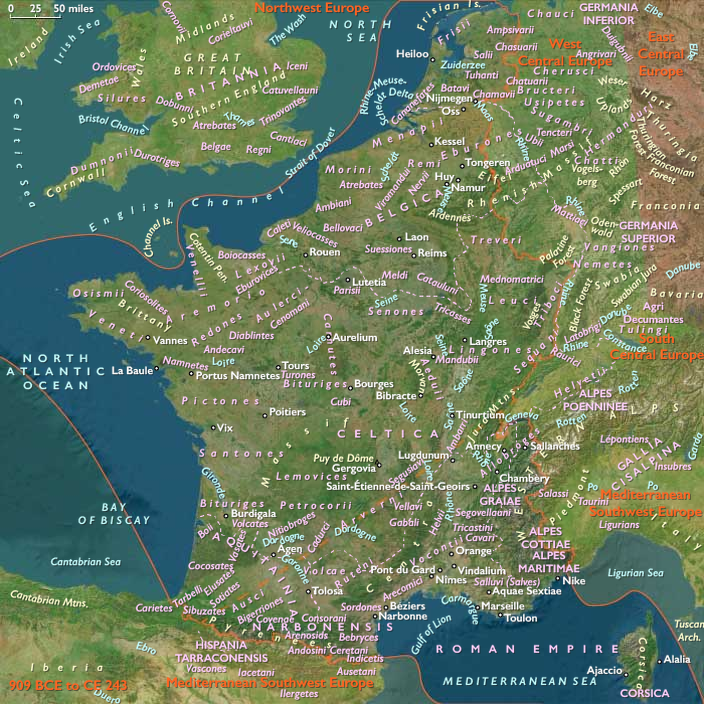
West Europe
View →Subregions