The isolated imperial outpost of Cherson in …
Years: 710 - 710
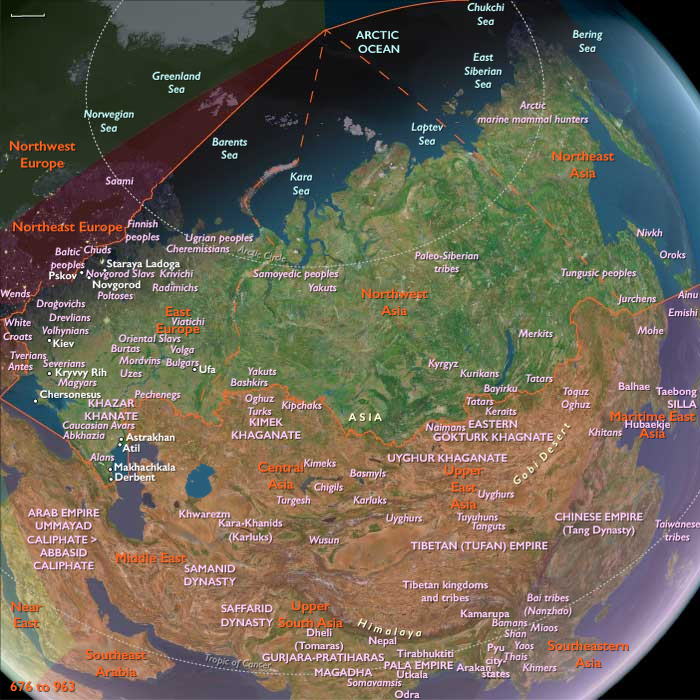
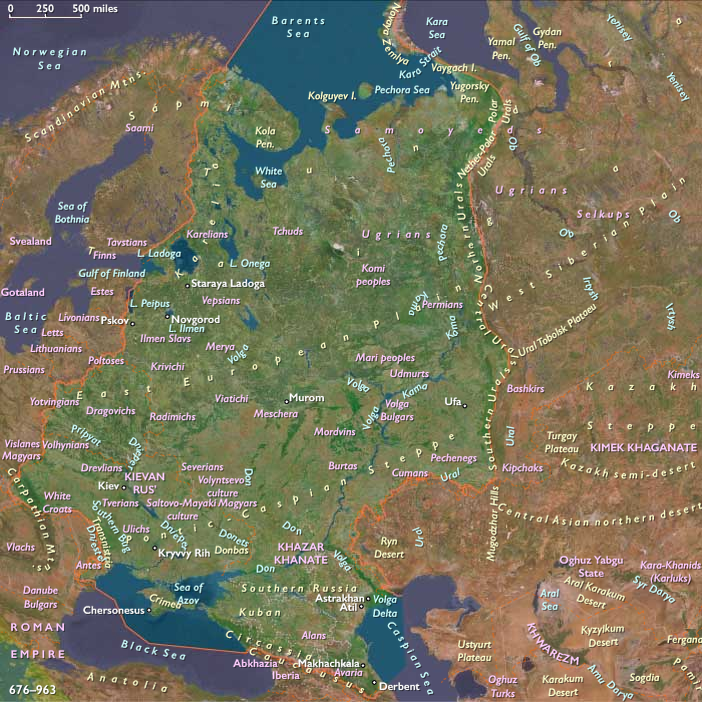
The isolated imperial outpost of Cherson in the Crimea rebels with Khazar assistance, against Justinian II.
The emperor sends a fleet under the patrikios Stephen, which retakes the city and restores imperial control.
The fleet however is struck by a storm on its way back and loses many ships, while the Chersonites, again with the aid of the Khazars, rebel anew.
Locations
People
Groups
Topics
- Migration Period
- Byzantine Papacy
- Arab-Byzantine Wars
- Arab-Khazar Wars
- Byzantine-Muslim War of 692-718
Commodoties
Subjects
Regions
Subregions
Related Events
Filter results
Showing 10 events out of 55798 total
Heijo (Nara), founded in 706 as the intended seat of the Japanese government, modeled after the Chinese T'ang dynasty's capital of Ch’ang-an (Xi'an), is completed in 710.
The city becomes the permanent seat of Japanese government, inaugurating the so-called Nara period.
The Chinese-influenced “Tachibana Shrine,” a miniature shrine owned by the Horyu temple in Nara expresses the complex iconography of Amida, the Buddha of the Western Paradise, in the triad of Amida and two bodhisattvas seated on lotus pedestals rising from a pond; behind them stands a low-relief bronze screen portraying a placid scene of the souls reborn in the Western Paradise.
Abd al-Rahman is able to reestablish Muslim control over Tokharistan almost without bloodshed in spring 710.
Most of the rebel rulers flee or capitulate, and finally, Nizak is captured and executed on al-Hajjaj's orders, despite promises of pardon, while the Yabghu is exiled to Damascus and kept there as a hostage.
Tokharistan is more firmly incorporated into the Caliphate, as Arab district representatives are appointed alongside the local princes, who are gradually relegated to secondary positions.
Qutayba's brother Abd al-Rahman ibn Muslim is installed with a garrison near Balkh to oversee the affairs of the province.
Despite the swift end of Nizak's revolt, the king of Shuman and Akharun decides to rebel as well.
Qutayba leads his forces against him, besieges his citadel and takes it.
The king falls in battle, and his supporters are executed.
Qutayba then marches west over the Iron Gate, taking Kish and Nasaf and visiting Bukhara, where he settles relations between the Arabs and the locals, installed the young Sogdian prince Tughshada in the position of Bukhar Khudah and establishes an Arab military colony in the city.
Traces of human settlements have been found in the area of Salzburg dating to the Neolithic Age.
The first settlements at Salzburg were apparently begun by the Celts around the fifth century BCE.
The separate settlements had been merged into one city by the Roman Empire around 15 BCE.
At this time, the city was called Juvavum and was awarded the status of a Roman municipium in CE 45.
Juvavum developed into an important town of the Roman province of Noricum.
After the collapse of the Norican frontier, Juvavum declined so sharply that by the late seventh century it had become a "near ruin".
The Life of Saint Rupert credits the eighth-century saint with the city's rebirth.
When Theodo of Bavaria asked Rupert to become bishop in about 700, Rupert had reconnoitered the river for the site of his basilica.
Rupert chose Juvavum, ordained priests, and annexed the manor Piding.
Rupert named the city "Salzburg".
He traveled to evangelize among pagans.
The name Salzburg means "Salt Castle".
It derives its name from the barges carrying salt on the Salzach River, which were subject to a toll in the eighth century, as was customary for many communities and cities on European rivers.
Rupert founds Nonnberg Abbey, a Benedictine monastery, around 710; it is the oldest women's religious house in the German-speaking world.
Its first abbess is Saint Erentrudis of Salzburg, who is either a niece or a sister of Saint Rupert.
The abbey's endowment is provided by Theodebert, Duke of Bavaria.
Muhammad ibn Marwan, when al-Walid I acceded to the throne in 705, had begun to be eclipsed by his nephew Maslama ibn Abd al-Malik, who like him had also born to an enslaved woman.
Maslama had assumed the leadership of the campaigns against Constantinople, and finally replaces Muhammad completely in his capacity as governor of Mesopotamia, Armenia and Azerbaijan in 709/710.
Muslim Arab adventurers have staged unsuccessful attacks on different towns western India.
A group under Ibn al-Harri al-Bahitti finally succeeds in capturing Makran, a semi-desert coastal strip in the south of Sindh and Balochistan, between 700 and 710.
Islamic caliphs begin to employ Christian mosaicists of the Eastern Roman Empire to decorate the Mosque known as the Dome of the Rock, under construction in Jerusalem since 661.
Construction begins in 710 on the al-Aqsa Mosque, also on Jerusalem’s Temple Mount.
Visigothic king Wittiza, who had suffered the Jews to return to Spain, dies in 710, leaving two young sons, for whom Wittiza's widow and family try to secure the succession.
The turbulent Visigothic nobility instead elects Roderick and drives the Wittizans from Toledo.
Roderick, who seems to have been dux or military commander of one of the provinces, perhaps Baetica, faces a revolt of the Basques and is never recognized in the Northeast.
Meanwhile, Wittiza's family, determined to oust Roderick, has made contact with the Muslims in North Africa.
The Kingdom of Nekor, an emirate in the Rif area of modern day Morocco, is founded by an immigrant of Yemen, Salih I ibn Mansur al-Himyarī in 710, by caliphal grant.
A Muslim army is invited into Ceuta by its governor, the possibly legendary Count Julian.
Roman Africa had been largely lost by the end of the seventh century to its Muslim conquerors, who in 711 seize the last outpost at Septem, where Julian, being an opponent of King Roderic of the Visigoths, encourages them to invade the Iberian peninsula.
According to the Egyptian historian Ibn Abd-el-Hakem, writing a century and a half after the events, Julian sent one of his daughters to Roderic's court at Toledo for education (and as a gauge of Julian's loyalty) and Roderic subsequently made her pregnant.
When Julian learned of the affair he removed his daughter from Roderic's court and, out of vengeance, betrayed Hispania to the Muslim invaders, thus making possible the Umayyad conquest of Hispania.
Later ballads and chronicles inflated this tale, Muslims making her out an innocent virgin who was ravished, Christians making her a seductress.
In Spanish she came to be known as la Cava Rumía, but this might well only be a legend.
Personal power politics were more likely at play, as better historical evidence points to a civil war among the Visigothic aristocracy.
Roderic had been appointed to the throne by the bishops of the Visigothic Catholic church—this appointment snubbing the sons of the previous king, Wittiza, who dies or is killed in 710; Wittiza's relatives and partisans had fled Iberia for Julian's protection at Ceuta (Septem), the Pillar of Hercules in North Africa on the northern shore of the Maghreb.
Here they have gathered with Arians and Jews fleeing forced conversions at the church's hands.
At this time, the surrounding area of the Maghreb had recently been conquered by Musa ibn Nusair, who has established his governor, Tariq ibn Ziyad, at Tangier with a Moorish army of seventeen hundred men.
Julian had therefore approached Musa to negotiate the latter's assistance in an effort to topple Roderic.
What is unclear is whether Julian hoped to place a son of Wittiza on the throne and gain power and preference thereby or whether he was intentionally opening up Iberia to foreign conquest.
The latter, though unlikely, isn't inconceivable, given that Julian may have long been on good terms with the Muslims of North Africa and found them to be more tolerant overlords than the Catholic Visigoths.
Moreover, if Julian was the Greek commander of the last imperial outpost in Africa, he would only have had an alliance with the Kingdom of the Visigoths rather than been part of it.
Perhaps, then, in exchange for lands in al-Andalus (the Arab name for the area the Visigoths still called by its Roman name, Hispania), or perhaps to topple a king and his religious allies, Julian provides military intelligence, troops, and ships.
Musa is initially unsure of Julian's project and so in July 710 directs Tarif ibn Malluk to lead a probe of the Iberian coast.
Legend says that Julian participated as a guide and emissary, arranging for Tarif to be hospitably received by supportive Christians—perhaps Julian's kinsmen, friends, and supporters—who agreed to become allies in the contemplated battle for the Visigothic throne.

Justinian's second reign is marked by a reconciliation with the papacy, cemented by the visit of Pope Constantine to Constantinople in 710-11.
The emperor is obsessed, however, with a desire for revenge against his opponents, and the resulting mass executions in turn have led to the alienation of many of his former supporters.
Bardanes is the son of the patrician Nicephorus, who was of Armenian extraction from an Armenian colony in Pergamon. (His original name, Vardan, may have been derived from that of his mother).
Relying on the support of the Monothelite party, he had made some pretensions to the throne on the outbreak of the first great rebellion against Emperor Justinian II; these had led to his relegation to Cephalonia by Tiberios Apsimarus, and subsequently to his banishment to Cherson by order of Justinian.
Here Bardanes, taking the name of Philippikos, has successfully incited the inhabitants to revolt with the help of the Khazars.
The successful rebels seize Constantinople, and Justinian flees.
Tervel gives the deposed emperor only three thousand soldiers who, after several skirmishes, are given safe conduct to Bulgaria by the new emperor and Justinian II, unable to rally substantial support in the provinces, is executed, together with his family, in December 711.
After resuming rule, Justininian had wreaked a vengeance so terrible that the fact of his second deposition and death is surprising only in it having been delayed for six years.
Philippikos takes the throne.
Years: 710 - 710
Locations
People
Groups
Topics
- Migration Period
- Byzantine Papacy
- Arab-Byzantine Wars
- Arab-Khazar Wars
- Byzantine-Muslim War of 692-718