
The Karluks had spread from the valley…
665 CE
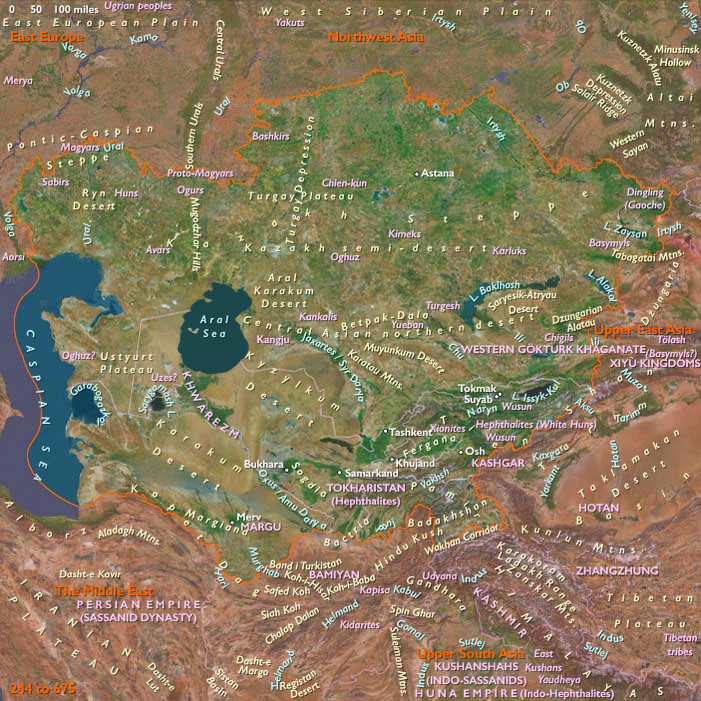
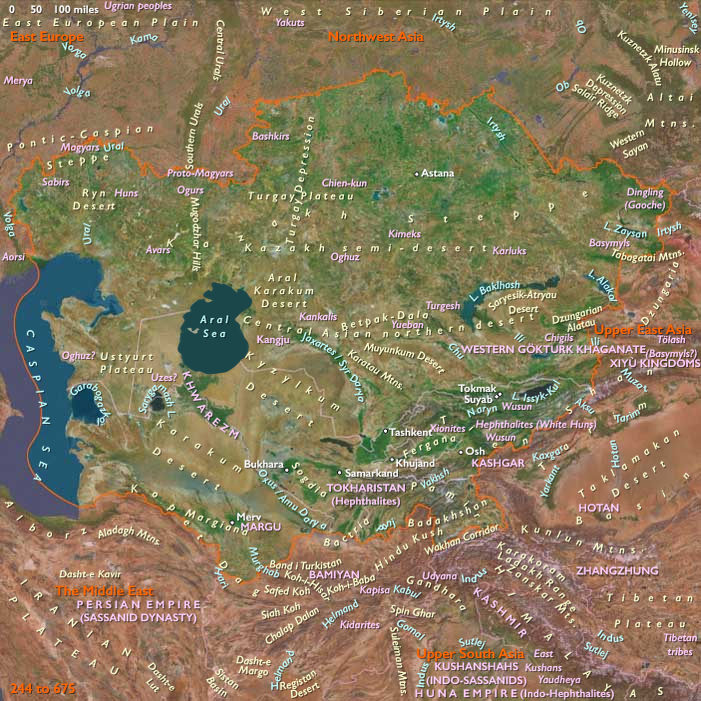
The Karluks had spread from the valley of the river Kerlyk along the Irtysh River in the western part of the Altay to beyond the Black Irtysh, Tarbagatai, and towards the Tien Shan.
By the year 665, the Karluk union is led by a former Uch-Karluk bey with the title Kül-Erkin, now titled "Yabgu" (prince), who has a powerful army.
Topics
Regions
Central Asia
View →Subregions
Central Asia
View →Related Events
No active filters.
Showing 10 events out of 56277 total
Khan Kubrat, having established a spacious state in the steppes of modern Ukraine, has ruled in peace with Constantinople, a result of his close friendship with the emperor and, conceivably, of his appreciation of the Empire’s culture.
According to legend the third, fourth, and fifth of the many sons of Kubrat with their hordes originally inhabited the Avar Khaganate.
The Pereshchepina hoard, discovered in 1912 by Ukrainian peasants in the vicinity of Poltava, yielded gold and silver objects of total weight of seventy-five kilograms, including a ring which eventually allowed identification of the grave as that belonging to Khan Kubrat.
The ring was inscribed in Greek "Chouvr(á)tou patr(i)k(íou)", indicating the dignity of patrikios that he had achieved in Constantinople.
His eldest son Batbayan succeeds Kubrat in Onoguria in 665.
Kallinikos (Callinicus) of Heliopolis, a Greek-speaking Jewish Syrian refugee from the Arab conquest of Syria, invents, around 665, “Greek fire”, a primitive incendiary bomb of unknown but evidently petroleum-based composition that bursts into flame spontaneously when wet and cannot be doused with water.
Sand and—according to legend—urine are the only effective means of extinguishing the flames.
It can be expelled by a pumplike device, or siphon, similar to a nineteenth-century hand-pumped fire engine, and it may also be thrown from catapults in breakable containers.
The art of compounding the mixture is a state military secret so closely guarded that its precise composition remains unknown to this day.
The most likely ingredients are colloidal suspensions of metallic sodium, lithium, or potassium-or perhaps quicklime-in a petroleum base.
Gennadius, the deposed Exarch of Africa, had fled to the court of Muawiyah at Damascus, where he asked the Caliph for aid in recapturing Carthage.
The Caliph had agreed and in 665 sends a large force with Gennadius to invade imperial Africa.
Gennadius dies however, in late 665 when he reaches Alexandria.
Swithelm is succeeded by his cousins Sighere and Sebbi as kings of Essex.
Sighere encourages his subjects to reject Christianity and return to their indigenous religion.
Oderzo, which had become the seat of an exarch under the Empire, is held by Constantinople until its destruction by the Lombard king Grimoald in 667.
Much of its population flees to …
…the nearby city of Heraclea, still under imperial control.
Most of its territory passes to the Count of Ceneda.
Ceneda becomes the seat of a Lombard county.
Near the heart of the city and on a strategic mountain, the Lombards construct the Castello di San Martino, which still overlooks the city.
Goguryeo stubbornly holds out against the combined Sillan-Chinese attacks until the capture of their capital in 668.
China annexes most of Goguryeo; the monarch of Silla enlarges his realm to include the area south of the Taedong River.
The Unified Silla period begins.
Bulgar khan Batbayan, warring with his relative Kotrag in 668, is temporarily driven into the Crimea.
Kotrag’s Khazars attack and eventually take the steppes between Don and the Urals, according to the treaty of 668 between Batbayan and the Khazar Khagan (Kaban) under which Batbayan and his sister Huba are taken prisoners.
Western Bulgar warriors will later adopt the practice of wearing Martenitsas—a small piece of adornment, made of white and red yarn and usually in the form of two dolls, a male and a female—in battle to remind them of the sacrifice of their ancestral relatives Batbayan and Huba.
Batbayan's Bulgars are an essential part of the ethnogenesis of the contemporary Balkars and probably in some scale of the Volga Tatars and Crimean Tatars, though the ethnogenesis of the eponymous inhabitants of modern Bulgarian is probably very little influenced by Batbayan's Bulgars.
When Great Bulgaria disintegrates under Khazar attack in 668, Batbayan's brothers part ways, leading their people to seek a more secure home in other lands.
Constans alienates Pope Vitalian in 668 by declaring Ravenna independent.
His plans to make the city a permanent capital and a strategic center for the defense of the West against the Arabs are cut short by his assassination at the baths of Daphne on September 15, thus ending the career of the last of Constantinople’s emperors to venture into the West.
In the absence of the sons of Constans II, the imperial general Mezezius is proclaimed Emperor by the army in Syracuse and reigns in Sicily for a few months.