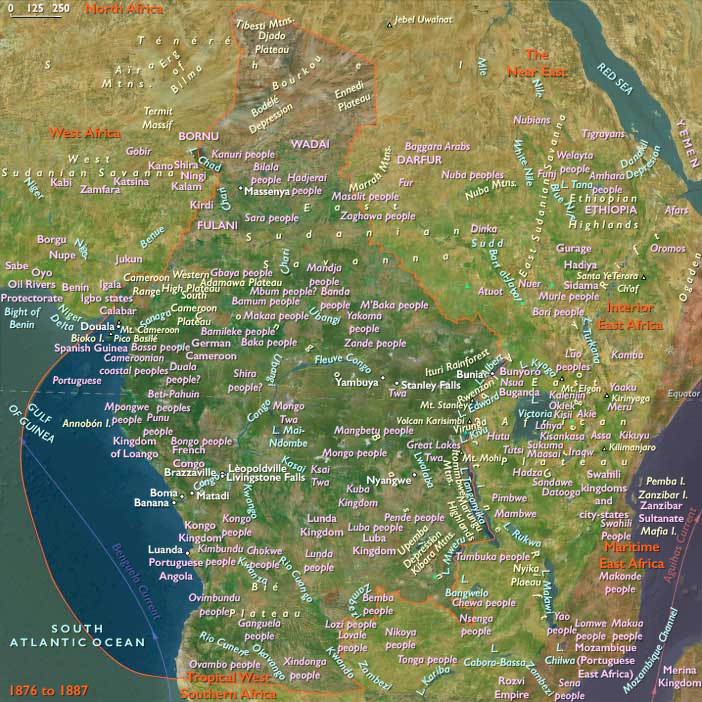
Competition over the slave trade has repercussions…
1876 CE to 1887 CE
Competition over the slave trade has repercussions far beyond the boundaries of Kongo society.
Slave-trading activities create powerful vested interests among both Africans and foreigners—the Portuguese and later the Dutch, French, British, and Arabs.
A new source of instability has thus been introduced into the coastal areas of Central Africa and its hinterland, which greatly hastens the decline of the kingdoms.
Nowhere is this more evident than in the history of the Kongo Kingdom, which is a centralized state system ruled by an absolute monarch.
Groups
Bantu peoples
View →
Arab people
View →
Mongo peoples
View →
Kongo people
View →
Luba people
View →
Mangbetu people
View →
Christians, Roman Catholic
View →
Zande people
View →
Kongo, Kingdom of
View →
Lunda people
View →
Kuba Kingdom
View →
Portuguese Empire
View →
Protestantism
View →
Chokwe people
View →
Luba, Kingdom of
View →
Portugal, Bragança Kingdom of
View →
Lunda, Kingdom of
View →
Kazembe
View →
Spain, Bourbon Kingdom (second restoration) of
View →
Topics
Commodities
Regions

Middle Africa
View →Subregions