
The Krupp family first appears in the…
1816 CE
The Krupp family first appears in the historical record in 1587, when Arndt Krupp joined the merchants' guild in Essen.
Arndt, a trader, had arrived in town just before an epidemic of the Black Death plague and became one of the city's wealthiest men by purchasing the property of families who fled the epidemic.
After he died in 1624, his son Anton took over the family business; Anton oversaw a gunsmithing operation during the Thirty Years' War (1618–48), which was the first instance of the family's long association with arms manufacturing.
For the next century, the Krupps had continued to acquire property and become involved in municipal politics in Essen.
By the mid-eighteenth century, Friedrich Jodocus Krupp, Arndt's great-great-grandson, headed the Krupp family.
In 1751, he married Helene Amalie Ascherfeld (another of Arndt's great-great-grandchildren); Jodocus died six years later, which left his widow to run the business: a family first.
The Widow Krupp had greatly expanded the family's holdings over the decades, acquiring a fulling mill, shares in four coal mines, and (in 1800) an iron forge located on a stream near Essen.
In 1807, the progenitor of the modern Krupp firm, Friedrich Krupp, had begun his commercial career at age 19 when the Widow Krupp appointed him manager of the forge.
Friedrich's father, the widow's son, had died eleven years previously; since that time, the widow had tutored the boy in the ways of commerce, as he seemed the logical family heir.
Unfortunately, Friedrich had proved too ambitious for his own good, and quickly ran the formerly profitable forge into the ground.
The widow soon had to sell it away.
In 1810, the widow died, and in what would prove a disastrous move, left virtually all the Krupp fortune and property to Friedrich.
Newly enriched, Friedrich had decided to discover the secret of cast (crucible) steel.
Benjamin Huntsman, a clockmaker from Sheffield, had pioneered a process to make crucible steel in 1740, but the British had managed to keep it secret, forcing others to import steel.
When Napoleon began his blockade of the British Empire, British steel became unavailable, and Napoleon had offered a prize of four thousand francs to anyone who could replicate the British process, piquing Friedrich's interest.
Thus, in 1811 Friedrich had founded the Krupp Gusstahlfabrik (Cast Steel Works) in Essen.
He realized he would need a large facility with a power source for success, and so he built a mill and foundry on the Ruhr River, which unfortunately proved an unreliable stream.
Friedrich has spent a significant amount of time and money in the small, waterwheel-powered facility, neglecting other Krupp business, but in 1816 he is able to produce smelted steel.
Locations
People
Commodities
Regions
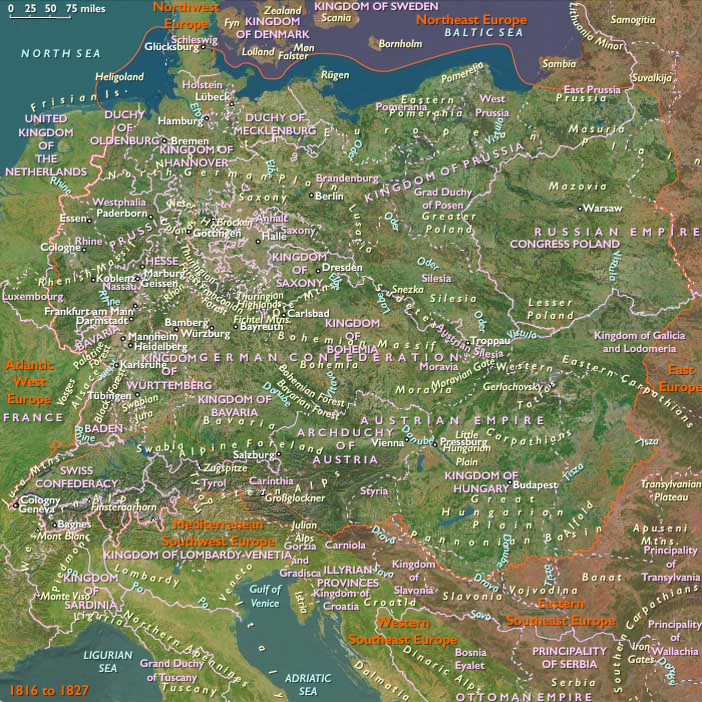
Central Europe
View →Subregions
