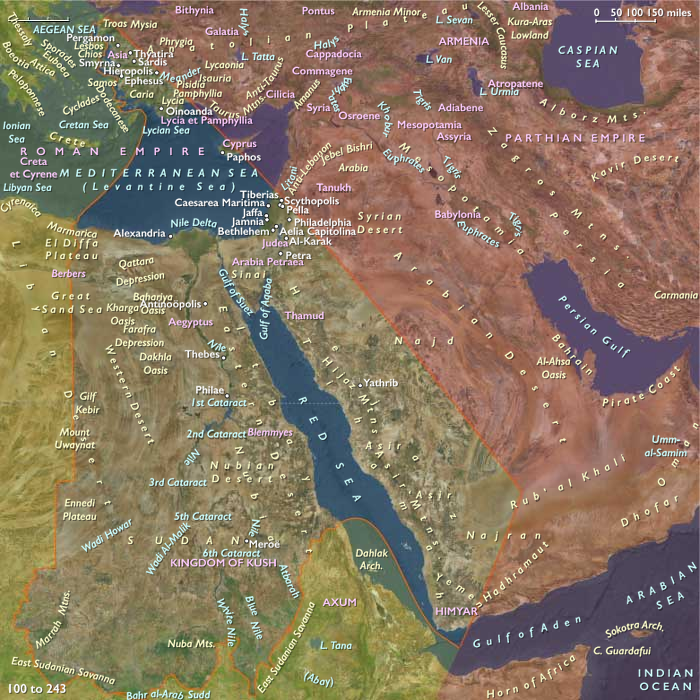
The language and the well-developed theology of…
100 CE
The language and the well-developed theology of the Gospel According to John, traditionally ascribed to John the Evangelist, suggest that the author may have lived later than John, “the beloved disciple” of Jesus, and based his writing on John's teachings and testimonies.
The place and date of composition of this fourth Gospel is also uncertain (many scholars suggest that it was written at Ephesus, in Asia Minor, in about 100 for the purpose of communicating the stories about Christ to Christians of Hellenistic background).
Although John's Gospel differs from the Synoptic Gospels in several ways, the major difference lies in the author's overall purpose.
Writing from a hostile perspective outside the Jewish world, the author repeatedly employs “the Jews” in place of the Synoptic Gospels' use of Pharisees, scribes, elders and priests as plotting against Jesus.
John, the gospel of belief, is written to persuade people to believe that Jesus is the Messiah, the Son of God.
John's purpose in writing is expressed in the conclusion, 20:30-31: "...these [Miracles of Jesus] are written that you may (come to) believe that Jesus is the Messiah, the Son of God, and that through this belief you may have life in his name."
Only in John does Jesus talk at length about himself, including a substantial amount of material Jesus shared with the disciples only.
Certain elements of the synoptics (such as parables, exorcisms, and the Second Coming) are not found in John.
Most commentators regard the work as anonymous.
The New Testament’s two “Epistles to Timothy,” classified with the “Epistle to Titus” as the “Pastoral Epistles” and traditionally ascribed to Paul, are addressed by Paul to his companion, Timothy, leader of the church at Ephesos (who, known from Acts and other epistles, had been martyred at Ephesos in 97).
The letters—pastoral in that they urge Timothy to combat false teaching and guide his people in preserving the truth—also give detailed instructions concerning the duties of bishops, deacons, widows, and other Christians.
The “Epistle to Titus”—addressed by Paul to his companion Titus, who has been left in charge in Crete to correct errors and appoint church leaders—urges Titus to promote sound doctrine, sober behavior, and appropriate submission to those in authority.
The Pastoral Epistles differ in language from the other epistles, and refer to a more developed church structure, emphasizing the importance of handing on tradition (thus, many scholars believe the Pastoral Epistles to have been written around 100, in Paul's name, rather than by Paul himself).
The Epistle of Jude, a short book of the Christian New Testament canon, consisting of twenty-five verses, is commonly believed to have been written by the Apostle Jude (or Thaddeus), perhaps between the end of the first century and the first quarter of the second century (however, as verse 17 indicates that the Apostles are already dead, the authorship and date of composition remain uncertain.)
The epistle is titled as written by "Jude, a servant of Jesus Christ and a brother of James".
If taken literally this means that the author is a brother of Jesus, an attribution which is now increasingly considered as the most probable.
The book cautions its readers against teachers promoting doctrines leading to immorality (some scholars suggest that these teachers are proponents of gnosticism).
“Jude” uses citations from the “Assumption of Moses” and the “Book of Enoch”, works that will later be classified as pseudepigrapha. (Clement, Tertullian and the Muratorian canon will consider the letter canonical. The authorship will be called into question when Origen first speaks of the doubts held by some—albeit not him. Eusebius classifies it with the "disputed writings, the antilegomena." The letter will eventually be accepted as part of the canon by the Church father Athanasius and the late fourth century Synods of Laodicea and Carthage. Doubts regarding Jude's authenticity will be revived at the time of the Protestant Reformation.)
Locations
Topics
Subjects
Regions

The Near and Middle East
View →Subregions