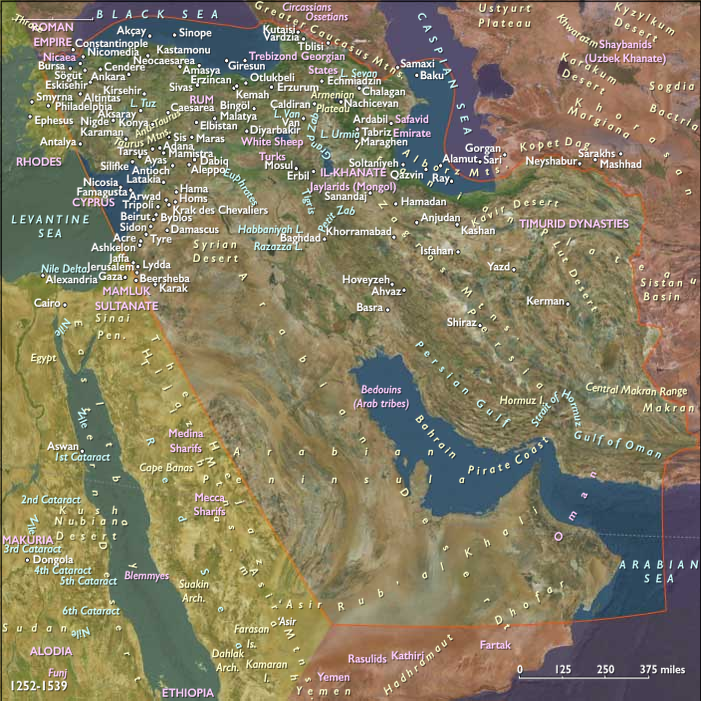
The Mongol defeat at Ain Jalut in…
1252 CE to 1395 CE
The Mongol defeat at Ain Jalut in 1260 leads directly to the first important war between grandsons of Chinggis.
The Mamluk leader, Baibars, makes an alliance with Berke Khan, Batu's brother and successor.
Berke has converted to Islam, and he thus is sympathetic to the Mamluk for religious reasons, as well as because he is jealous of his nephew, Hulagu.
When Hulagu sends an army to Syria to punish Baibars, he is attacked suddenly by Berke.
Hulagu has to turn his army back to the Caucasus to meet this threat, and he makes repeated attempts to ally himself with the kings of France and England and with the Pope in order to crush the Mamluks in Palestine.
Berke withdraws, however, when Kublai sends thirty thousand troops to aid the llkhans.
This chain of events marks the end of the Mongol expansion in Southwest Asia.
Although Hulagu's successors do not exhibit the austere martial qualities of their forebears, they do bring a partial and brief economic revival to Iran.
An increase in commerce and the expansion of trade routes brings a measure of cross-culturization between Iran and China.
The Mongol rulers devote themselves to a more genteel life and let their provinces be governed by Turkish viziers.
Finally these viziers seize control, and the Ilkhan khanate ends with the death of Abu Said in 1335.
Locations
People
Groups
Topics
Subjects
Regions
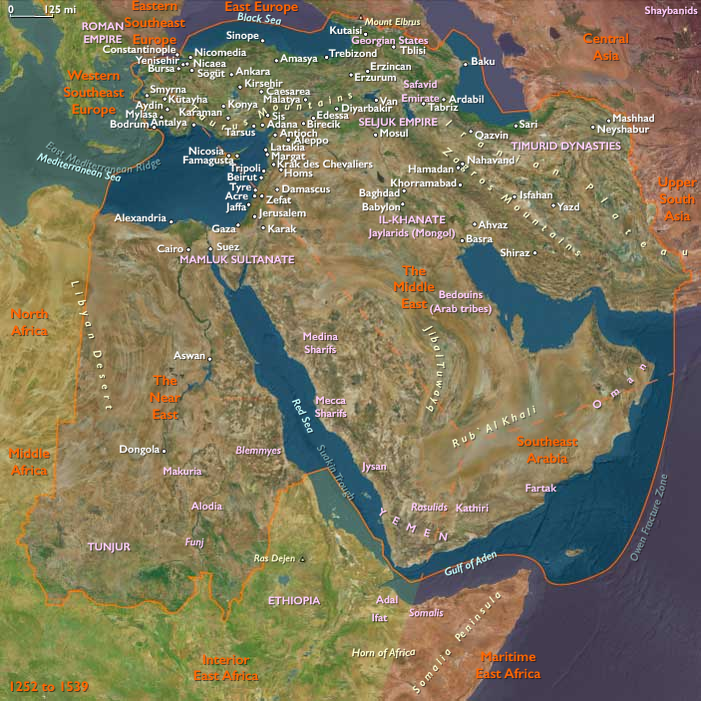
The Near and Middle East
View →Subregions