Dieric Bouts's Altarpiece of the Holy Sacrament…
1468 CE to 1479 CE
Dieric Bouts's Altarpiece of the Holy Sacrament and the Last Supper (1464–1467)
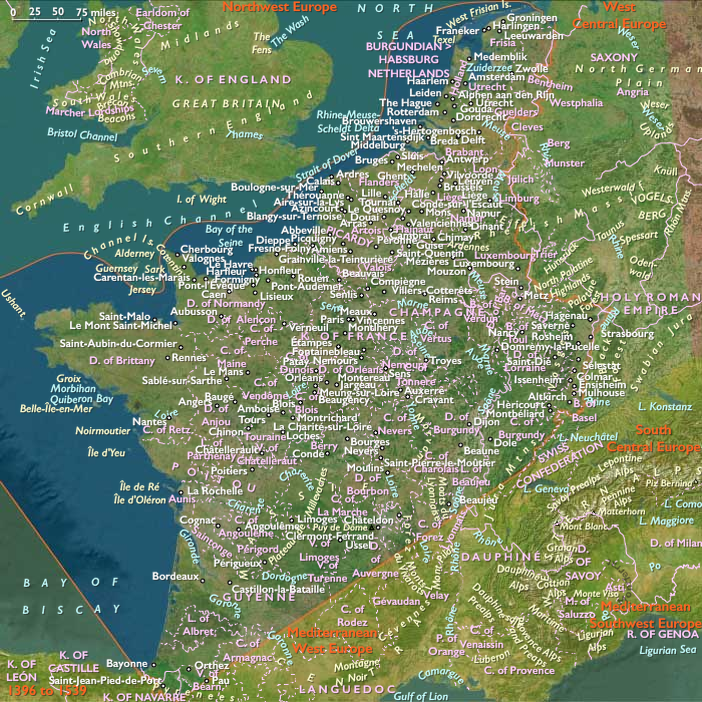
Commissioned in 1464 by the Confraternity of the Holy Sacrament for St. Peter’s Church in Leuven (Louvain), Dieric Bouts’s masterful Altarpiece of the Holy Sacrament prominently features the renowned panel depicting the Last Supper, completed by 1467. This groundbreaking work holds particular historical significance, both artistically and theologically, representing a profound synthesis of Flemish naturalism with pioneering use of Italian linear perspective.
Innovative Use of Linear Perspective
The Last Supper panel demonstrates Bouts’s pioneering grasp of Italian linear perspective, reflecting the Flemish painter’s exceptional artistic skill. Its composition employs carefully delineated orthogonals—lines running perpendicular to the picture plane that converge toward a single vanishing point centered precisely on the mantelpiece above Christ’s head. Notably, Bouts introduces additional complexity: a smaller side room has its own distinct vanishing point, and neither this nor the main room’s perspective aligns precisely with the horizon visible through the windows. This subtle departure from strict perspective conventions adds to the panel’s sophisticated spatial complexity.
Bouts’s painting is only the second dated Flemish panel (following Petrus Christus’s Virgin and Child Enthroned with St. Jerome and St. Francis from 1457) to clearly demonstrate the influence and application of Italian linear perspective.
Iconographic and Theological Innovation
Bouts’s depiction of the Last Supper also introduces remarkable theological and narrative innovations. Unlike typical representations of the biblical scene, which usually emphasize Judas’s betrayal or Christ’s emotional bond with John, Bouts instead portrays Christ explicitly in the role of a priest conducting the Eucharistic consecration, directly aligning the painting with contemporary liturgical practice. This bold interpretation underscores the painting’s primary devotional purpose, reinforcing the doctrine of transubstantiation and directly reflecting the theological priorities of its patrons, the Leuven Confraternity of the Holy Sacrament.
Inclusion of Confraternity Members and Local Context
Enhancing the painting’s depth and complexity, Bouts incorporates four servants—two visible through the window and two standing prominently in Flemish attire—into the scene. Previously assumed to be portraits of the artist and his sons, these figures are now generally recognized as representations of the confraternity members who commissioned the altarpiece, symbolically integrating patrons into the sacred narrative and emphasizing their spiritual role and patronage within the church community.
Artistic Style and Legacy
Characterized by exaggeratedly tall, slender figures, serene facial expressions, and solemn architectural spaces, Bouts’s style conveys a refined sense of elegance and meditative stillness. This restrained but sophisticated artistic language marks his work as uniquely influential within Flemish painting.
Bouts’s two later panels (circa 1470–75), depicting the morally charged narrative scenes of the "Judgment of the Emperor Otho III," "Execution of the Innocent Count," and "Ordeal by Fire," although thematically somber and morbid, further illustrate his stylistic mastery and narrative complexity. These paintings, along with the Altarpiece of the Holy Sacrament, substantially shaped the artistic traditions of Louvain, influencing subsequent generations of painters through their emotional restraint, spatial innovation, and refined compositional clarity.
Long-Term Significance
Dieric Bouts’s pioneering use of perspective, nuanced theological expression, and subtle integration of local cultural context make the Altarpiece of the Holy Sacrament, especially the Last Supper panel, a landmark work in Flemish painting. It significantly expanded artistic possibilities within Atlantic West Europe, influencing regional artistic traditions and laying important groundwork for subsequent Northern Renaissance painters.
People
Regions
West Europe
View →Subregions