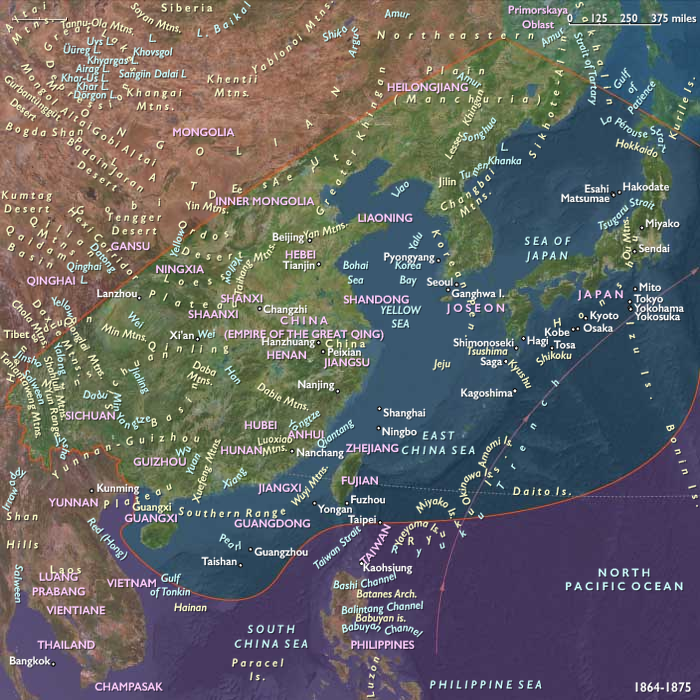
The late Joseon Dynasty, which patronizes Neo-Confucianism…
March 1864 CE
The late Joseon Dynasty, which patronizes Neo-Confucianism as the state ideology, has seen an increasing polarization between orthodox Confucian scholars and efforts by other Confucian scholars to revive social ethics and reform society.
The increasing presence and pressure from the West has created a greater sense of urgency among reformers, and thus Choe Je-u, who is from Gyeongju and whose pen name is 'Suun',had written his treatise, Comprehensive Book of Eastern Learning, or Dongkyeong Daejon.
This treatise, which marks the first use of the term "Eastern Learning", calls for a rejection of God (in the Christian sense), and other aspects of Christian theology.
Calling for a return to the "Way of Heaven", Choe, who had been alarmed by the intrusion of Christianity (Cheonjugyo Catholicism), and the Anglo-French occupation of Beijing, believes that the best way to counter foreign influence in Korea is to introduce democracy, establish human rights and create a paradise on Earth independent of foreign interference.
Choe Je-u's treatise argues a return to the Confucian understanding of Heaven, with emphasis on self-cultivation and improving one's nature.
As Choe had written, the Way of Heaven is within one's own mind, and so by improving one's nature, one also attains the Way of Heaven.
Donghak is not accompanied by a specific agenda or systematic doctrine.
Choe believes in improvising as events occur.
He has no practical plans or visions of how one would go about establishing a paradise on Earth, let alone what paradise means except that all people are equal.
Nevertheless, Choe's advocacy of democracy, human rights and nationalism strikes a chord among the peasant guerrillas and Donghak has spread across Korea rapidly.
Choe is executed on March 10, 1864 by order of the Heungseon Daewongun.
While Donghak had originated as a reform movement and revival of Confucian teachings, it will gradually evolve into a religion known today as Cheondoism in Korea under the third patriarch.
People
Groups
Subjects
Regions
East Asia
View →Subregions