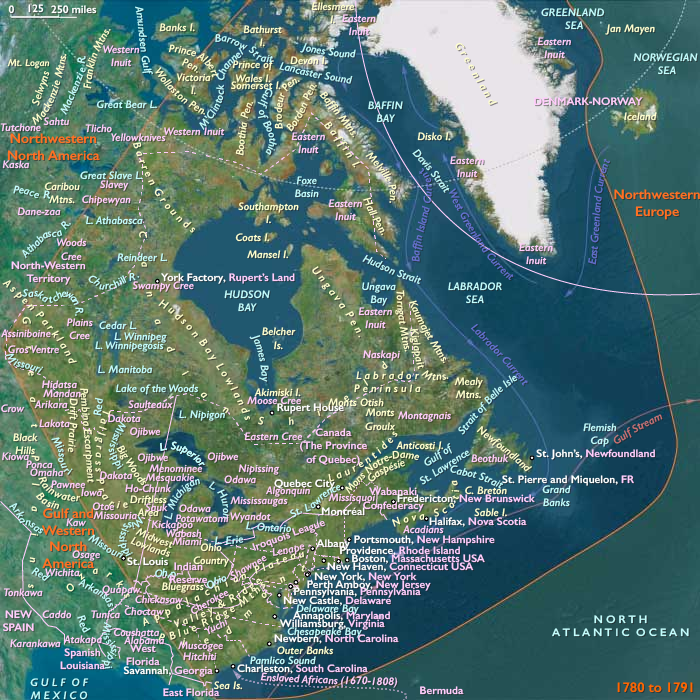
The Hidatsa and their ancestors have resided…
1782 CE
Accounts of recorded history in the early eighteenth century identify three closely related village groups to which the term Hidatsa is applied.
What is now known as the Hidatsa tribe is the amalgamation of these three groups, which had discrete histories and spoke different dialects; they came together only after settling on the Missouri River (Awati /Awáati).
The Awaxawi ("Village on the Hill") or Amahami ("Broken Land", "Mountainous Country") have a creation tradition similar to that of the Mandan, which describes their emergence long ago from the Earth, at Devil's Lake (Miri xopash / Mirixubáash / Miniwakan) ("Holy Water there").
Later they moved westward to the Painted Woods (near Square Buttes or Awakotchkesshesh) and settled near a village of Mandan and another of Awatixa.
The Awatixa ("Village of the Scattered Lodges") or Awadixá (″High Village″) originated not from the earth, but from the sky, led by Charred Body.
According to their tradition, their first people lived near Painted Woods, "where they were created."
After that they always lived between the Heart River (Naada Aashi / Naadáashishh) and Knife River (Mee ecci Aashi / Mé'cii'aashish) along the Middle Missouri River (Awati / Awáati).
The Hidatsa proper or Hiraacá / Hiratsa ("People of the Willows"), largest of the three, are a confederation of numerous nomadic Hidatsa bands from the north, who separated from the Awaxawi/Amahami in what is now western Minnesota.
First they settled to the north, then later moved south to Devil's Lake.
In their travels they had met the Mandan (Adahpakoa / Aróxbagua) (sometimes also called: Araxbakua Itawatish), then moved westward and settled with these distant relatives north of the Knife River, where they adopted agriculture and permanent villages.
Later they moved to the mouth of Knife River.
Their territory rangess upstream along the Missouri River, its tributary regions to the west, and the Mouse River and Devils Lake regions to the northeast.
They were initially part of those who would become the River Crow.
The Hidatsa called the Crow Nation Gixaa'iccá / Gixáa-iccá ("Those Who Pout Over Tripe").
The Hidatsa originally lived in Miri xopash / Mirixubáash / Miniwakan, the Devils Lake region of North Dakota, before being pushed southwestward by the Lakota (Itahatski / Idaahácgi).
As they migrated west, the Hidatsa came across the Mandan at the mouth of the Heart River.
The two groups had formed an alliance, and settled into an amiable division of territory along the area's rivers.
Prior to the epidemic of 1782, they had few enemies.
The Hidatsa hunt upstream from the earth lodge villages at and below the Knife River.
Here, between the Knife and Yellowstone River (Mii Ciiri Aashi /Mi'cíiriaashish), they are numerous enough to withstand attacks of the Assiniboine (Hidusidi / Hirushíiri), who hunt in the area but rarely winter on the Missouri River.
As part of the mighty Iron Confederacy (which is dominated by the Cree (Sahe / Shahíi) and Assiniboine) they are an opponent the Hidatsa has to pay attention to.
Groups
Commodities
Subjects
Regions

Northern North America
View →Subregions