
The Execution of the Távora Family and…
January 1759 CE
The Execution of the Távora Family and the Triumph of Pombal (1759)
Despite vehemently denying all charges, the Távora family and their allies were found guilty of treason and attempted regicide in what was undoubtedly a politically motivated show trial. Their fate was sealed not by proof, but by the will of Sebastião José de Carvalho e Melo, whose goal was to crush the aristocracy and consolidate absolute power under the monarchy.
The Erasure of the Távora Name
As part of their sentence, the Távora estates were confiscated, their palace in Lisbon was razed, and the earth salted to symbolize their permanent disgrace. In an effort to obliterate their legacy, the family’s name was erased from the peerage, and their coat of arms was outlawed.
Originally, the death sentence had included entire families, condemning women and children to execution alongside their fathers, husbands, and brothers. However, at the pleading of Queen Mariana Victoria and the princess-heiress Maria Francisca, most of the children and younger family members were spared. Instead, members of the Alorna family and the daughters of the Duke of Aveiro were sentenced to life imprisonment in various monasteries and convents.
The Spectacle of the Távora Execution – January 13, 1759
One of the most shocking public executions in Portuguese history unfolded on January 13, 1759, in an open field near Lisbon, where the Marchioness Leonor of Távora and the other convicted conspirators faced their gruesome fate.
The King himself, accompanied by his court, witnessed the event—an act of deliberate intimidation orchestrated by Carvalho de Melo. The nobles present were horrified to see their own peers and relatives tortured and executed, but they dared not object.
The executions were brutal:
- The Marchioness of Távora, her husband, and the Duke of Aveiro were broken on the wheel—their limbs shattered before they were put to death.
- Others were garroted or beheaded, their bodies displayed as a warning to the nobility.
- Afterwards, the execution ground was salted, a final symbolic act to prevent new life from growing in the place where the Távoras had fallen.
Sebastião de Melo’s Rise to Power
For his handling of the Távora Affair, Carvalho de Melo was made Count of Oeiras in 1759, formalizing his position as Portugal’s most powerful figure. His opponents had been eliminated, and the nobility, once defiant, was now fully subdued.
His absolute control over Portugal was further cemented in 1770, when King José I elevated him to Marquis of Pombal, the title by which he is known today.
The Political Context – A Convenient Elimination of Enemies
While the official narrative framed the Távora Affair as a failed aristocratic coup, doubts persist.
- The Duke of Aveiro had once been a potential candidate for the throne, as many aristocrats had been dissatisfied with the lack of a male heir. However, his conviction conveniently removed him as a political rival.
- With the Távoras gone, and the Jesuits expelled, all major opponents of Sebastião de Melo were eliminated.
- The attack on King José I might have been nothing more than a random highway robbery, given that he was traveling unguarded on an isolated road—an unusual lack of security for a reigning monarch.
- None of the Távoras or their allies attempted to flee the country in the days following the attack, implying they did not see themselves as guilty.
The Távora Affair remains one of the most infamous political purges in Portuguese history, orchestrated not just to punish alleged conspirators, but to crush the nobility and secure absolute power in the hands of Sebastião de Melo and King José I.
Locations
Groups
Regions
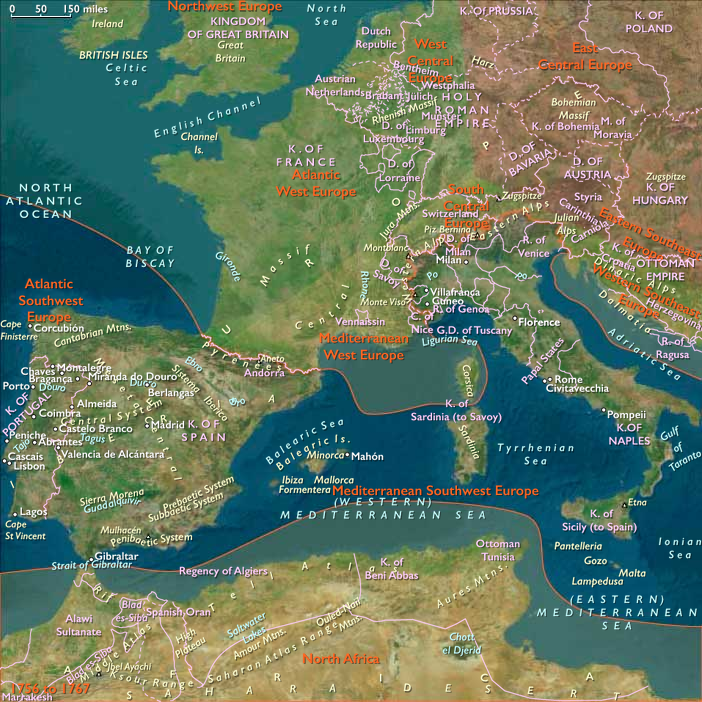
Southwest Europe
View →Subregions
