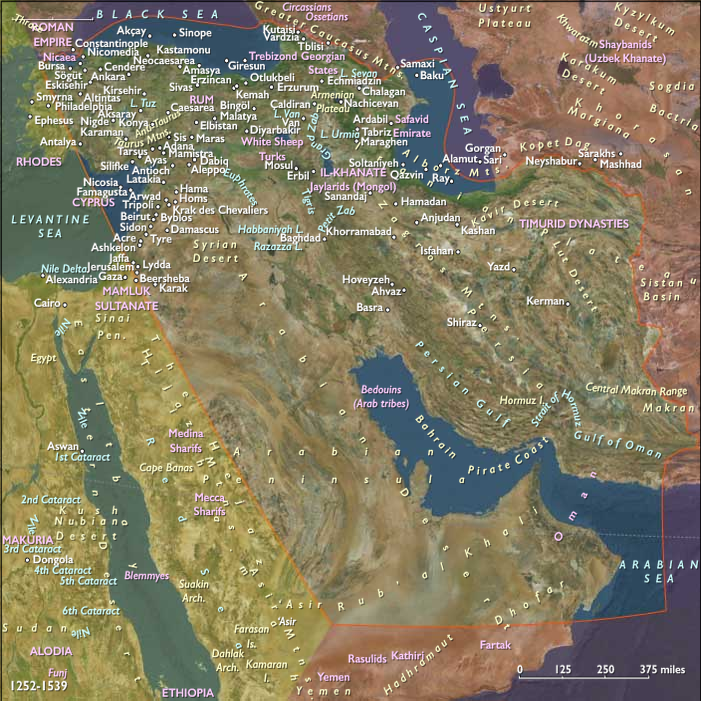
The Middle East: 1372–1383 CE Murad I…
1372 CE to 1383 CE
The Middle East: 1372–1383 CE
Murad I and Ottoman Expansion into the Balkans
During the era 1372–1383 CE, Sultan Murad I decisively expands the Ottoman Empire into the Balkans. Having consolidated Ottoman authority in Thrace, Murad now turns toward the strategic conquest of the western Balkans, methodically securing critical territories and fortresses. He establishes Edirne (Adrianople) firmly as the empire’s new capital, emphasizing its significance as a gateway to Europe and symbolizing Ottoman ambitions beyond Anatolia.
The Ottoman Janissary corps matures under Murad's leadership into an elite military force. This corps of highly disciplined infantry, recruited from captured Christian youths converted to Islam, emerges as the backbone of Ottoman military operations and plays a critical role in the conquest of Balkan territories, marking a turning point in Ottoman military strategy and organization.
Jalayrid Decline and Regional Fragmentation
In Iraq and western Persia, the Jalayrid Sultanate struggles to maintain stability amid ongoing internal strife and external threats. The Jalayrids, descendants of the Mongol Jalayir tribe, face persistent pressure from competing dynasties and regional warlords who exploit weakened central authority. This period sees growing chaos, with local dynasties like the Muzaffarids in southern Persia and smaller Turkmen emirates increasingly asserting autonomy, further fragmenting former Il-Khanate territories.
Turkmen Emirate Rivalries in Anatolia
Anatolia witnesses intensified rivalry among several Turkmen emirates following the dissolution of Seljuq dominance. While the Ottoman principality steadily expands, other emirates, such as the Karamanids and the Germiyanids, also strengthen their positions in central and eastern Anatolia, creating a politically volatile landscape characterized by shifting alliances, periodic warfare, and diplomatic intrigue.
Economic and Cultural Dynamism Amid Political Turmoil
Despite ongoing political instability, urban centers such as Damascus, Aleppo, and Cairo continue thriving as economic and cultural hubs. Trade networks, particularly those connecting the Mediterranean to Central Asia through caravan routes, remain robust. The resilience of regional commerce underpins the continued cultural exchange and intellectual activity exemplified by scholars who maintain vibrant traditions of literature, philosophy, and science.
Ongoing Impact of the Black Death
The Black Death continues to periodically resurface throughout the Middle East, disrupting demographic stability, economic productivity, and social cohesion. While not as catastrophic as the initial mid-fourteenth-century epidemic, these outbreaks perpetuate fear and caution, shaping societal attitudes and influencing urban planning, trade practices, and public health measures.
Thus, from 1372 to 1383 CE, the Middle East witnesses dynamic Ottoman territorial expansion under Murad I, ongoing fragmentation and instability in the post-Mongol Persian and Iraqi regions, rivalry among Anatolian emirates, and persistent economic and cultural vigor despite the backdrop of recurring plague outbreaks.
People
Groups
Topics
Subjects
Regions
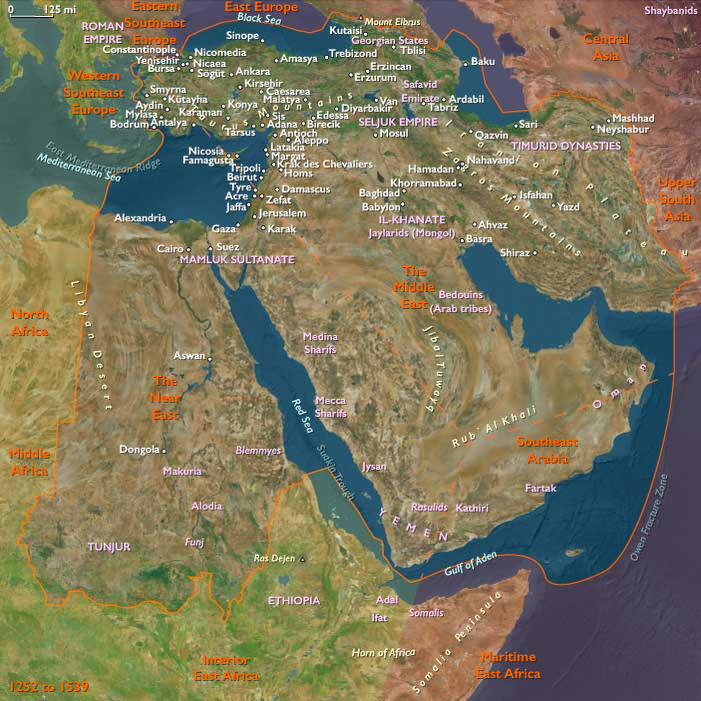
The Near and Middle East
View →Subregions