
The Middle East: 1684–1695 CE Power …
Years: 1684 - 1695
The Middle East: 1684–1695 CE
Power Struggles and Shifting Alliances
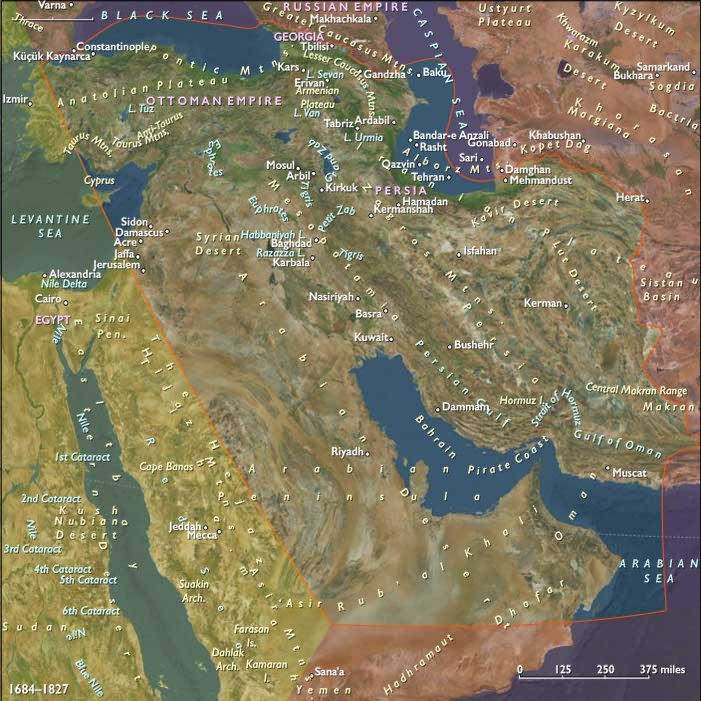
Following their expulsion of the Portuguese from Muscat and other coastal territories, the Yarubid Imamate continues consolidating power across Oman's interior and coast. By this era, the Yarubids firmly control trade routes to East Africa and India, further cementing Oman's strategic maritime significance. Muscat becomes a prosperous port city, fueling Oman's rise as a formidable maritime empire in the western Indian Ocean and effectively supplanting Portuguese dominance in regional trade.
In the Levant, particularly in Mount Lebanon, Ottoman governance remains nominal as local dynasties persist with significant autonomy. The legacy of Fakhr ad-Din ibn Maan lingers, influencing Druze and Maronite interactions, though no equally charismatic leader emerges to unite these groups. Instead, Lebanon experiences continued factionalism, with various Druze and Maronite families seeking influence through complex alliances and rivalries. Ottoman oversight continues but is primarily concerned with taxation and military conscription, leaving local politics relatively unchecked.
Further east, the Safavid Empire endures internal and external pressures, notably the continued rivalry with the Ottoman Empire. Safavid control in Iraq and the Caucasus is tenuous, with Baghdad remaining firmly in Ottoman hands since the Treaty of Qasr-e Shirin (1639). The period sees increasing decentralization in Safavid territories, compounded by declining military organization and weakened central authority. Safavid territories suffer from economic stagnation, partly resulting from heavy taxation, administrative corruption, and waning external trade.
In the Caucasus, Ottoman-Persian rivalries persist, maintaining the division of Armenia and Georgia into spheres of influence. The Ottomans sustain administrative practices such as the millet system, which grants considerable autonomy to religious minorities, notably the Armenian Apostolic Church. Such arrangements enable the Armenians and Georgians to retain cultural distinctiveness despite external political pressures.
Iraq remains a contested buffer zone. Tribal confederations like the Muntafiq in southern Iraq and the Baban Dynasty in the Kurdish north challenge Ottoman authority, creating ongoing administrative instability. The tribal leaders, exercising near-complete autonomy, regularly ignore mandates from distant Ottoman governors in Baghdad, thereby fragmenting governance and economic cohesion.
Trade relations between Europe and the Levant strengthen notably during this era, reflecting the extensive activities of European merchant companies like Britain's Levant Company and French trading interests based in Aleppo and Beirut. These commercial interactions foster robust cultural exchanges and contribute to the growing prominence of cities like Aleppo as cosmopolitan trade centers.
Legacy of the Era
Between 1684 and 1695 CE, the Middle East is characterized by intensified local autonomy, fragmented imperial governance, and increasing European commercial penetration. Oman's ascendancy reshapes Indian Ocean trade dynamics, while Levantine cities flourish commercially despite internal divisions. Persistent tribal autonomy in regions like Iraq, coupled with declining central Safavid power, anticipates profound transformations in regional geopolitics in subsequent decades.
Groups
- Omanis
- Muslims, Sunni
- Muslims, Shi'a
- Muslims, Ibadi
- Venice, (Most Serene) Republic of
- Al-Muntafiq
- Ottoman Empire
- Persia, Safavid Kingdom of
- Levant Company, or Turkey Company (in full: Company of Merchants of England trading to the Seas of the Levant)
- France, (Bourbon) Kingdom of
- Habsburg Monarchy, or Empire
- Yaruba dynasty
- Oman, Second Imamate of
- Baban
Commodoties
Subjects
Regions
Subregions
Related Events
Showing 10 events out of 30218 total
Years: 1684 - 1695
Groups
- Omanis
- Muslims, Sunni
- Muslims, Shi'a
- Muslims, Ibadi
- Venice, (Most Serene) Republic of
- Al-Muntafiq
- Ottoman Empire
- Persia, Safavid Kingdom of
- Levant Company, or Turkey Company (in full: Company of Merchants of England trading to the Seas of the Levant)
- France, (Bourbon) Kingdom of
- Habsburg Monarchy, or Empire
- Yaruba dynasty
- Oman, Second Imamate of
- Baban
Commodoties
Subjects
Regions
Subregions