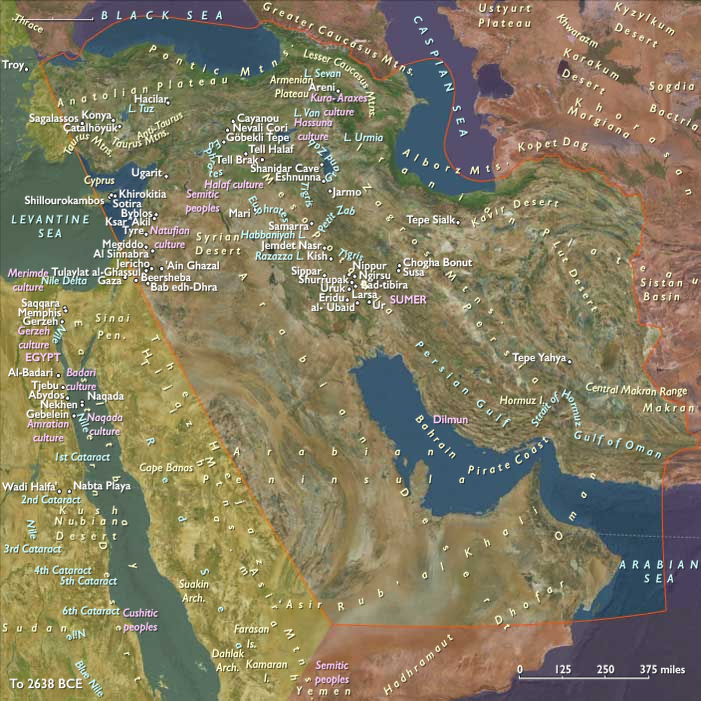
Middle East (4,365 – 2,638 BCE) Late…
4365 BCE to 2638 BCE
Middle East (4,365 – 2,638 BCE) Late Neolithic / Chalcolithic — Canal Oases, Copper, and Exchange Webs
Geographic and Environmental Context
The Middle East includes Iraq, Iran, Syria, Armenia, Georgia, Azerbaijan, eastern Jordan, most of Turkey’s central/eastern uplands (including Cilicia), eastern Saudi Arabia, northern Oman, Qatar, Bahrain, the UAE, northeastern Cyprus, and all but the southernmost Lebanon.-
Anchors: the Tigris–Euphrates alluvium and marshes; the Zagros (Luristan, Fars), Alborz, Caucasus (Armenia–Georgia–Azerbaijan); northern Syrian plains and Cilicia; Khuzestan and Fars lowlands; the Arabian/Persian Gulf littoral (al-Ahsa–Qatar–Bahrain–UAE–northern Oman); northeastern Cyprus and the Lebanon coastal elbow (north).
Climate & Environment
-
Warm with beginning arid pulses; alluvial levees shifted; marsh belts waxed/waned in Lower Mesopotamia.
Subsistence & Settlement
-
Canalized fields in Khuzestan–Lower Tigris–Euphrates; Ubaid-like village networks (style influences) in our north–east periphery; mixed farming in Iranian fans; pastoral transhumance in Zagros.
-
Caucasus highlands developed the Shulaveri–Shomu/Leilatepe-type agro-villages (shared horizon with South Caucasus).
Technology & Material Culture
-
Copper tools/adornments; stamp seals; painted ceramics; long-house compounds; boat building on marsh edges.
Corridors
-
Alluvium ⇄ Gulf watercraft; overland Zagros caravan trails; Araxes–Kura to the Caucasus.
Symbolism
-
Temple-precursor spaces; canal-opening rites; ancestor veneration persists.
Adaptation
-
Canal maintenance, pasture switching, and oasis redundancy hedged against channel avulsion and aridity.
Transition
Toward the Bronze Age, metallurgy and canal polities will scale up into early states (Uruk/Ur—south of our boundary—interfacing with our oases).
Groups
Topics
Commodities
Subjects
Regions
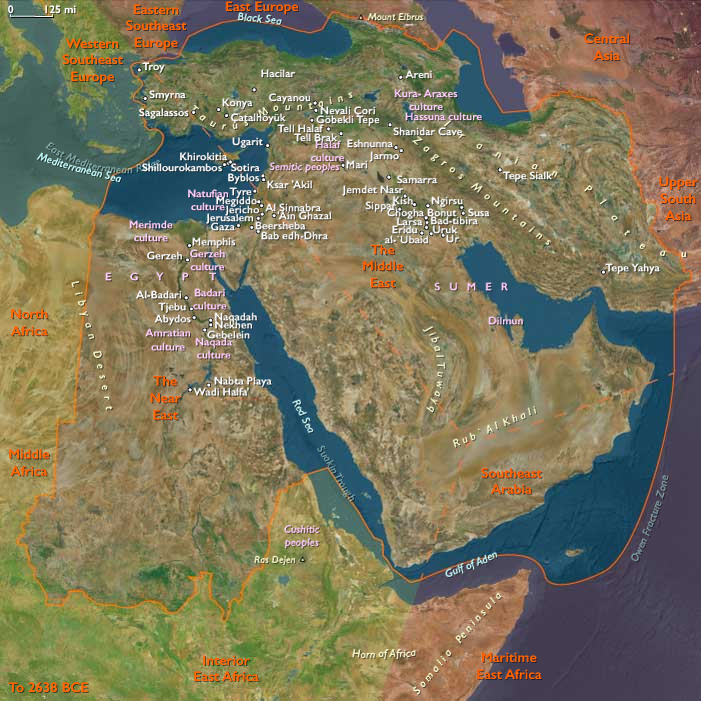
The Near and Middle East
View →Subregions