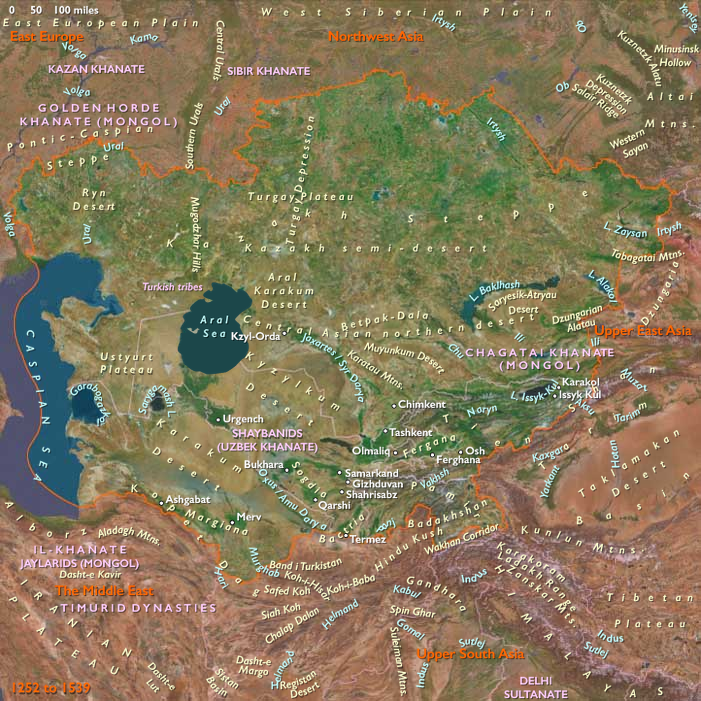
Timur, who also invaded Russia before dying…
1396 CE to 1539 CE
By supporting such people, Timur had imbued his empire with a very rich culture.
A wide range of religious and palatial construction projects are undertaken in Samarkand and other population centers during Timur's reign and the reigns of his immediate descendants.
Timur also patronizes scientists and artists; his grandson Ulugh Beg is one of the world's first great astronomers.
It is during the Timurid dynasty that Turkish, in the form of the Chaghatai dialect, becomes a literary language in its own right in Mawarannahr—although the Timurids also patronize writing in Persian.
Until this time only Persian had been used in the region.
The greatest Chaghataid writer, Ali Shir Nava'i, is active in the city of Herat, now in northwestern Afghanistan, in the second half of the fifteenth century.
The Timurid state quickly breaks into two halves after the death of Timur.
The chronic internal fighting of the Timurids attracts the attention of the Uzbek nomadic tribes living to the north of the Aral Sea, who begin a wholesale invasion of Mawarannahr in 1501.
The Uzbeks complete their conquest of Central Asia by 1510, including the territory of the present-day Uzbekistan.
Locations
People
Groups
Tajik people
View →
Iranian peoples
View →
Arab people
View →
Persian people
View →
Kazakhs (also spelled Kazaks, Qazaqs)
View →
Oghuz Turks
View →
Turkmens (Central Asia)
View →
Mongols
View →
Uzbeks
View →
Chagatai Khanate, Western
View →
Timurid Empire
View →
Bukhara, Uzbek (Shaybanid) Khanate of
View →
Subjects
Regions
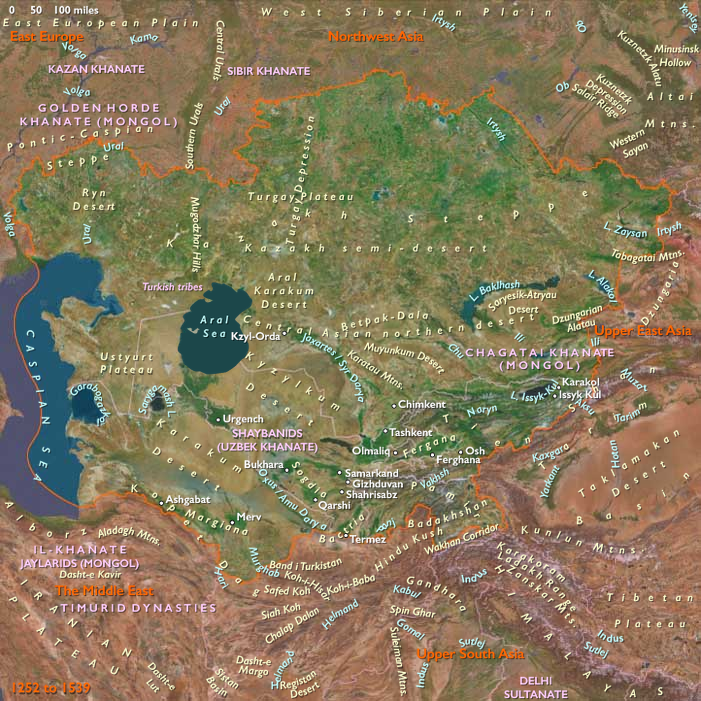
Central Asia
View →Subregions