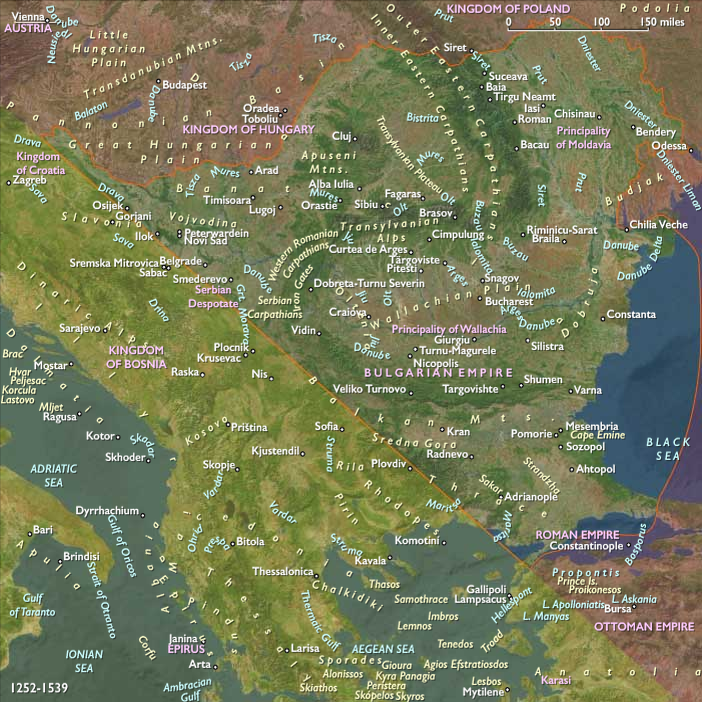
Transylvanian emigres in the thirteenth and fourteenth…
1252 CE to 1395 CE
Transylvanian emigres in the thirteenth and fourteenth centuries found two principalities, Walachia and Moldavia.
Legend says that in 1290 Negru-Voda, a leading Romanian nobleman (voivode), left Fagaras in southern Transylvania with a group of nobles and foundes "Sara Românească" on the lands between the southern Carpathians and the Danube. (The name "Sara Românească" means "Romanian land," here, actually "Walachia"; the word "Walachia" is derived from the Slavic word vlach, which is related to the Germanic walk, meaning "foreigner.")
A second legend holds that a Romanian voivode named Dragoș crossed the Carpathians and settled with other Romanians on the plain between the mountains and the Black Sea.
They are joined in 1349 by a Transylvanian voivode named Bogdan, who revolts against his feudal overlord and settles on the Moldova River, from which Moldavia derives its name.
Bogdan declares Moldavia's independence from Hungary a decade later.
The remaining Romanian nobles in Transylvania eventually adopt the Hungarian language and culture; Transylvania's Romanian serfs continue to speak Romanian and cling to Orthodoxy but are powerless to resist Hungarian domination.
Locations
Groups
Topics
Subjects
Regions
Southeast Europe
View →Subregions