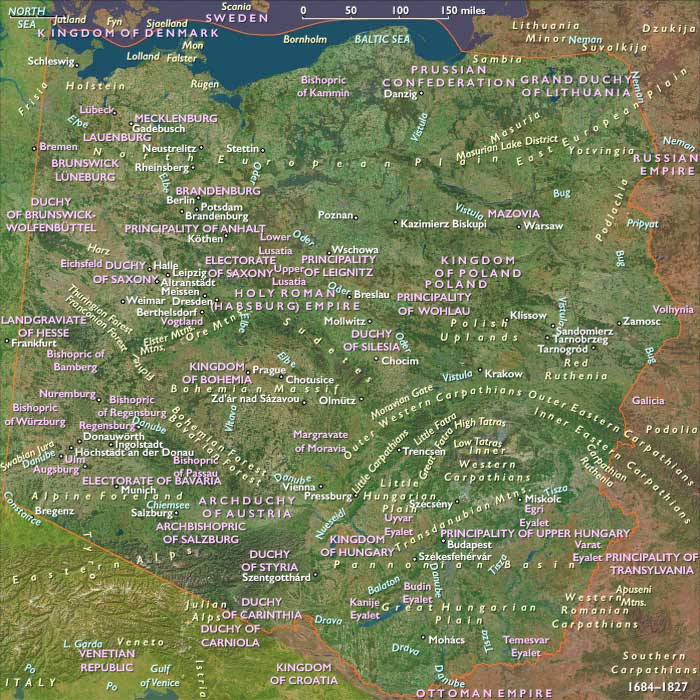
Brandenburg in 1648 had been a small…
1684 CE to 1827 CE
Brandenburg in 1648 had been a small state in northern Germany.
It has been ruled by the Hohenzollern Dynasty since the late fifteenth century and consists of the core region and its capital, Berlin: eastern Pomerania; an area around Magdeburg; the former holdings of the Knights of the Teutonic Order in eastern Prussia; and some smaller holdings in western Germany.
Brandenburg becomes known as Prussia in 1701 when its ruler crowns himself King Frederick I of Prussia.
Prussia acquires the rest of Pomerania after defeating Sweden in the Great Northern War (1700-21).
Prussia's increase in size and influence may be attributed to a succession of capable leaders, all of whom enjoy long reigns.
The first is Frederick William (r. 1640-88), known as the Great Elector, who increases his family's power by granting favors to the nobility, weakening the independence of the towns, and maintaining a professional standing army.
His son Frederick I (r. 1688-1713) establishes Prussia as a kingdom.
Frederick further strengthens the army, but not nearly as much as his son Frederick William I (r. 1713- 40), who also modernizes the kingdom's bureaucracy.
Frederick II (r. 1740-86), known to posterity as Frederick the Great, continues along the same lines as his father but shows much greater imagination and ruthlessness, transforming his small kingdom into one of the great powers of Europe.
Locations
People
Groups
Topics
Subjects
Regions
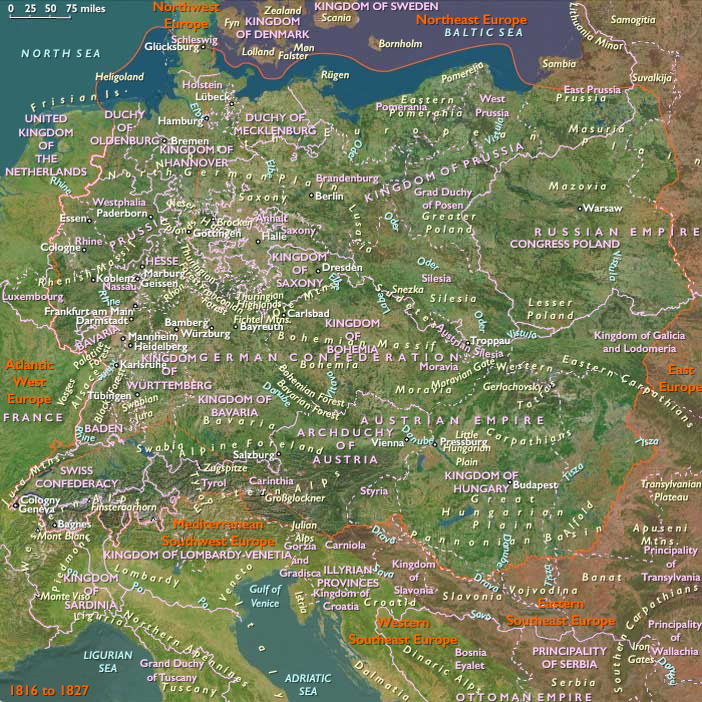
Central Europe
View →Subregions