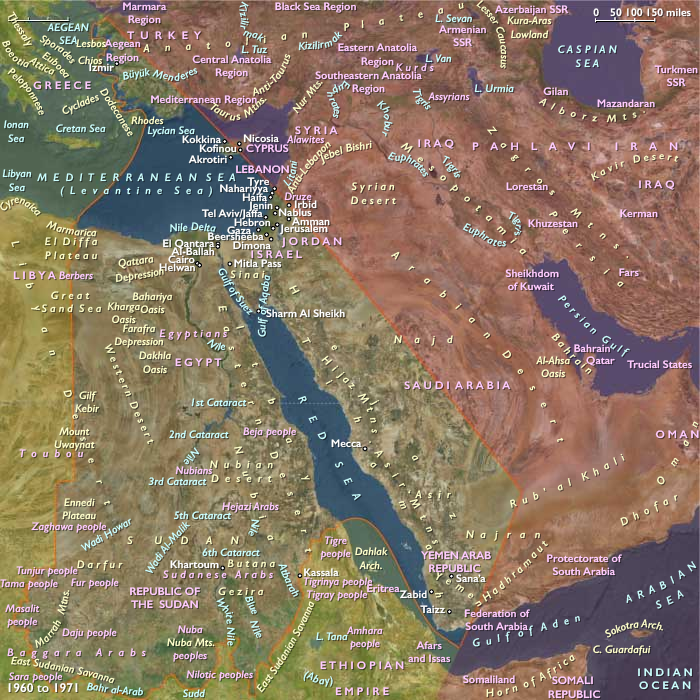
The Near East, 1960 to 1971 CE:…
1960 CE to 1971 CE
The Near East, 1960 to 1971 CE: Turbulent Politics and Regional Conflict
Sudan: Political Instability and Military Rule
Between 1960 and 1971, Sudan experiences significant political turmoil and internal unrest. General Ibrahim Abboud, who seized power in a military coup in 1958, fails to fulfill promises of returning Sudan to civilian governance. Discontent culminates in widespread riots and strikes in October 1964, leading to Abboud's resignation and the establishment of a transitional civilian administration.
Parliamentary elections in April 1965 result in a coalition government of the Umma Party and the National Unionist Party (NUP) under Prime Minister Muhammad Ahmad Mahjoub. However, political instability persists from 1966 to 1969 due to factional disputes, economic stagnation, and ethnic tensions, particularly in southern Sudan, which had sparked the First Sudanese Civil War (1955–1972).
In May 1969, Colonel Jaafar Nimeiry leads a second military coup, abolishing parliament and outlawing political parties. The early Nimeiry era sees ideological struggles between Marxist and non-Marxist factions, resulting in a brief communist-led coup in July 1971. Anti-communist military factions quickly restore Nimeiry's rule, reinforcing authoritarian governance in Sudan.
The Arab-Israeli Conflict: The Six-Day War and War of Attrition
Regional tensions peak during the Six-Day War of June 1967, as Israel decisively defeats Arab forces, occupying significant territories including the West Bank, Gaza Strip, Sinai Peninsula, and Golan Heights. The war dramatically reshapes regional geopolitics and inflames Arab nationalism.
Following the Six-Day War, the War of Attrition (1967–1970) emerges, marked by ongoing clashes between Egypt and Israel along the Suez Canal. This protracted conflict underscores the Cold War dynamics as the Soviet Union heavily supports Egypt, while the United States backs Israel, deepening geopolitical divisions.
Black September and Jordan's Crisis
In Jordan, tensions between the government and Palestinian guerrilla organizations reach a critical point in September 1970, resulting in Black September. Jordanian forces clash violently with Palestinian militants, driving them from the country and significantly affecting regional Palestinian politics.
Yemen: Civil War and Independence
The North Yemen Civil War (1962–1970), another arena of Cold War rivalry, involves Saudi-supported royalists fighting Egyptian-backed republicans, leading to prolonged conflict and instability. In 1967, the British withdrawal from South Yemen results in South Yemeni Independence and the establishment of the People's Democratic Republic of Yemen, the Arab world's first Marxist state, deepening Cold War alignments.
Egypt: The Corrective Revolution
In May 1971, Egyptian President Anwar Sadat consolidates power through the Corrective Revolution, significantly reshaping Egyptian politics. Sadat's regime emphasizes political stability, economic liberalization, and strategic realignment away from Soviet influence toward improved relations with the West.
Regional Reform Demonstrations
Throughout this period, the Near East sees numerous reform demonstrations driven by socioeconomic grievances, ideological divisions, and opposition to autocratic governance. These movements reflect widespread dissatisfaction with the slow pace of reform and the increasing pressures of modernization and globalization.
Legacy of the Era: Persistent Instability and Future Conflict
The years from 1960 to 1971 lay critical foundations for ongoing political instability, regional conflict, and ideological polarization in the Near East. Unresolved political tensions, economic disparities, and external Cold War influences set the stage for continued turbulence and conflict in subsequent decades.
Groups
Topics
Commodities
Regions
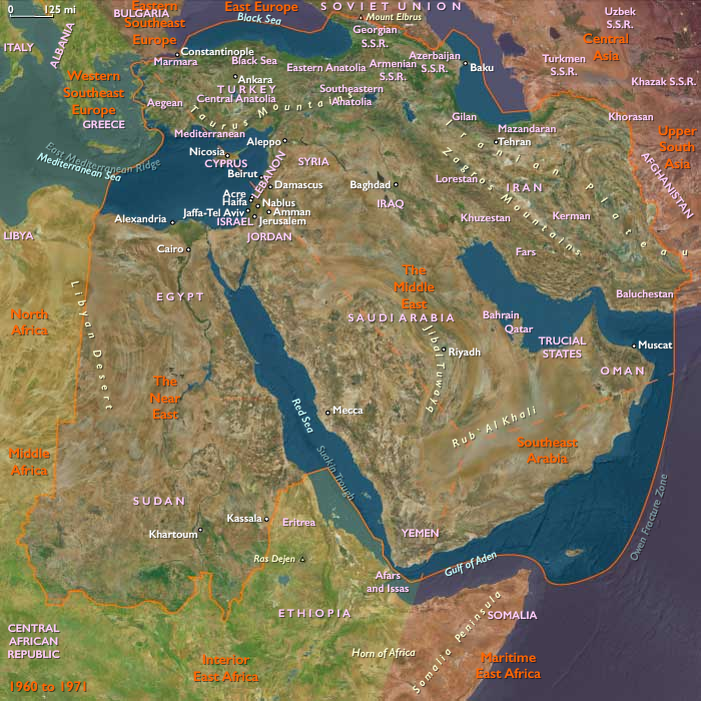
The Near and Middle East
View →Subregions