
The Near East (3213–3070 BCE): Egyptian Unification …
Years: 3213BCE - 3070BCE
The Near East (3213–3070 BCE): Egyptian Unification and the Dawn of Writing
Proto-Dynastic Egypt and Cultural Integration
During the late Naqada III period (circa 3200–3000 BCE), Egypt moves decisively toward political and cultural unification. The characteristic material culture of southern Egypt gradually expands northward, replacing the previously distinct culture of Lower Egypt. Typical Egyptian artifacts evolve: undecorated stone vessels from the Gerzean period supersede Amratian-style pottery. This era also witnesses an influx of distinctly Mesopotamian influences, including cylinder seals, recessed panel architecture, and ceremonial maceheads executed in the Mesopotamian "pear-shaped" style. Cosmetic palettes bearing relief carvings share stylistic elements with the contemporary Mesopotamian Uruk culture.
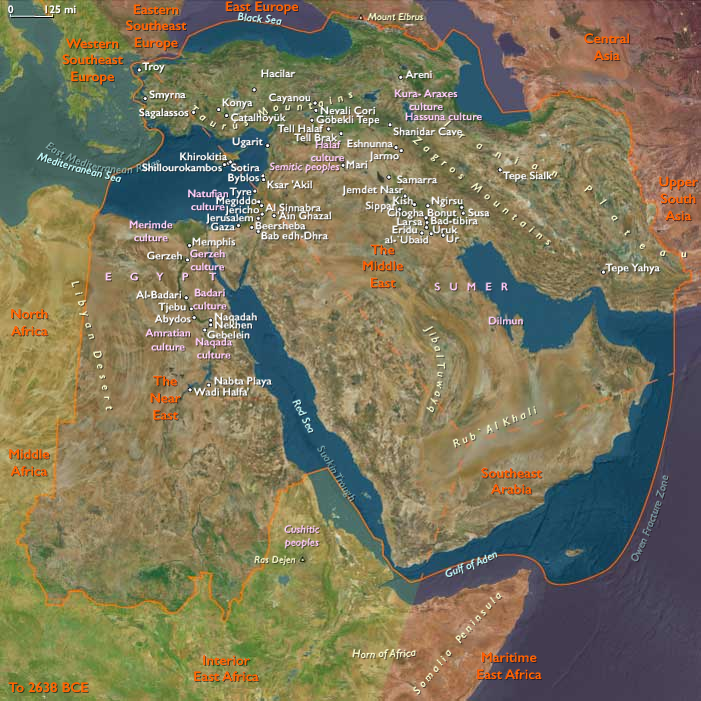
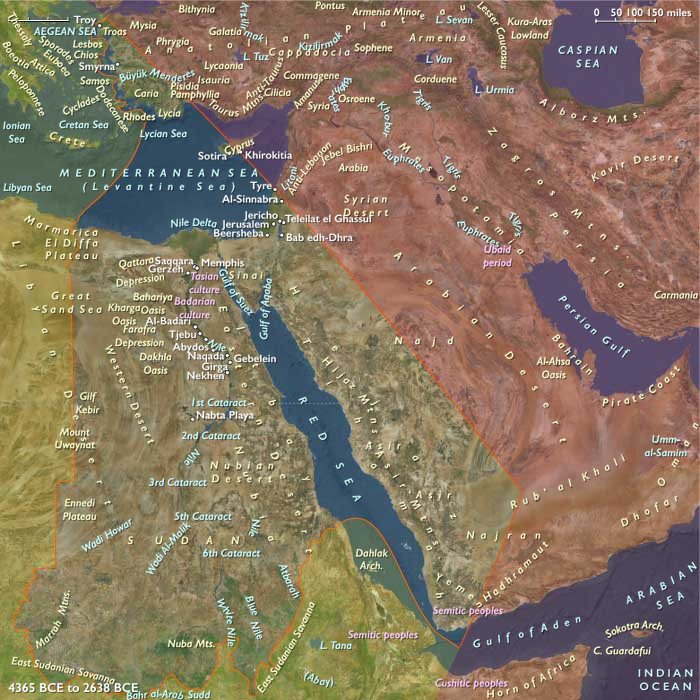
Evidence suggests trade connections between Egypt and Mesopotamia occurred via maritime routes. The presence of artifacts from Byblos indicates Mediterranean trade routes, possibly involving land transit across Sinai or maritime travel along the Red Sea coast. Gerzean settlement distribution, notably at wadis opening to the Red Sea, supports this interpretation.
Egyptian Fortresses and Trade in Canaan
At Tell as-Sakan, south of modern-day Gaza, settlement begins around 3300 BCE with an Egyptian fortress in Canaanite territory. Initially thriving through trade in agricultural products, the settlement later declines when Egypt shifts economic interests toward Lebanese cedar, reducing Gaza to a mere transit port. Consequently, Tell as-Sakan is virtually abandoned by the Early Bronze Age II.
Dynasty 0 (Proto-Dynastic Period)
Egypt's Proto-Dynastic Period, or Dynasty 0 (circa 3200–3000 BCE), marks the culmination of state formation processes begun in the previous period. Powerful regional kings lead emerging polities, their names inscribed within serekhs (royal name-symbols) on pottery, tombs, and votive objects. This is also when hieroglyphic script first emerges, recording names and brief inscriptions on artifacts.
Southern Israel contains evidence of Egyptian colonies or trading outposts during this period, indicating extensive regional influence.
King Narmer and Political Unification
King Narmer emerges as a key historical figure around this time, traditionally recognized for uniting Upper and Lower Egypt into a single state. Depicted prominently on the famous Narmer Palette, Narmer wears the double crown—symbolically uniting the lotus flower (Upper Egypt) and papyrus reed (Lower Egypt)—foreshadowing later Egyptian royal symbolism. Although the historian Manetho credits "Menes" with Egypt’s first unified kingship, scholars widely believe Narmer and Menes might be the same person.
Development of Hieroglyphic and Hieratic Scripts
Around 3100 BCE, Egyptians transition from using purely pictorial representations to an organized system of writing, inventing hieroglyphics. These early hieroglyphs appear initially on ceremonial objects like the Narmer Palette, and even earlier on clay labels discovered at Abydos (Tomb U-j), dated to the early Naqada IIIA period (circa 3200 BCE).
A related, more cursive script, hieratic, emerges concurrently, used primarily for brush-and-ink writing. Contrary to earlier beliefs, hieratic and hieroglyphics develop in parallel, not sequentially, with hieratic becoming the common writing method of scribes, predating monumental stone-carved hieroglyphs, which appear only in the First Dynasty.
Formation of Egyptian City-States
Multiple small city-states develop along the Nile, with Upper Egypt eventually consolidated into three dominant states: Thinis, Naqada, and Nekhen (Hierakonpolis). The Set cult is prominent in Naqada, while Thinis and Nekhen are centers of the Horus cult. Naqada, positioned between the two, becomes the first to be absorbed, subsequently followed by the conquest of Lower Egypt by Thinis. Thinis is possibly the origin of the First and Second Dynasties, though its exact location remains uncertain (possibly near modern Girga). Thinite kings are buried in Abydos.
King Serket ("Scorpion King"), possibly contemporary with Narmer, rules either Nekhen or a competing region and is depicted on ceremonial maceheads. His identity and relationship to Narmer remain unclear; he may represent either a rival or an alternate identity for Narmer.
Urbanization and Religious Authority
The emergence of walled towns, structured tombs resembling houses, and advanced architectural techniques, many likely derived from northern (Lower Egyptian) influence, becomes widespread. Increased trade and craft specialization lead to significant social stratification and hierarchical governance.
The spiritual power of divine kingship solidifies during this period. Cults of gods like Horus, Set, and Neith enhance royal legitimacy, and rulers assume divine roles to consolidate authority. Horus, associated prominently with Nekhen, becomes a potent symbol of kingship, protection, and unified sovereignty.
Sodom, Gomorrah, and Natural Disasters
Southwest of the Dead Sea, five settlements (Bab edh-Dhra among them) dating from this period possibly correspond to the biblical cities of Sodom, Gomorrah, Admah, Zeboiim, and Zoar. The presence of bitumen and petroleum deposits rich in sulfur and natural gas suggests potential historical foundations for legends of their fiery destruction. Recent hypotheses propose that the catastrophic explosion of a meteor over Austria around 3123 BCE could have triggered such widespread devastation, providing a geological explanation for the biblical narrative.
Groups
Topics
Commodoties
Subjects
Regions
Subregions
Related Events
Showing 10 events out of 68717 total
Years: 3213BCE - 3070BCE
Groups
Topics
Commodoties
Subjects
Regions
Subregions