
The Near East (3501–3358 BCE): Cultural Flourishing…
3501 BCE to 3358 BCE
The Near East (3501–3358 BCE): Cultural Flourishing and Emerging Complexity
Trade and Mesopotamian Influence in Egypt
The period between 3501 and 3358 BCE is marked by increased intercultural contacts, especially between Egypt and Mesopotamia. Distinctly foreign art forms and artifacts discovered in Egypt provide concrete evidence of substantial trade relations across various regions of Asia. Egyptian artisans during this era produced items clearly influenced by Mesopotamian styles, notably exemplified by the intricately carved Gebel el-Arak knife handle, adorned with relief carvings that unmistakably mirror Mesopotamian motifs, though with uniquely Egyptian adaptations.
Advanced Settlements in the Negev Desert
In the Negev desert of southern Israel, archaeological findings from Tel Be'er Sheva, located northeast of modern-day Beersheba, reveal thriving communities by the fourth millennium BCE. The inhabitants of this region predominantly dwell in caves, crafting sophisticated metal tools and raising cattle, indicative of significant technological advancement. The region's copper and ivory-working industries further demonstrate a rising class of specialized artisans, reflecting an evolving socio-economic structure based on craftsmanship and trade.
The Gerzean (Naqada II) Cultural Evolution
In Egypt, the Gerzean culture (Naqada II), evolving seamlessly from the earlier Amratian (Naqada I) culture, becomes foundational for Dynastic Egypt. Starting in the Nile Delta and expanding southwards through Upper Egypt, Gerzean culture introduces distinctive ceramics, prominently decorated in dark red, featuring motifs of animals, people, ships, and geometric designs. Pottery handles from this era become artistically "wavy," illustrating heightened decorative sensibilities.
Gerzean artisans skillfully utilize precious materials such as silver, gold, lapis lazuli, and faience for ornamental purposes. Cosmetic palettes previously simple in design now bear sophisticated relief carvings. A significant reduction in rainfall heightens reliance on agricultural productivity, with farming dominating subsistence strategies. Despite this agricultural emphasis, hunting persists as a culturally relevant activity, depicted frequently in contemporary art.
With food surplus, settlements grow substantially, giving rise to cities with populations approaching five thousand inhabitants. During this phase, Egyptians increasingly abandon traditional reed structures in favor of robust mudbrick buildings, broadly adopting Mesopotamian construction techniques, including sun-dried bricks, arches, and decorative recessed walls.
Metallurgy and Mining Innovations
The period sees a crucial transition in tool-making: stone tools evolve from simple bifacial construction to more refined ripple-flaked techniques. Concurrently, copper is extensively used for tools and weaponry. Iron objects remain exceptionally rare due to corrosion, but remarkable examples such as meteoric iron beads from Gerzeh (containing a telltale 7.5% nickel, indicative of extraterrestrial origin) underscore sophisticated metallurgical understanding around 3500 BCE.
Egyptians initiate extensive copper and turquoise mining in the Sinai Peninsula by 3400 BCE, establishing one of the world's earliest known hard-rock mining operations.
Ghassulian Chalcolithic Developments
In southern Israel, the Ghassulian culture, dating from around 3800 BCE to 3350 BCE, excels in metallurgy, particularly copper smelting. Ghassulian funerary practices prominently feature burials in stone dolmens. Trading affinities, including unique churn-shaped "bird vases," possibly link Ghassulian communities to early Minoan culture in Crete, reflecting extensive regional exchange networks.
Hierakonpolis (Nekhen) and Early Urbanism
The city of Nekhen (Hierakonpolis), initially established around 4400 BCE, experiences its zenith around 3400 BCE, reaching a population estimated between five and ten thousand residents. Excavations at Hierakonpolis reveal the oldest known zoological collection dating to 3500 BCE, including diverse exotic animals such as hippos, hartebeests, elephants, baboons, and wildcats. Artistic achievements include the creation of distinctive pottery, exemplified by jars featuring elaborate boat designs.
Rise of Totemism and Horus Worship
Religious life during this period is characterized by totemism, a worldview rooted in kinship associations with specific animals and plants. Interwoven with ancestor worship and animistic beliefs, totemism profoundly shapes Egyptian spirituality. Each regional principality identifies with a distinct totemic animal, prominently including Horus, the falcon god. Worshipped from the Predynastic period onward, Horus, especially revered at Nekhen, emerges as a central deity overseeing domains such as the sky, war, and protection, reflecting the increasingly complex religious symbolism of emerging Egyptian civilization.
Gebelein Mummies and Burial Practices
Around 3400 BCE, the earliest known naturally preserved Egyptian mummies, the Gebelein mummies, date to the Late Predynastic period. Excavated by Wallis Budge near Gebelein (modern Naga el-Gherira), these mummified individuals, positioned in fetal poses within shallow sand graves, offer invaluable insights into early Egyptian burial customs. Accompanying grave goods, including pottery and flints (now lost), indicate ritualistic and cultural complexity associated with burial rites.
Early Lead Use and Craft Specialization
A lead figure dating from 3500 BCE, discovered in Abydos' temple of Osiris and currently housed in the British Museum, underscores early Egyptian experimentation with various metals, including lead for glazing pottery, soldering, and ornamental objects. These technical innovations reflect an increasing specialization of artisanship driven by sustained long-distance trade and interactions with Southwest Asia.
Social Hierarchies and Early Urban Development
Intensified trade, burgeoning artisan classes, and the advent of specialized production significantly impact social structures along the Nile, fostering urban growth and hierarchical governance. Leaders or headmen, credited with controlling the Nile floods, gain authority as revered "rainmaker kings." Urban centers evolve into crucial trading hubs, political capitals, and religious cult sites. Although debates persist among Egyptologists regarding precise timelines, it is during this transformative era that separate communities progressively coalesce into the distinct kingdoms of Lower and Upper Egypt, setting the stage for eventual unification under a centralized Egyptian state.
Groups
Commodities
Regions
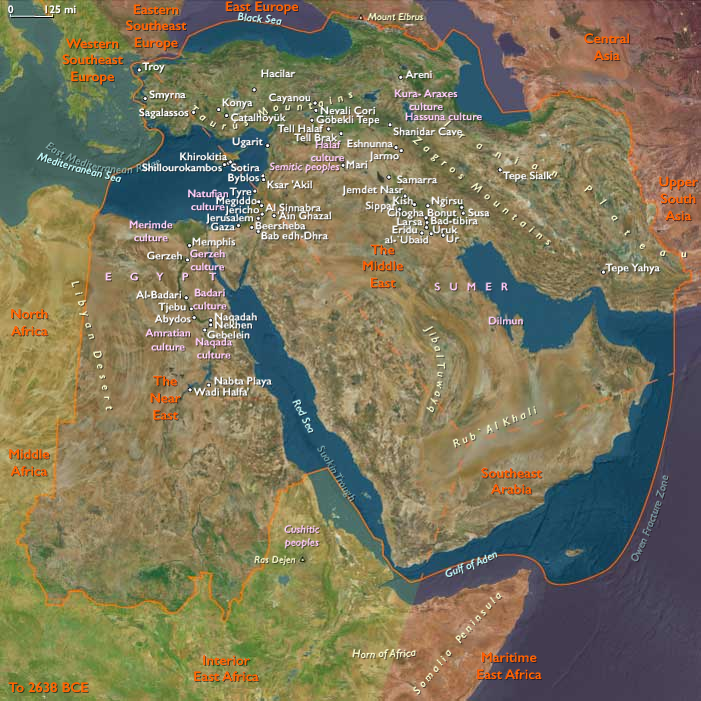
The Near and Middle East
View →Subregions
