
The Near East (3789–3646 BCE): Calendrical Foundations …
Years: 3789BCE - 3646BCE
The Near East (3789–3646 BCE): Calendrical Foundations and the Ghassulian Culture
Establishment of the Hebrew Calendar
This period witnesses a crucial event in the chronology of ancient Near Eastern civilizations: the establishment of the Hebrew calendar, a lunisolar system primarily used for Jewish religious observances. The calendar's epoch—the foundational date corresponding to the first day of Creation according to Jewish tradition—is set at 1 Tishrei 1 AM, equivalent to Monday, October 7, 3761 BCE, in the proleptic Julian calendar. This tabular date aligns closely with the traditionally recognized date of Creation, 25 Elul AM 1, derived from the second-century CE historical work, the Seder Olam Rabbah, composed by Rabbi Yossi ben Halafta. Today, adding 3760 years (before Rosh Hashanah) or 3761 years (after Rosh Hashanah) to a Julian or Gregorian year after 1 CE accurately determines the corresponding Hebrew year.
The Ghassulian Culture: Migration and Settlement
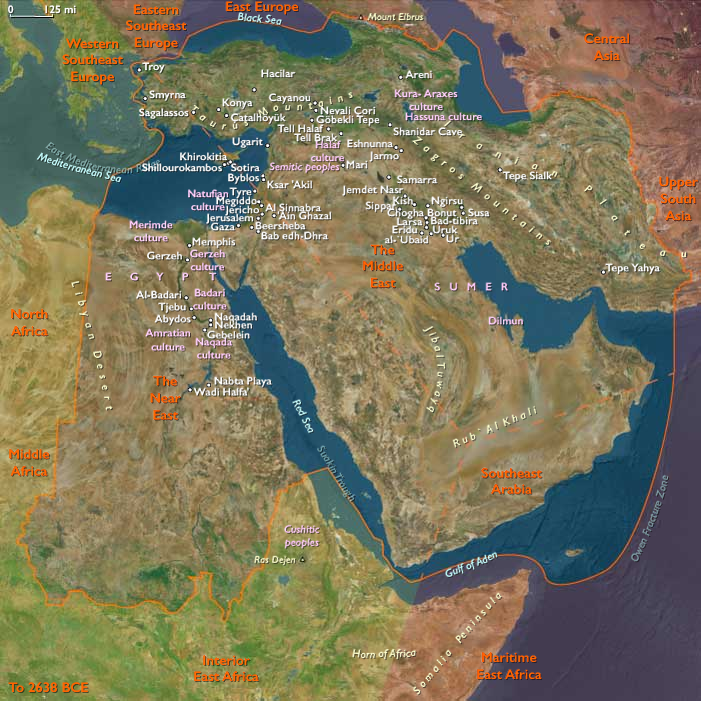
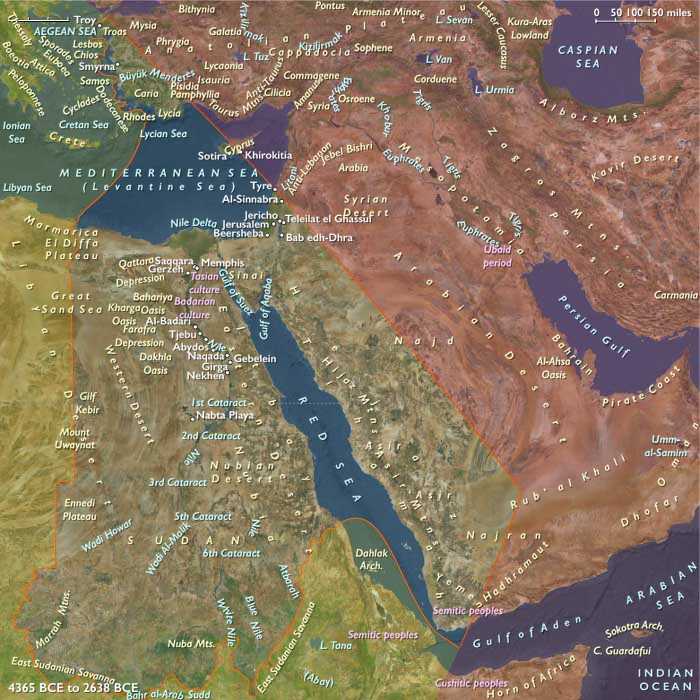
Around 3800 BCE, the Ghassulian culture begins migrating into Palestine, primarily settling in the southern regions with further extensions along the coastal plain and adjacent areas. Originating from an unknown source—though archaeological consensus suggests northern migrations from areas in modern Syria—this Middle Chalcolithic culture (circa 3800–3350 BCE) is named after its type-site, Tulaylat al-Ghassul, located in the Jordan Valley near the Dead Sea in contemporary Jordan, extensively excavated during the 1930s.
Ghassulian settlements comprise small hamlets inhabited by mixed farming communities practicing both agriculture and pastoralism. Architectural evidence includes distinct trapezoid-shaped houses constructed from mud-brick, notable for their exceptional polychrome wall paintings, indicative of both aesthetic sophistication and cultural expression.
Elaborate Pottery and Agricultural Innovation
Ghassulian ceramics represent significant cultural innovations, characterized by elaborate designs such as footed bowls and unique horn-shaped goblets. These pottery forms strongly suggest advanced agricultural practices, including the cultivation and consumption of wine. Some pottery samples exhibit refined artistic techniques, including sculptural embellishments and reserved slip decoration—where a thin clay-water coating is selectively wiped away to create intricate patterns.
These developments highlight a flourishing cultural period in the Near East, marked by calendrical innovation and agricultural sophistication, laying important foundations for subsequent cultural complexities in the region.
Groups
- Jericho, Ancient
- Egypt (Ancient), Predynastic
- Tasian culture
- Amratian culture (Naqada I)
- Badarian culture
- Ghassulian culture
Topics
Commodoties
Subjects
Regions
Subregions
Related Events
Showing 10 events out of 68787 total
Years: 3789BCE - 3646BCE
Groups
- Jericho, Ancient
- Egypt (Ancient), Predynastic
- Tasian culture
- Amratian culture (Naqada I)
- Badarian culture
- Ghassulian culture
Topics
Commodoties
Subjects
Regions
Subregions