Completion of Strasbourg Cathedral's North Tower (1439)…
1439 CE
Completion of Strasbourg Cathedral's North Tower (1439)
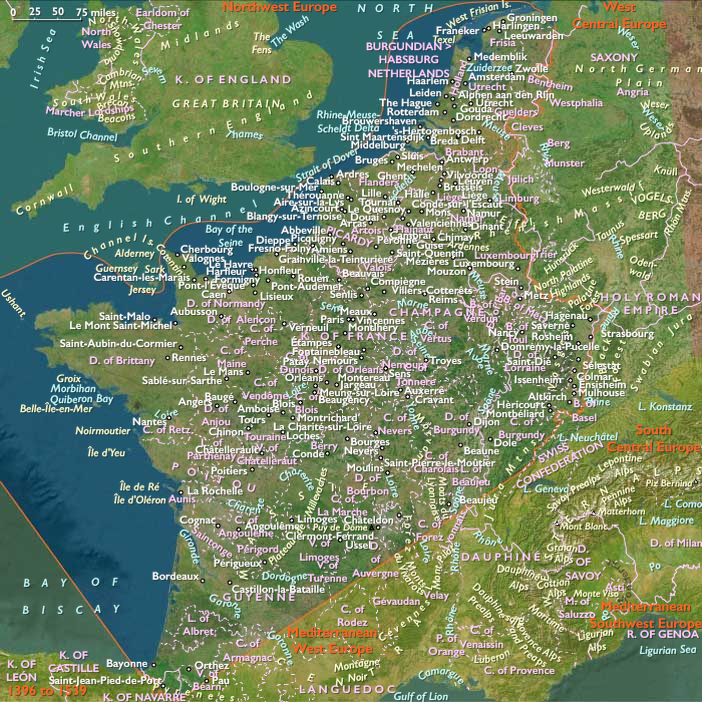
In 1439, the completion of the North Tower of Strasbourg Cathedral significantly marked the architectural achievements of late medieval Europe. Standing as the world's second-tallest building after the spire of St. Olav's Church in Tallinn, this remarkable structure became a testament to Gothic engineering and design.
Inside the cathedral, a notable attraction is the sophisticated astronomical clock, originally constructed in the fourteenth century. A masterpiece of medieval mathematical ingenuity, this clock possessed the remarkable ability to calculate the computus—the complex method used to determine the annual date of Easter—long before the advent of modern computational technology.
The cathedral and its clock thus symbolize both the technical sophistication and the deep cultural significance of medieval craftsmanship, reflecting the integration of art, religion, and science that characterized late medieval intellectual and architectural culture in Atlantic West Europe.
Locations
Groups
Regions
West Europe
View →Subregions