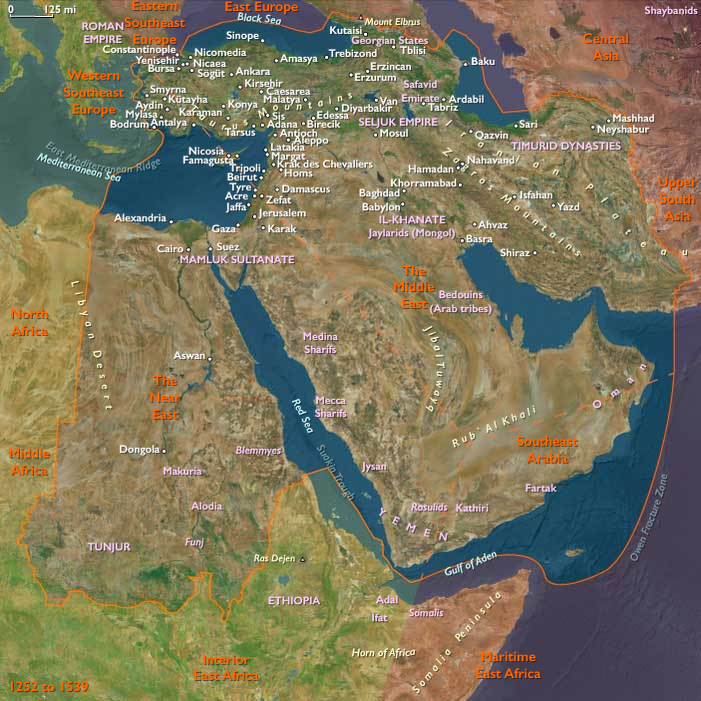
Outremer, French (outre-mer) for "overseas", is the…
1252 CE to 1263 CE
Outremer, French (outre-mer) for "overseas", is the general name given to the Crusader states established after the First Crusade: the County of Edessa (lost in 1144), the Principality of Antioch, the County of Tripoli and especially the Kingdom of Jerusalem.
The name is often used as an equivalent to Levant, Syria or Palestine, and incorporated areas that are today also part of Israel, Jordan, and Lebanon.
The rising power of Islam had eventually expelled the Knights Templar from Jerusalem itself, which had fallen in 1187.
The Hospitallers, together with the Knights Templar, have by the mid-thirteenth century become the most powerful Christian groups in the region.
The order has come to distinguish itself in battles with the Muslims, its soldiers wearing a black surcoat with a white cross.
The Knights Templar, officially endorsed by the Roman Catholic Church in 1128/1129, had become a favored charity across Europe and grown rapidly in membership and power.
Templars, in their distinctive white mantles, each with a red cross, have numbered among the best fighting units of the Crusades.
Noncombatant members now manage a large economic infrastructure throughout Christendom, inventing or adapting many financial techniques that are an early form of banking, and building numerous fortifications across Europe and the Holy Land.
Arguably the world’s first multinational corporation, the Templars have come to acquire considerable wealth.
The kings and great nobles of Spain, France, and England have given lordships, castles, seigniories, and estates to the order, so that by the mid-twelfth century the Templars own properties scattered throughout western Europe, the Mediterranean, and the Holy Land.
The Templars' military strength enables them to safely collect, store, and transport bullion to and from Europe and the Holy Land, and their network of treasure storehouses and their efficient transport organization causes the Templars to be used as bankers both by kings and by pilgrims to the Holy Land.
In this way, the order, with its vast resources spread throughout the Christian world, has grown to wield great financial power.
Groups
Topics
Commodities
Subjects
Regions