
Event
St Mary's Church, Reculver, an exemplar of…
St Mary's Church, Reculver, an exemplar of Anglo-Saxon architecture and sculpture, had been founded in the seventh century as either a minster or a monastery on the site of a Roman fort at Reculver, which was then at the north-eastern extremity of Kent in southeastern England.
In 669, the site of the fort had been given for this purpose by King Ecgberht of Kent to a priest named Bassa, beginning a connection with Kentish kings that led to King Eadberht II of Kent being buried there in the 760s, and the church becoming very wealthy by the beginning of the ninth century.
From the early ninth century to the tenth the church had been treated as essentially a piece of property, with ownership passing between kings of Mercia and Wessex and the archbishops of Canterbury.
Viking attacks may have extinguished the church's religious community in the ninth century, although an early eleventh-century record indicates that the church was then in the hands of a dean accompanied by monks.
By the time of Domesday Book, completed in 1086, St Mary's was serving as a parish church.
The original building, which incorporated stone and tiles scavenged from the Roman fort, was a simple one consisting only of a nave and an apsidal chancel, with a small room, or porticus, built out from each of the church's northern and southern sides where the nave and chancel met.
The church was much altered and expanded during the Middle Ages; the last addition, in the fifteenth century, was of north and south porches leading into the nave.
This expansion coincided with a long period of prosperity for the settlement of Reculver, but its decline had led to the church's decay.
In the autumn of 1807 a northerly storm had combined with a high tide to bring erosion of the cliff on which the church stood to within the churchyard.
Sea defenses had been in place since at least 1783, but although they had been costly to build their design had led to further undermining of the cliff.
Two further schemes have been devised by Sir Thomas Page and John Rennie to preserve the cliff by means of new sea defenses, Rennie's being estimated to cost £8,277.
Instead, at a vestry meeting on January 12, 1808, and at the instigation of the vicar, Christopher Naylor, it is decided that the church should be demolished; the work will be undertaken with gunpowder in the following year.
-
{# Image navigates to the detail page; the magnifying-glass chip is the only Fancybox lightbox trigger (kept a separate sibling — anchors can't nest). #}
 The North Atlantic Lands
World
-
{# Image navigates to the detail page; the magnifying-glass chip is the only Fancybox lightbox trigger (kept a separate sibling — anchors can't nest). #}
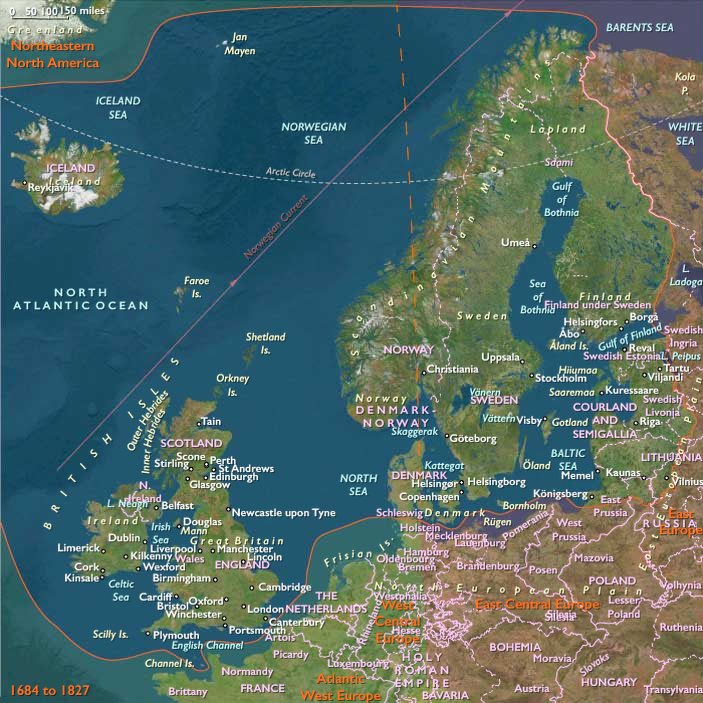 North Europe
Region
-
{# Image navigates to the detail page; the magnifying-glass chip is the only Fancybox lightbox trigger (kept a separate sibling — anchors can't nest). #}
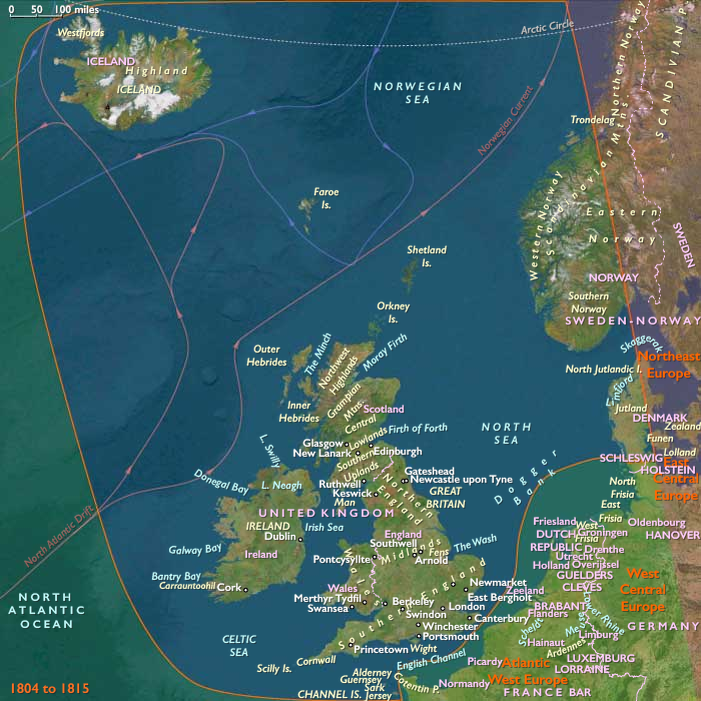 Northwest Europe
Subregion
