
The other cantons expel Zurich from the…
1440 CE
The other cantons expel Zurich from the Swiss confederation and declare war in 1440.
Zurich retaliates by making an alliance with Frederick III, Holy Roman Emperor of the house of Habsburg.
Defeated at Pfäffikon, Zürich is forced to withdraw its economic proscriptions.
Locations
People
Groups
Topics
Regions
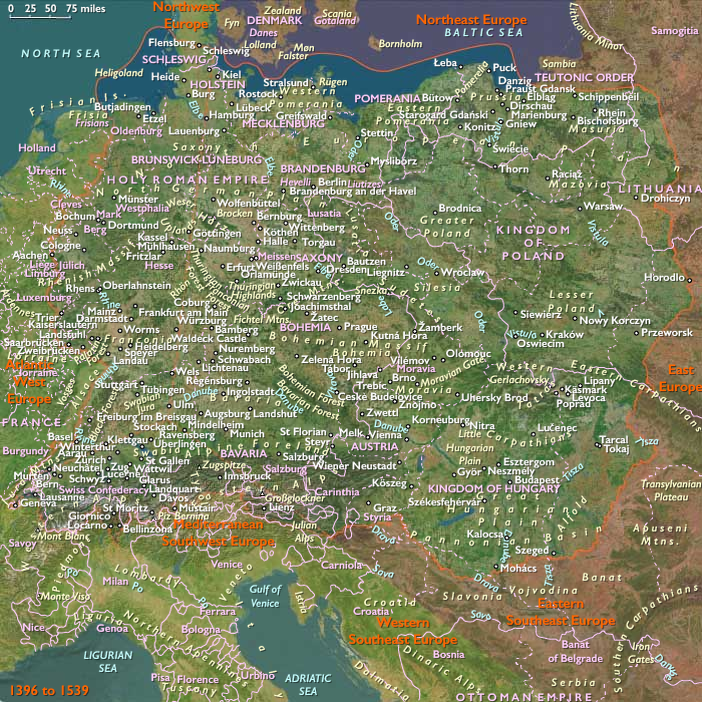
Central Europe
View →Subregions

South Central Europe
View →Related Events
No active filters.
Showing 10 events out of 41838 total
The Shans share power in Upper Burma by 1440 with the now-diminished Burmese kingdom of Ava.
At the birth of Albert’s posthumous son, Ladislas, the infant is placed under the guardianship of Frederick III, King of Germany, elected King of Hungary in 1439 by a faction of nobles.
In the ensuing brief civil war, Wladyslaw, greatly aided by Hunyadi, secures the Hungarian throne, assuming it in 1440 as King Uladislas I, contending with stiff opposition from Slovakian Hussites led by John Jiskra of Brandýs, who have taken control of Slovakia.
Frederick I, elector of Brandenburg from 1417 and founder of the Brandenburg line of Hohenzollern, had in 1425 handed over the control of Brandenburg to his eldest son, John the Alchemist, returned to Franconia, and devoted the rest of his life to imperial affairs, having himself spent less than six years in Brandenburg.
Active in the negotiations with the Hussites as a champion of religious moderation, he had helped bring about the pacts of Prague (1433) and Iglau (1436), and takes part in the election of Frederick III as German king in 1440.
At his death on September 20 of this year, he leaves his sons firmly in control.
Albert’s twenty-four year-old-cousin, Frederick V, Duke of Inner Austria (Styria, Carniola, and Carinthia), who inherits from his predecessor the leadership of the Habsburg family, covets Ladislas’ inheritance and assumes control of the infant without legal designation as regent.
The European and Anatolian revolts that had arisen early in the reign of Murad II has been at least partly stimulated and supported by members of the Kapikulu, as well as the Christian slaves and vassals who had been losing their power to the Turkish notables.
As soon as Murad had come to power, however, he resumed earlier efforts to make the sultanate more independent, building up the strength of the Janissaries and their associates and playing them off against the notables.
Murad seeks only to establish a balance of power and function between the two groups so that he can use and control both for the benefit of the empire.
Thus, he enlarges the concept of Kapikulu to include members of the Turkish nobility and their Turkmen spahis as well as the products of the devsirme.
Now only persons accepting the status of slaves of the sultan can hold positions in the Ottoman government and army.
Persons of Muslim and non-Muslim origin can achieve this status as long as they accept the limitations involved: absolute obedience to their master and the devotion of their lives, properties, and families to his service.
After this time, all important ministers, military officers, judges, governors, timar holders, tax farmers, Janissaries, spahis, and the like will be made members of this class and attached to the will and service of the sultan.
The salaried Janissary corps remains the primary source of strength of the devsirme class, whereas the spahis and the timar system remain the bases of power of the Turkish notables.
Murad II has thus avoided the fate of the great Middle Eastern empires that had preceded that of the Ottomans, in which rule had been shared among members of the ruling dynasty and with others and rapid disintegration had resulted.
The Ottomans establish the principle of indivisibility of rule, with all members of the ruling class subjected to the absolute will of the sultan.
Murad launches a campaign against Hungary in 1440 in retaliation for Hungarian support for the “false Mustafa” and his claim to the sultanate.
Vagarshapat (modern Echmiadzin), originating in the seventh century BCE as the town of Vardkesavan, lies on the plain of the Aras River, twelve miles (twenty kilometers) west of Yerevan in west-central Armenia.
It had been renamed Vagarshapat about CE 140, when the Parthian king Vologases III made it his capital.
Upon the conversion of Armenia to Christianity about 300, Vagarshapat had become the residence of the Armenian patriarch.
In 344 the town ceased to be the Armenian capital, and in 453 the patriarchal seat was removed elsewhere, but in 1441 Kirakos, the supreme catholicos, or primate, of the Armenian Catholic Church, brings back the seat to Vagarshapat, which hereafter will remain the home of the “catholicos of all Armenians.”
The Turks, masters of Albania, allow conquered clan chiefs to maintain their positions and property, but they must pay tribute, send their sons to the Turkish court as hostages, and provide the Ottoman army with auxiliary troops.
Antonio Vivarini, who operates a successful family workshop of painters in Venice, uses the vitreous, enameled colors of Venetian glass in his early Madonnas, like the one painted around 1440 for the Oratorio dei Filippini in Padua.
The figures in this and other early works by Antonio, symbols of divine splendor, show no attempt at naturalness.
He initially trained with Andrea da Murano, and his works show the influence of Gentile da Fabriano.
The earliest known date of a picture of his, an altarpiece in the Accademia, is 1440.
Nicholas of Cusa, a German polymath, had in 1432 attended the Council of Basel, where he had published De concordantia catholica ("On Catholic Concordance"), in support of conciliarism.
He had later broken with the conciliar party, however, and become a staunch supporter of the pope; in 1437 he had been a member of a papal legation to Constantinople.
In his first (and most important) theological work, De docta ignorantia (“On Learned Ignorance”), written in 1440, Nicholas argues that knowledge is learned ignorance, that wisdom lies in the recognition that the human mind is incapable of grasping the infinity of God, in whom all opposites are combined.
He also writes on astronomy, physics, and mathematics, demonstrating, in all his thought, a continuity with contemporary speculation in the Neoplatonic tradition and a bold and original synthesizing intellect.
The Praguerie Revolt and its Suppression (1440)
In 1440, tensions arising from the centralizing policies and growing royal authority of King Charles VII erupted into open rebellion in an event known as the Praguerie. Named after a recent revolt in Prague, Bohemia—then closely linked to France through the House of Luxembourg—the Praguerie represented a coordinated aristocratic challenge to royal authority. The uprising was actively supported by Philip the Good, Duke of Burgundy, who, despite his reconciliation with Charles VII in the 1435 Treaty of Arras, reversed course in 1439 due to Charles's centralizing reforms, aligning himself once more against the French king.
Central to the rebellion was the ambitious Charles I, Duke of Bourbon, who sought to undermine royal control along with prominent nobles including Jean, Duke of Alençon, and mercenary captains such as Antoine de Chabannes. The rebels secured the symbolic leadership of the sixteen-year-old Dauphin Louis, proposing to replace his father as king and establish a regency controlled by the nobles.
Responding swiftly, Arthur de Richemont, Constable of France, led royal troops into Poitou, historically a contested region associated with previous conflicts against royal minister Georges de la Trémoille. Within two months, Richemont decisively subdued much of the region, deploying the new royal artillery effectively to breach noble strongholds and quickly restoring order.
Efforts by the Dauphin and Alençon to incite broader uprisings in Auvergne failed, isolating the revolt. Although royal forces could not entirely prevent mercenary bands from pillaging parts of Poitou and ...